
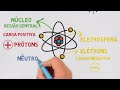
Atomic Models and Their Discoveries

Interactive Video
•
Chemistry, Science
•
7th - 10th Grade
•
Practice Problem
•
Hard

Aiden Montgomery
FREE Resource
Read more
10 questions
Show all answers
1.
MULTIPLE CHOICE QUESTION
30 sec • 1 pt
Which of the following is NOT one of the four main atomic models discussed in the video?
Dalton's Model
Thomson's Model
Rutherford-Bohr Model
Einstein's Model
2.
MULTIPLE CHOICE QUESTION
30 sec • 1 pt
According to Dalton's atomic model, what is the nature of atoms?
Atoms are divisible and destructible.
Atoms are indivisible and indestructible.
Atoms are made up of electrons and protons.
Atoms can change their weight during reactions.
3.
MULTIPLE CHOICE QUESTION
30 sec • 1 pt
Why was Dalton's atomic model referred to as the 'billiard ball model'?
Because atoms were thought to be flexible.
Because atoms were thought to be liquid.
Because atoms were thought to be solid spheres.
Because atoms were thought to be hollow spheres.
4.
MULTIPLE CHOICE QUESTION
30 sec • 1 pt
What discovery did Thomson make using cathode ray experiments?
Neutrons
Electrons
Nucleus
Protons
5.
MULTIPLE CHOICE QUESTION
30 sec • 1 pt
Thomson's atomic model is often compared to which dessert?
Fruit salad
Ice cream
Pudding with raisins
Chocolate cake
6.
MULTIPLE CHOICE QUESTION
30 sec • 1 pt
What was the unexpected result in Rutherford's gold foil experiment?
Alpha particles were deflected at large angles.
All alpha particles passed straight through.
Alpha particles were absorbed by the foil.
Alpha particles turned into beta particles.
7.
MULTIPLE CHOICE QUESTION
30 sec • 1 pt
In Rutherford's atomic model, where is most of the atom's mass concentrated?
In the electrons
In the electron cloud
Evenly distributed
In the nucleus
Access all questions and much more by creating a free account
Create resources
Host any resource
Get auto-graded reports

Continue with Google

Continue with Email

Continue with Classlink

Continue with Clever
or continue with

Microsoft
%20(1).png)
Apple

Others
Already have an account?
Similar Resources on Wayground

11 questions
Moles and Molecular Formulas
Interactive video
•
9th - 10th Grade
11 questions
Ionic and Covalent Bonding Concepts
Interactive video
•
9th - 10th Grade
11 questions
Ionic Sizes and Electronegativity Trends
Interactive video
•
9th - 10th Grade
11 questions
Water Hybridization and Bonding Concepts
Interactive video
•
9th - 10th Grade
7 questions
Quadratic Equations in Profit Modeling
Interactive video
•
9th - 10th Grade
7 questions
Geometric Sequences and Functions
Interactive video
•
9th - 10th Grade
6 questions
Warthogs in Addo Elephant National Park
Interactive video
•
9th - 10th Grade
6 questions
Electronegativity and Chemical Bonding
Interactive video
•
9th - 10th Grade
Popular Resources on Wayground
15 questions
Fractions on a Number Line

Quiz
•
3rd Grade
20 questions
Equivalent Fractions
Quiz
•
3rd Grade
25 questions
Multiplication Facts
Quiz
•
5th Grade
29 questions
Alg. 1 Section 5.1 Coordinate Plane
Quiz
•
9th Grade
22 questions
fractions
Quiz
•
3rd Grade
11 questions
FOREST Effective communication

Lesson
•
KG
20 questions
Main Idea and Details
Quiz
•
5th Grade
20 questions
Context Clues
Quiz
•
6th Grade
Discover more resources for Chemistry
22 questions
Unit 9 Gas Law Quiz
Quiz
•
10th Grade
10 questions
Exploring Types of Chemical Reactions
Interactive video
•
6th - 10th Grade
20 questions
Types of Chemical Reactions
Quiz
•
9th - 12th Grade
20 questions
Acids and Bases
Quiz
•
10th Grade
30 questions
Energy Review
Quiz
•
9th Grade
7 questions
GCSE Chemistry - Balancing Chemical Equations #4
Interactive video
•
9th - 10th Grade
20 questions
Chemistry: Classification of Matter
Quiz
•
10th Grade
40 questions
Unit 3 (Part 1) Chemical Equations & Reactions Review Game
Quiz
•
8th - 12th Grade