
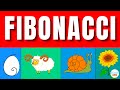
Fibonacci Sequence and Golden Ratio

Interactive Video
•
Mathematics, Science, Biology, History, Arts, Architecture
•
6th - 10th Grade
•
Practice Problem
•
Easy
Standards-aligned

Mia Campbell
Used 16+ times
FREE Resource
Standards-aligned
Read more
10 questions
Show all answers
1.
MULTIPLE CHOICE QUESTION
30 sec • 1 pt
Which of the following is a common Fibonacci number found in flowers?
10
8
6
4
2.
MULTIPLE CHOICE QUESTION
30 sec • 1 pt
How are the seeds of sunflowers typically arranged?
In circles
In rows
Randomly
In left- and right-handed spirals
Tags
CCSS.HSF.BF.A.2
3.
MULTIPLE CHOICE QUESTION
30 sec • 1 pt
What is the rule for generating the Fibonacci sequence?
Each number is the sum of the previous three numbers
Each number is the difference of the previous two numbers
Each number is the sum of the previous two numbers
Each number is the product of the previous two numbers
Tags
CCSS.HSF.IF.A.3
4.
MULTIPLE CHOICE QUESTION
30 sec • 1 pt
What is the formula for the Fibonacci sequence?
F(n) = F(n-1) * F(n-2)
F(n) = F(n-1) - F(n-2)
F(n) = F(n-1) + F(n-2)
F(n) = F(n-1) / F(n-2)
5.
MULTIPLE CHOICE QUESTION
30 sec • 1 pt
Who is the Fibonacci sequence named after?
Leonardo Pisano
Leonardo da Vinci
Galileo Galilei
Isaac Newton
6.
MULTIPLE CHOICE QUESTION
30 sec • 1 pt
What significant contribution did Fibonacci make to the Western world?
He introduced the concept of zero
He brought the Hindu-Arabic numeral system
He invented the abacus
He developed calculus
Tags
CCSS.HSA-REI.B.4B
7.
MULTIPLE CHOICE QUESTION
30 sec • 1 pt
What is the golden ratio approximately equal to?
1.732
2.718
1.414
1.618
Access all questions and much more by creating a free account
Create resources
Host any resource
Get auto-graded reports

Continue with Google

Continue with Email

Continue with Classlink

Continue with Clever
or continue with

Microsoft
%20(1).png)
Apple

Others
Already have an account?

