
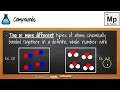
Understanding Compounds and Mixtures

Interactive Video
•
Chemistry, Science
•
6th - 8th Grade
•
Practice Problem
•
Easy

Ethan Morris
Used 1+ times
FREE Resource
Read more
10 questions
Show all answers
1.
MULTIPLE CHOICE QUESTION
30 sec • 1 pt
What is the primary purpose of particle models?
To create artistic representations of atoms
To determine the temperature of substances
To make complex forms of matter simple to understand
To measure the weight of atoms
2.
MULTIPLE CHOICE QUESTION
30 sec • 1 pt
What does a monoatomic element consist of?
Two different types of atoms
One type of atom
Three types of atoms
Four types of atoms
3.
MULTIPLE CHOICE QUESTION
30 sec • 1 pt
Which of the following is an example of a diatomic element?
Water
Hydrogen
Carbon monoxide
Sodium
4.
MULTIPLE CHOICE QUESTION
30 sec • 1 pt
What distinguishes a compound from a diatomic element?
Compounds are always in a gaseous state
Compounds are not chemically bonded
Compounds consist of only one type of atom
Compounds consist of two or more different types of atoms chemically bonded
5.
MULTIPLE CHOICE QUESTION
30 sec • 1 pt
Which of the following is a compound?
Oxygen
Hydrogen
Sodium
Carbon monoxide
6.
MULTIPLE CHOICE QUESTION
30 sec • 1 pt
What is a characteristic of mixtures?
They have a fixed ratio of elements
They are chemically bonded
They are always homogeneous
They consist of elements, compounds, or both in no fixed ratio
7.
MULTIPLE CHOICE QUESTION
30 sec • 1 pt
In a mixture, how are the elements and compounds related?
They are not bonded together
They are chemically bonded
They always form a homogeneous mixture
They form a new element
Access all questions and much more by creating a free account
Create resources
Host any resource
Get auto-graded reports

Continue with Google

Continue with Email

Continue with Classlink

Continue with Clever
or continue with

Microsoft
%20(1).png)
Apple

Others
Already have an account?

