
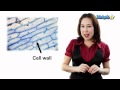
Differences Between Eukaryotic, Animal, and Plant Cells

Interactive Video
•
Biology
•
6th - 10th Grade
•
Practice Problem
•
Easy

Liam Anderson
Used 2+ times
FREE Resource
Read more
10 questions
Show all answers
1.
MULTIPLE CHOICE QUESTION
30 sec • 1 pt
What is a fundamental similarity between all eukaryotic organisms?
They all have a central vacuole.
They all have a cell wall.
Their DNA is housed in a nucleus.
They all perform photosynthesis.
2.
MULTIPLE CHOICE QUESTION
30 sec • 1 pt
What does it mean for plant cells to be autotrophic?
They do not need food.
They store food in chloroplasts.
They make their own food.
They rely on other organisms for food.
3.
MULTIPLE CHOICE QUESTION
30 sec • 1 pt
Which of the following is NOT a characteristic of animal cells?
They do not have chloroplasts.
They must get their food from the environment.
They have a rigid cell wall.
They are heterotrophic.
4.
MULTIPLE CHOICE QUESTION
30 sec • 1 pt
What is the function of the rigid cell wall in plant cells?
It helps in photosynthesis.
It stores nutrients.
It houses the DNA.
It provides structure and support.
5.
MULTIPLE CHOICE QUESTION
30 sec • 1 pt
Which organelle is responsible for photosynthesis in plant cells?
Ribosomes
Nucleus
Chloroplasts
Mitochondria
6.
MULTIPLE CHOICE QUESTION
30 sec • 1 pt
What is the role of the central vacuole in plant cells?
It houses the DNA.
It produces proteins.
It regulates water and stores nutrients.
It helps in cell division.
7.
MULTIPLE CHOICE QUESTION
30 sec • 1 pt
Which of the following is NOT a function of the central vacuole?
Storing poisons
Storage of nutrients
Water regulation
Producing energy
Access all questions and much more by creating a free account
Create resources
Host any resource
Get auto-graded reports

Continue with Google

Continue with Email

Continue with Classlink

Continue with Clever
or continue with

Microsoft
%20(1).png)
Apple

Others
Already have an account?


