
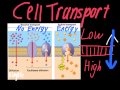
Cell Transport Mechanisms: Active vs Passive

Interactive Video
•
Biology
•
6th - 10th Grade
•
Practice Problem
•
Hard

Amelia Wright
Used 1+ times
FREE Resource
Read more
10 questions
Show all answers
1.
MULTIPLE CHOICE QUESTION
30 sec • 1 pt
What is the primary function of the cell membrane?
To control what enters and leaves the cell
To provide structural support
To store genetic information
To produce energy for the cell
2.
MULTIPLE CHOICE QUESTION
30 sec • 1 pt
Which component of the cell membrane is primarily involved in transport?
Carbohydrates
Cholesterol
Proteins
Phospholipids
3.
MULTIPLE CHOICE QUESTION
30 sec • 1 pt
What is the main characteristic of passive transport?
It requires energy
It involves endocytosis
It moves substances from low to high concentration
It does not require energy
4.
MULTIPLE CHOICE QUESTION
30 sec • 1 pt
Which type of diffusion involves membrane proteins?
Active transport
Simple diffusion
Facilitated diffusion
Osmosis
5.
MULTIPLE CHOICE QUESTION
30 sec • 1 pt
What is an example of a molecule that can pass through the cell membrane via simple diffusion?
Glucose
Water
Proteins
Ions
6.
MULTIPLE CHOICE QUESTION
30 sec • 1 pt
What is required for active transport to occur?
Facilitated diffusion
A concentration gradient
ATP (energy)
Osmosis
7.
MULTIPLE CHOICE QUESTION
30 sec • 1 pt
In which direction does active transport move substances?
Along the concentration gradient
From low concentration to high concentration
From high concentration to low concentration
Through osmosis
Access all questions and much more by creating a free account
Create resources
Host any resource
Get auto-graded reports

Continue with Google

Continue with Email

Continue with Classlink

Continue with Clever
or continue with

Microsoft
%20(1).png)
Apple

Others
Already have an account?

