
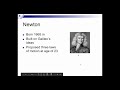
Exploring Newton's First Law

Interactive Video
•
Science
•
6th - 10th Grade
•
Practice Problem
•
Medium
Standards-aligned

Amelia Wright
Used 4+ times
FREE Resource
Standards-aligned
10 questions
Show all answers
1.
MULTIPLE CHOICE QUESTION
30 sec • 1 pt
According to Aristotle, what is the natural state of an object?
At rest
In a circular path
In a straight line
In motion
2.
MULTIPLE CHOICE QUESTION
30 sec • 1 pt
What was Aristotle's main error regarding motion?
He believed in circular motion for all objects
He didn't account for gravity
He didn't understand friction
He thought objects move in a straight line
3.
MULTIPLE CHOICE QUESTION
30 sec • 1 pt
What did Galileo conclude about friction?
It is necessary to keep objects at rest
It is a force that slows down moving objects
It has no effect on motion
It only affects objects in space
4.
MULTIPLE CHOICE QUESTION
30 sec • 1 pt
What did Galileo's ball and ramp experiment demonstrate?
Objects stop due to air resistance
Objects need a force to keep moving
Objects will roll forever without friction
Objects slow down due to gravity
Tags
NGSS.MS-PS2-4
5.
MULTIPLE CHOICE QUESTION
30 sec • 1 pt
What is inertia?
A gravitational pull
A type of friction
A resistance to change in motion
A force that moves objects
6.
MULTIPLE CHOICE QUESTION
30 sec • 1 pt
According to Newton's First Law, what happens to an object in motion?
It continues in a straight line at constant speed
It accelerates
It changes direction
It eventually stops
7.
MULTIPLE CHOICE QUESTION
30 sec • 1 pt
What does the law of inertia state?
Objects resist changes in their state of motion
Objects need a force to stay at rest
Objects move in circular paths
Objects accelerate when a force is applied
Access all questions and much more by creating a free account
Create resources
Host any resource
Get auto-graded reports

Continue with Google

Continue with Email

Continue with Classlink

Continue with Clever
or continue with

Microsoft
%20(1).png)
Apple

Others
Already have an account?


