
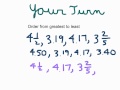
Ordering Decimals, Fractions, and Mixed Numbers

Interactive Video
•
Mathematics
•
6th - 10th Grade
•
Practice Problem
•
Hard
+5
Standards-aligned

Amelia Wright
FREE Resource
Standards-aligned
10 questions
Show all answers
1.
MULTIPLE CHOICE QUESTION
30 sec • 1 pt
Why is it easier to compare fractions and decimals when they are all in decimal form?
Fractions are harder to understand.
Decimals are easier to visualize.
Decimals are always larger than fractions.
Decimals have a common base of 10.
Tags
CCSS.6.NS.C.7A
CCSS.6.NS.C.7B
2.
MULTIPLE CHOICE QUESTION
30 sec • 1 pt
What is the decimal equivalent of the fraction 3/5?
0.3
0.5
0.6
0.8
3.
MULTIPLE CHOICE QUESTION
30 sec • 1 pt
When comparing 0.4 and 0.6, which one is smaller?
0.6
Cannot be determined
0.4
They are equal
Tags
CCSS.4.NF.C.7
4.
MULTIPLE CHOICE QUESTION
30 sec • 1 pt
What should you remember to do after ordering fractions and decimals?
Convert them back to their original form.
Change the fractions to mixed numbers.
Leave them as decimals.
Add extra zeros to the decimals.
5.
MULTIPLE CHOICE QUESTION
30 sec • 1 pt
What is the decimal form of 3 and 1/2?
3.07
3.17
3.5
3.1
6.
MULTIPLE CHOICE QUESTION
30 sec • 1 pt
Why might someone add a zero after a decimal number?
To make the number smaller.
To make the number larger.
To ensure all numbers have the same number of decimal places.
To convert it to a fraction.
Tags
CCSS.5.NBT.B.7
7.
MULTIPLE CHOICE QUESTION
30 sec • 1 pt
What is the decimal equivalent of 8 and 3/4?
8.25
8.5
8.75
8.6
Access all questions and much more by creating a free account
Create resources
Host any resource
Get auto-graded reports

Continue with Google

Continue with Email

Continue with Classlink

Continue with Clever
or continue with

Microsoft
%20(1).png)
Apple

Others
Already have an account?

