
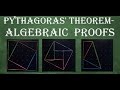
Exploring Algebraic Proofs of Pythagoras' Theorem

Interactive Video
•
Mathematics
•
6th - 10th Grade
•
Practice Problem
•
Hard
+3
Standards-aligned

Ethan Morris
FREE Resource
Standards-aligned
10 questions
Show all answers
1.
MULTIPLE CHOICE QUESTION
30 sec • 1 pt
What is the area of the square formed by the hypotenuse in the first algebraic proof?
b^2
a^2 + b^2
a^2
c^2
Tags
CCSS.8.G.B.8
2.
MULTIPLE CHOICE QUESTION
30 sec • 1 pt
In the second algebraic proof, what is the area of the large square?
a^2 + 2ab + b^2
2ab
a^2 + b^2
c^2
Tags
CCSS.3.MD.C.7B
CCSS.4.MD.A.3
3.
MULTIPLE CHOICE QUESTION
30 sec • 1 pt
What geometric shape is formed by dropping a perpendicular from the right angle to the hypotenuse in the third proof?
A rectangle
A square
A trapezium
Two similar triangles
Tags
CCSS.HSG.CO.C.9
4.
MULTIPLE CHOICE QUESTION
30 sec • 1 pt
In the third proof, what is the relationship between the smaller triangles and the original triangle?
They are congruent
They are different
They are similar
They are identical
Tags
CCSS.HSG.SRT.B.5
5.
MULTIPLE CHOICE QUESTION
30 sec • 1 pt
Who is credited with the fourth algebraic proof of Pythagoras' theorem?
Isaac Newton
Albert Einstein
James Garfield
Pythagoras
Tags
CCSS.8.G.B.8
6.
MULTIPLE CHOICE QUESTION
30 sec • 1 pt
What geometric shape is used in Garfield's proof?
A square
A trapezium
A triangle
A circle
7.
MULTIPLE CHOICE QUESTION
30 sec • 1 pt
In the fifth proof, what is the area of the quadrilateral formed by rotating the triangle?
a^2
b^2
c^2
1/2 c^2
Tags
CCSS.HSG.SRT.D.9
Access all questions and much more by creating a free account
Create resources
Host any resource
Get auto-graded reports

Continue with Google

Continue with Email

Continue with Classlink

Continue with Clever
or continue with

Microsoft
%20(1).png)
Apple

Others
Already have an account?

