
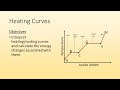
Exploring Heating Curves and Energy Changes

Interactive Video
•
Science
•
6th - 10th Grade
•
Practice Problem
•
Hard

Olivia Brooks
FREE Resource
Read more
10 questions
Show all answers
1.
MULTIPLE CHOICE QUESTION
30 sec • 1 pt
What does a heating curve represent?
How the volume of a substance changes as heat is added.
How the mass of a substance changes as heat is added.
How the temperature of a substance changes as heat is added.
How the pressure of a substance changes as heat is added.
2.
MULTIPLE CHOICE QUESTION
30 sec • 1 pt
What happens to the particles of a solid as heat is added?
They start to form a gas.
They start to lose energy.
They start vibrating more rapidly.
They start moving slower.
3.
MULTIPLE CHOICE QUESTION
30 sec • 1 pt
At the melting point, what does the added energy do?
Increases the temperature.
Overcomes the attractions between molecules.
Decreases the temperature.
Turns the substance into a gas.
4.
MULTIPLE CHOICE QUESTION
30 sec • 1 pt
During the phase change from liquid to gas, what happens to the temperature?
It fluctuates.
It increases.
It decreases.
It stays the same.
5.
MULTIPLE CHOICE QUESTION
30 sec • 1 pt
Why does vaporization require more energy than melting?
Because gas particles are closer together.
Because liquid particles are more spread out.
Because it takes more energy to break the attractions between liquid molecules.
Because melting involves a larger temperature change.
6.
MULTIPLE CHOICE QUESTION
30 sec • 1 pt
Which equation is used to calculate energy changes when only one phase is present?
Q = mH fusion
Q = mcΔT
Q = mH vaporization
Q = mH
7.
MULTIPLE CHOICE QUESTION
30 sec • 1 pt
What is the specific heat of liquid water?
40.7 kJ/mol
6.01 kJ/mol
4.18 J/g°C
2.1 J/g°C
Access all questions and much more by creating a free account
Create resources
Host any resource
Get auto-graded reports

Continue with Google

Continue with Email

Continue with Classlink

Continue with Clever
or continue with

Microsoft
%20(1).png)
Apple

Others
Already have an account?


