
Ionic, Non-Polar and Polar Covalent Bonds
10th Grade
•16 Qs

Similar activities
UNIT 8 - QUIZ # 1
10th - 12th Grade
•18 Qs
S3 Chem - Molecules and Covalent Bond
9th Grade - University
•20 Qs
2.1 and 2.2 quiz
7th - 12th Grade
•13 Qs
Displacement reactions/redox/electron transfer
9th - 10th Grade
•20 Qs
Periodic table of elements
10th - 11th Grade
•15 Qs
Semester 2 Final Exam: Vocabulary Review
9th - 12th Grade
•18 Qs
Periodic Table Review
9th - 12th Grade
•18 Qs
Semester 2 Review - Physical Science
9th - 10th Grade
•20 Qs
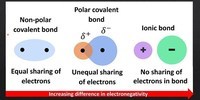
Ionic, Non-Polar and Polar Covalent Bonds

Quiz
•
Chemistry
•
10th Grade
•
Practice Problem
•
Medium
+1
Standards-aligned

Charles Martinez
Used 4+ times
FREE Resource

Enhance your content in a minute
16 questions
Show all answers
1.
MULTIPLE CHOICE QUESTION
30 sec • 1 pt
A covalent bond is formed when two atoms
share an electron with each other.
share one or more pairs of electrons with each other.
gain electrons.
gain and lose electrons.
2.
MULTIPLE CHOICE QUESTION
30 sec • 1 pt
A polar covalent bond
Has equal attraction of the electron pair between the bonded atoms
Has unequal attraction of the electron pair between the bonded atoms
Tags
NGSS.HS-PS1-1
3.
MULTIPLE CHOICE QUESTION
1 min • 1 pt
Use the table below to choose the pair of elements that will most likely have the least ionic character.
Element = Na
Electronegativity = 0.9
Element = O
Electronegativity = 3.5
Element = Cl
Electronegativity = 3.0
Element = H
Electronegativity = 2.1
Na and Cl
O and Cl
H and O
Na and O
Tags
NGSS.HS-PS1-3
4.
MULTIPLE CHOICE QUESTION
30 sec • 1 pt
What is the dipole charge on the chlorine atom in the molecule HCl?
+1
-1
δ+
δ-
5.
MULTIPLE CHOICE QUESTION
2 mins • 1 pt
Atoms that are bonded with an electronegativity difference of 0 to 0.3 are generally considered to be
negatively charged compounds.
non-polar-covalent compounds.
polar-covalent compounds.
ionic compounds.
6.
MULTIPLE CHOICE QUESTION
2 mins • 1 pt
K = 0.2
Br = 2.8
N = 3.0
S = 2.5
choose the pair of elements that will most likely have the greatest ionic character.
K and N
K and S
N and Br
S and Br
Tags
NGSS.HS-PS1-1
NGSS.HS-PS1-2
7.
MULTIPLE CHOICE QUESTION
20 sec • 1 pt
1. Which of the following molecules is the most polar?
H − Cl
H − Br
H − I
H − F
Access all questions and much more by creating a free account
Create resources
Host any resource
Get auto-graded reports

Continue with Google

Continue with Email

Continue with Classlink

Continue with Clever
or continue with

Microsoft
%20(1).png)
Apple

Others
Already have an account?
Similar Resources on Wayground
13 questions
Periodic Table and Trends
Quiz
•
10th - 12th Grade
11 questions
Types of Reactions Quiz
Quiz
•
10th - 12th Grade
20 questions
Periodicity
Quiz
•
10th Grade
20 questions
Ionic vs Covalent
Quiz
•
9th - 12th Grade
20 questions
Intro to Biomolecules
Quiz
•
9th - 12th Grade
12 questions
Empirical and Molecular Formulas
Quiz
•
10th Grade
20 questions
Chemical Nomenclature
Quiz
•
10th - 11th Grade
18 questions
Kinetic Molecular Theory Homework Review
Quiz
•
10th - 12th Grade
Popular Resources on Wayground
15 questions
Fractions on a Number Line
Quiz
•
3rd Grade
20 questions
Equivalent Fractions
Quiz
•
3rd Grade
25 questions
Multiplication Facts
Quiz
•
5th Grade
54 questions
Analyzing Line Graphs & Tables
Quiz
•
4th Grade
22 questions
fractions
Quiz
•
3rd Grade
20 questions
Main Idea and Details
Quiz
•
5th Grade
20 questions
Context Clues
Quiz
•
6th Grade
15 questions
Equivalent Fractions
Quiz
•
4th Grade
Discover more resources for Chemistry
20 questions
Types of Chemical Reactions
Quiz
•
9th - 12th Grade
10 questions
Exploring Stoichiometry Concepts

Interactive video
•
6th - 10th Grade
20 questions
Naming & Writing Chemical Formulas
Quiz
•
10th Grade
20 questions
Practice: E-Con, Orbital Notation, Noble Gas Notation
Quiz
•
10th Grade
20 questions
Covalent Bonding
Quiz
•
10th Grade
10 questions
Periodic Table Families and Groups
Quiz
•
10th Grade
20 questions
electron configurations and orbital notation
Quiz
•
9th - 12th Grade
22 questions
Solubility Curve Practice
Quiz
•
10th Grade