
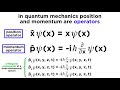
Operators and Principles in Quantum Mechanics

Interactive Video
•
Physics
•
11th Grade - University
•
Practice Problem
•
Hard

Ethan Morris
FREE Resource
Read more
10 questions
Show all answers
1.
MULTIPLE CHOICE QUESTION
30 sec • 1 pt
Why is a mathematical understanding crucial for comprehending quantum mechanics?
Because quantum mechanics is purely theoretical.
Because quantum mechanics relies heavily on advanced mathematical principles.
Because quantum mechanics is unrelated to mathematics.
Because quantum mechanics is based on simple arithmetic.
2.
MULTIPLE CHOICE QUESTION
30 sec • 1 pt
What is a key difference between classical and quantum systems?
Quantum systems do not follow any rules.
Classical systems are unpredictable.
Quantum systems can be measured with absolute precision.
Classical systems allow simultaneous measurement of position and momentum.
3.
MULTIPLE CHOICE QUESTION
30 sec • 1 pt
What does the Heisenberg uncertainty principle state about quantum particles?
Their position and momentum can be known precisely at the same time.
Their momentum is always certain.
Their position and momentum cannot be known precisely at the same time.
Their position is always uncertain.
4.
MULTIPLE CHOICE QUESTION
30 sec • 1 pt
What are operators in quantum mechanics?
They are mathematical objects that act on functions to produce other functions.
They are numbers that describe quantum states.
They are physical devices used to measure quantum particles.
They are constants that do not change.
5.
MULTIPLE CHOICE QUESTION
30 sec • 1 pt
Why do we use operators for quantum particles but not for classical particles?
Because quantum particles are larger than classical particles.
Because quantum particles have well-defined properties.
Because quantum particles exist in multiple states simultaneously.
Because classical particles are unpredictable.
6.
MULTIPLE CHOICE QUESTION
30 sec • 1 pt
What does the wavefunction represent in quantum mechanics?
The energy level of a particle.
The momentum of a particle.
The probability distribution of a particle's position.
The exact position of a particle.
7.
MULTIPLE CHOICE QUESTION
30 sec • 1 pt
How do operators provide information about quantum objects?
By acting on wavefunctions to retrieve encoded information.
By predicting the particle's future state.
By directly measuring the particle's position.
By calculating the particle's speed.
Access all questions and much more by creating a free account
Create resources
Host any resource
Get auto-graded reports

Continue with Google

Continue with Email

Continue with Classlink

Continue with Clever
or continue with

Microsoft
%20(1).png)
Apple

Others
Already have an account?
Similar Resources on Wayground

6 questions
Felix Baumgartner's space suit
Interactive video
•
11th Grade - University
6 questions
Harnessing Quantum Interference
Interactive video
•
11th Grade - University
6 questions
TED-Ed: Can you solve the time traveling car riddle? | Daniel Finkel
Interactive video
•
KG - University
11 questions
Are there Infinite Versions of You?
Interactive video
•
11th Grade - University
8 questions
Overview of Geologic Structures Part 2: Faults and Folds
Interactive video
•
11th Grade - University
Popular Resources on Wayground
15 questions
Fractions on a Number Line

Quiz
•
3rd Grade
20 questions
Equivalent Fractions
Quiz
•
3rd Grade
25 questions
Multiplication Facts
Quiz
•
5th Grade
29 questions
Alg. 1 Section 5.1 Coordinate Plane
Quiz
•
9th Grade
22 questions
fractions
Quiz
•
3rd Grade
11 questions
FOREST Effective communication

Lesson
•
KG
20 questions
Main Idea and Details
Quiz
•
5th Grade
20 questions
Context Clues
Quiz
•
6th Grade
Discover more resources for Physics
21 questions
PE & KE Practice
Quiz
•
8th - 11th Grade
21 questions
Electromagnets
Quiz
•
9th - 12th Grade
15 questions
Unit Test Review
Quiz
•
11th Grade
14 questions
Bill Nye Waves
Interactive video
•
9th - 12th Grade
19 questions
Electrostatics Review
Quiz
•
11th Grade
20 questions
Newton's Laws of Motion review
Quiz
•
9th - 12th Grade
15 questions
Parallel and Series Circuits
Quiz
•
12th Grade