
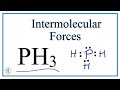
Intermolecular Forces and PH3 Properties

Interactive Video
•
Chemistry
•
9th - 10th Grade
•
Practice Problem
•
Hard

Ethan Morris
FREE Resource
Read more
9 questions
Show all answers
1.
MULTIPLE CHOICE QUESTION
30 sec • 1 pt
What type of compound is PH3?
Ionic
Covalent
Metallic
Hydrogen-bonded
2.
MULTIPLE CHOICE QUESTION
30 sec • 1 pt
Why does PH3 not have any ions?
It is an ionic compound.
It is a covalent compound with non-metals.
It is a hydrogen-bonded compound.
It is a metallic compound.
3.
MULTIPLE CHOICE QUESTION
30 sec • 1 pt
What is the molecular geometry of PH3?
Trigonal pyramidal
Trigonal planar
Tetrahedral
Linear
4.
MULTIPLE CHOICE QUESTION
30 sec • 1 pt
What role does the lone pair play in the geometry of PH3?
It pushes the hydrogen atoms down, creating a trigonal pyramidal shape.
It makes the molecule planar.
It makes the molecule linear.
It has no effect on the geometry.
5.
MULTIPLE CHOICE QUESTION
30 sec • 1 pt
What type of charge distribution is present in PH3?
No charge distribution
Uniform charge distribution
Negative charge at the bottom and positive at the top
Positive charge at the bottom and negative at the top
6.
MULTIPLE CHOICE QUESTION
30 sec • 1 pt
Which of the following is a characteristic of PH3's intermolecular forces?
Both dipole-dipole and London dispersion forces
Only London dispersion forces
Hydrogen bonding
Only dipole-dipole forces
7.
MULTIPLE CHOICE QUESTION
30 sec • 1 pt
Why does PH3 exhibit dipole-dipole forces?
Because it has hydrogen bonding.
Because it is a polar molecule.
Because it is a non-polar molecule.
Because it is an ionic compound.
Access all questions and much more by creating a free account
Create resources
Host any resource
Get auto-graded reports

Continue with Google

Continue with Email

Continue with Classlink

Continue with Clever
or continue with

Microsoft
%20(1).png)
Apple

Others
Already have an account?
Similar Resources on Wayground

11 questions
Rotational Motion Concepts and Applications
Interactive video
•
9th - 12th Grade
11 questions
Understanding Atomic Structure and Antimatter
Interactive video
•
9th - 12th Grade
11 questions
Understanding Water Flow in a Conic Tank
Interactive video
•
9th - 12th Grade
6 questions
Chords in a Circle
Interactive video
•
9th - 10th Grade
11 questions
Great Circles and Opposite Points
Interactive video
•
9th - 10th Grade
11 questions
3D Geometry Concepts and Distance
Interactive video
•
9th - 10th Grade
11 questions
Stanley Miller's Experiment and the Origin of Life
Interactive video
•
10th - 12th Grade
10 questions
Exploring Inscribed Angles and Their Properties
Interactive video
•
8th - 12th Grade
Popular Resources on Wayground
15 questions
Fractions on a Number Line

Quiz
•
3rd Grade
10 questions
Probability Practice
Quiz
•
4th Grade
15 questions
Probability on Number LIne
Quiz
•
4th Grade
20 questions
Equivalent Fractions
Quiz
•
3rd Grade
25 questions
Multiplication Facts
Quiz
•
5th Grade
22 questions
fractions
Quiz
•
3rd Grade
6 questions
Appropriate Chromebook Usage

Lesson
•
7th Grade
10 questions
Greek Bases tele and phon
Quiz
•
6th - 8th Grade
Discover more resources for Chemistry
20 questions
Predicting Products
Quiz
•
9th - 12th Grade
11 questions
Balancing Chemical Equations
Lesson
•
9th Grade
10 questions
Exploring Types of Chemical Reactions
Interactive video
•
6th - 10th Grade
19 questions
Stoichiometry, % yield, Limiting Reactants
Quiz
•
10th Grade
20 questions
Types of Chemical Reactions
Quiz
•
9th - 12th Grade
10 questions
Exploring Ionic and Covalent Bonding Concepts
Interactive video
•
6th - 10th Grade
7 questions
GCSE Chemistry - Balancing Chemical Equations #4
Interactive video
•
9th - 10th Grade
12 questions
Percent Yield
Quiz
•
10th Grade