
Warm up 03/31/2025
Authored by Elizabeth Trott
Science
8th Grade
NGSS covered
Used 7+ times


AI Actions
Add similar questions
Adjust reading levels
Convert to real-world scenario
Translate activity
More...
Content View
Student View
10 questions
Show all answers
1.
MULTIPLE CHOICE QUESTION
30 sec • 1 pt

What type of evidence for evolution does this represent?
Embryological development
Fossil record
Anatomical structures
DNA sequencing
Tags
NGSS.MS-LS4-2
NGSS.MS-LS4-1
NGSS.MS-LS4-3
2.
MULTIPLE CHOICE QUESTION
30 sec • 1 pt

Based off of the bone structure of humans and snakes, which of the following can we conclude?
Humans are an ancestor of snakes
One of the ancestors of snakes had legs, which they no longer use
Humans will eventually become snakes
Snakes have legs that they still use
Tags
NGSS.MS-LS4-2
NGSS.MS-LS4-1
3.
MULTIPLE CHOICE QUESTION
30 sec • 1 pt

Using this fossil record, which statement below is true?
The T-rex lived before the Devonian fish
Trilobites lived in multiple time periods
The mammoth and the T-rex lived close together in time.
The Devonian fish is the oldest fossil ever found.
Tags
NGSS.MS-LS4-1
4.
MULTIPLE CHOICE QUESTION
30 sec • 1 pt

Why is the fossil record considered the strongest evidence for evolution?
They provide physical examples of living things changing over time
Fossils are very easy to find, making this type of evidence very common
They show organisms developing from early stages of life until they die.
Tags
NGSS.MS-LS4-2
NGSS.MS-LS4-1
5.
MULTIPLE CHOICE QUESTION
2 mins • 1 pt
Which of the following have a similar structures but have a different function in each organism?
A dolphin fin and a shark fin
Human fingernails and monkey fingernails
Front leg of a cat and the wing of a bat
The wing of a bumble bee and the wing of a bird
Tags
NGSS.MS-LS4-2
6.
MULTIPLE CHOICE QUESTION
2 mins • 1 pt
What is artificial selection?
humans breed organisms for certain characteristics
individuals that are better adapted to their environment
inherited traits in a population change over generation
Charles Darwin noted the differences among finches
Tags
NGSS.MS-LS4-5
7.
MULTIPLE CHOICE QUESTION
2 mins • 1 pt
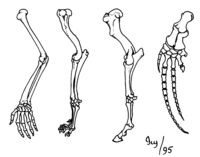
Which of these answers best describes the relationship between a human’s forearm and a bat’s wing?
similar physical structures with similar functions
different physical structures with similar functions
similar physical structures with different functions
different physical structures with different functions
Tags
NGSS.MS-LS4-2
Access all questions and much more by creating a free account
Create resources
Host any resource
Get auto-graded reports

Continue with Google

Continue with Email

Continue with Classlink

Continue with Clever
or continue with

Microsoft
%20(1).png)
Apple

Others
Already have an account?
Similar Resources on Wayground

8 questions
Plant Cells & Microorganisms

Quiz
•
5th - 9th Grade
12 questions
H7.P1&P2.Nova2.Geluid.mhv
Quiz
•
4th - 10th Grade
10 questions
Bab 9 : Kimia Industri Ting4
Quiz
•
1st - 12th Grade
12 questions
EARTH ENERGY: Ocean currents
Quiz
•
8th - 12th Grade
10 questions
components of food
Quiz
•
KG - Professional Dev...
15 questions
Weather, Climate and Adaptions of Animals to Climate
Quiz
•
7th Grade - Professio...
10 questions
Chemical activity of metals
Quiz
•
3rd - 8th Grade
10 questions
Sc-F3 (5.0)
Quiz
•
7th - 9th Grade
Popular Resources on Wayground
8 questions
Spartan Way - Classroom Responsible
Quiz
•
9th - 12th Grade
15 questions
Fractions on a Number Line
Quiz
•
3rd Grade
14 questions
Boundaries & Healthy Relationships

Lesson
•
6th - 8th Grade
20 questions
Equivalent Fractions
Quiz
•
3rd Grade
3 questions
Integrity and Your Health
Lesson
•
6th - 8th Grade
25 questions
Multiplication Facts
Quiz
•
5th Grade
9 questions
FOREST Perception
Lesson
•
KG
20 questions
Main Idea and Details
Quiz
•
5th Grade
Discover more resources for Science
22 questions
Phases of the moon
Quiz
•
8th Grade
20 questions
Waves and Wave Properties
Quiz
•
6th - 8th Grade
8 questions
Amoeba Sister Asexual vs Sexual Reproduction

Interactive video
•
8th Grade
10 questions
Exploring the Rock Cycle: Types and Formation
Interactive video
•
6th - 8th Grade
20 questions
8th Grade Science STAAR Review
Quiz
•
8th Grade
22 questions
Newton's Laws of Motion
Lesson
•
8th Grade
9 questions
Seasons and Earth's Tilt
Lesson
•
6th - 8th Grade
10 questions
Exploring the Evolution of the Peppered Moth
Interactive video
•
6th - 10th Grade