
Evolution Evidence and Mechanisms
Authored by Lisa Thompson
Science
9th Grade
NGSS covered


AI Actions
Add similar questions
Adjust reading levels
Convert to real-world scenario
Translate activity
More...
Content View
Student View
15 questions
Show all answers
1.
MULTIPLE CHOICE QUESTION
1 min • 1 pt
Which of the following is NOT a piece of evidence for evolution?
Fossil Record
Comparative Anatomy
Molecular Biology
Intelligent Design
Tags
NGSS.MS-LS4-2
NGSS.MS-LS4-1
NGSS.MS-LS4-4
2.
MULTIPLE CHOICE QUESTION
1 min • 2 pts
Lamarck believed that organisms could acquire traits during their lifetime and pass them on to their offspring.
TRUE
FALSE
3.
MULTIPLE CHOICE QUESTION
1 min • 2 pts
Both Lamarck and Darwin proposed mechanisms for how evolution occurs.
TRUE
FALSE
Tags
NGSS.MS-LS4-4
4.
MULTIPLE CHOICE QUESTION
1 min • 1 pt
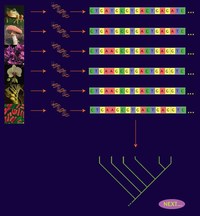
Two organisms that are closely related would have
very similar DNA sequence
exactly the same DNA sequences
no proteins in common
completely different DNA sequence
Tags
NGSS.HS-LS3-1
5.
MULTIPLE CHOICE QUESTION
1 min • 1 pt
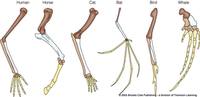
The similarities of the bones in the diagram provide evidence that---
The organisms shown lived in the same natural envionrment
The organisms shown may have developed from a common ancestor
The organisms shown have the same genetic diseases
All vertebrate species have identical forelimbs
Tags
NGSS.MS-LS4-2
6.
MULTIPLE CHOICE QUESTION
1 min • 1 pt
How do fossils provide evidence that evolution has happened on Earth?
Fossils show how the sizes of certain animals has changed drastically over millions of years
Fossils show that some species have gone extinct
Fossils show how life forms present today are different than those from the past
Different sedimentary rock layers provide evidence for how the environment has changed over time
Tags
NGSS.MS-LS4-2
NGSS.MS-LS4-1
7.
MULTIPLE CHOICE QUESTION
1 min • 1 pt
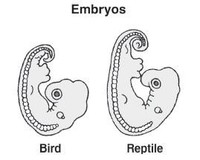
The diagram illustrates an embryonic stage of two organisms.
Which of the following can be determined by observing the embryos shown in the diagram
The organisms share a common ancestry.
The organisms belong to the same genus.
The organisms are native to the same geographic areas.
The organisms will grow into anatomically similar adults.
Tags
NGSS.MS-LS4-2
NGSS.MS-LS4-3

Access all questions and much more by creating a free account
Create resources
Host any resource
Get auto-graded reports

Continue with Google

Continue with Email

Continue with Classlink

Continue with Clever
or continue with

Microsoft
%20(1).png)
Apple

Others
Already have an account?
Similar Resources on Wayground

10 questions
IMPERFECTIONS IN SOLID AND PHASE DIAGRAM

Quiz
•
University
15 questions
Cell Transport Vocabulary Quiz
Quiz
•
9th Grade
15 questions
Environmental Studies - Test 2
Quiz
•
University
13 questions
Wind Energy
Quiz
•
9th - 10th Grade
20 questions
R10RQ3
Quiz
•
10th Grade
10 questions
Rate of chemical reactions
Quiz
•
9th Grade
14 questions
Unit 2 AOS 1 - Groups, Obedience & Conformity (5)
Quiz
•
11th Grade
19 questions
Light as a Wave & Particle Quiz
Quiz
•
11th Grade
Popular Resources on Wayground
15 questions
Fractions on a Number Line
Quiz
•
3rd Grade
20 questions
Equivalent Fractions
Quiz
•
3rd Grade
25 questions
Multiplication Facts
Quiz
•
5th Grade
29 questions
Alg. 1 Section 5.1 Coordinate Plane
Quiz
•
9th Grade
22 questions
fractions
Quiz
•
3rd Grade
11 questions
FOREST Effective communication

Lesson
•
KG
20 questions
Main Idea and Details
Quiz
•
5th Grade
20 questions
Context Clues
Quiz
•
6th Grade
Discover more resources for Science
8 questions
Momentum and Collisions
Lesson
•
9th - 12th Grade
25 questions
Naming Ionic and Covalent Compounds
Quiz
•
9th Grade
10 questions
Exploring Weathering, Erosion, and Deposition Processes

Interactive video
•
6th - 10th Grade
10 questions
Cladogram Practice
Quiz
•
9th Grade
12 questions
The Respiratory System
Lesson
•
9th - 12th Grade
14 questions
Natural Selection and Adaptation
Lesson
•
9th - 12th Grade
10 questions
Exploring the Rock Cycle and Plate Tectonics
Interactive video
•
6th - 10th Grade
10 questions
calculating work
Quiz
•
9th Grade