
IMF
10th Grade
•15 Qs

Similar activities
Kinetic Molecular Theory and Boyle's Law
10th Grade
•20 Qs
Pre-Test Physical Science
11th - 12th Grade
•15 Qs
matter in our surroundings
8th - 10th Grade
•10 Qs
Electromagnetism
10th Grade
•10 Qs
Quimica 1er Trimestre
10th - 12th Grade
•11 Qs
Light Phenomena
11th - 12th Grade
•10 Qs
Q1W11 EALS Human Activities that trigger Landslides (QUIZ)
11th Grade
•10 Qs
NetForceStudyGuide
5th - 10th Grade
•11 Qs

IMF

Quiz
•
Science
•
10th Grade
•
Practice Problem
•
Easy
+1
Standards-aligned

Lisa Thompson
Used 1+ times
FREE Resource

Enhance your content in a minute
15 questions
Show all answers
1.
MULTIPLE CHOICE QUESTION
1 min • 1 pt
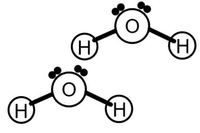
Which type of IMF is responsible for the attraction pictured above?
Dipole-Dipole Interaction
Ion-Dipole Interaction
Hydrogen Bonds
Covalent Bond
Ionic Bond
2.
MULTIPLE CHOICE QUESTION
1 min • 1 pt
If a liquid has high viscosity (thick), it probably has:
strong IMF
weak IMF
Tags
NGSS.HS-PS1-3
3.
MULTIPLE CHOICE QUESTION
1 min • 1 pt
The force of attraction between nonpolar molecules:
Hydrogen Bonding
Dipole - Dipole Forces
LDF
Ionic Forces
4.
MULTIPLE CHOICE QUESTION
1 min • 1 pt
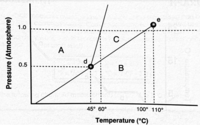
What letter on the diagram represents a substance only in the solid phase?
A
B
C
D
Tags
NGSS.HS-PS3-4
5.
MULTIPLE CHOICE QUESTION
1 min • 1 pt

Which container has the greatest Intermolecular Force between Molecules?
red
yellow
blue
6.
MULTIPLE CHOICE QUESTION
1 min • 1 pt

Which compound has the strongest IMF
HOH
CH4
C2H6
CH3OH
7.
MULTIPLE CHOICE QUESTION
1 min • 1 pt
Xenon has a greater atomic weight than neon. Xe has 131.3 amu while Ne has 20.2 amu. The boiling points are 166.1K and 27.3K, respectively. How do intermolecular forces account for the difference?
Dipole-dipole interaction is greater in Xe than Ne so more energy is needed to break the bonds.
H-bonding is greater for substances with higher atomic weight so greater energy is needed to change Xe to vapor.
Atomic weight increases the chance of lesser dispersion forces so greater energy is needed to separate Xe atoms to change to vapor
London dispersion forces are greater in substances with heavier atomic weight so greater energy is needed to separate
the atoms of Xe than Ne.

Access all questions and much more by creating a free account
Create resources
Host any resource
Get auto-graded reports

Continue with Google

Continue with Email

Continue with Classlink

Continue with Clever
or continue with

Microsoft
%20(1).png)
Apple

Others
Already have an account?
Similar Resources on Wayground
20 questions
8C Reactivity
Quiz
•
7th - 10th Grade
20 questions
THE PERIODIC TABLE OF ELEMENTS
Quiz
•
11th Grade
12 questions
Artificial Teeth
Quiz
•
University
10 questions
Forces 5a Contact and non Contact Forces
Quiz
•
10th Grade
10 questions
Tectonic Activity
Quiz
•
7th - 10th Grade
15 questions
Reviewer in Gen. Chem. 2 - Midterms
Quiz
•
12th Grade
11 questions
C9 Type of Forces
Quiz
•
9th - 12th Grade
15 questions
Ionic Bonding and Covalent Bonding
Quiz
•
8th Grade - University
Popular Resources on Wayground
15 questions
Fractions on a Number Line
Quiz
•
3rd Grade
20 questions
Equivalent Fractions
Quiz
•
3rd Grade
25 questions
Multiplication Facts
Quiz
•
5th Grade
22 questions
fractions
Quiz
•
3rd Grade
20 questions
Main Idea and Details
Quiz
•
5th Grade
20 questions
Context Clues
Quiz
•
6th Grade
15 questions
Equivalent Fractions
Quiz
•
4th Grade
20 questions
Figurative Language Review
Quiz
•
6th Grade
Discover more resources for Science
10 questions
Exploring the Layers of the Earth

Interactive video
•
6th - 10th Grade
14 questions
Natural Selection and Adaptation

Lesson
•
9th - 12th Grade
10 questions
Exploring the Ring of Fire: Volcanoes and Earthquakes
Interactive video
•
6th - 10th Grade
38 questions
Water Cycle and Groundwater
Quiz
•
9th - 12th Grade
10 questions
Exploring Spring and Neap Tides
Interactive video
•
6th - 10th Grade
12 questions
Cell Organelles and Their Functions
Lesson
•
9th - 12th Grade
22 questions
Earth's Spheres and Interactions Quiz Reveiw
Quiz
•
8th - 10th Grade
16 questions
Air Masses & Fronts
Lesson
•
8th - 10th Grade