
P.3.7.3.1 Coulomb's Law
11th - 12th Grade
•15 Qs

Similar activities
Activité n°1 : Actions, interactions : souvenirs
1st - 12th Grade
•10 Qs
Energy Calculations
9th - 12th Grade
•10 Qs
Hubble Telescope Picture
9th - 12th Grade
•10 Qs
REFUERZO DE FÍSICA
11th Grade
•19 Qs
Perbaikan (elastisitas)
12th Grade
•12 Qs
ԷԼԵԿՏՐԱՍՏԱՏԻԿԱ
11th Grade
•16 Qs
DAYA & GERAKAN II Hukum Newton Kedua
11th Grade
•12 Qs
Matter and its Nature
10th Grade - University
•17 Qs
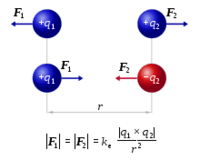
P.3.7.3.1 Coulomb's Law

Quiz
•
Physics
•
11th - 12th Grade
•
Practice Problem
•
Hard

Stanton Wertjes
Used 11+ times
FREE Resource

Enhance your content in a minute
15 questions
Show all answers
1.
MULTIPLE CHOICE QUESTION
30 sec • 1 pt

The diagram shows the path of an α particle deflected by the nucleus of an atom. Point P on the path is the point of closest approach of the α particle to the nucleus. Which of the following statements about the α particle on this path is correct?
Its acceleration is zero at P.
Its kinetic energy is greatest at P.
Its potential energy is least at P.
Its speed is least at P.
2.
MULTIPLE CHOICE QUESTION
30 sec • 1 pt
The diagram shows two particles at distance d apart. One particle has charge +Q and the other –2Q. The two particles exert an electrostatic force of attraction, F, on each other. Each particle is then given an additional charge +Q and their separation is increased to distance 2d. Which of the following gives the force that now acts between the two particles?
an attractive force of F/4
a repulsive force of F/4
an attractive force of F/2
a repulsive force of F/2
3.
MULTIPLE CHOICE QUESTION
30 sec • 1 pt

A +2.0 nC point charge X is at a fixed distance from a –1.0 nC point charge Y. The force between the two charges is F. If an additional charge of +2.0 nC is supplied to both X and Y, which line gives the magnitude and direction of the force on X?
Magnitude: 2 F
Direction: from X to Y
Magnitude: 4 F
Direction: from X to Y
Magnitude: 2 F
Direction: from Y to X
Magnitude: 4 F
Direction: from Y to X
4.
MULTIPLE CHOICE QUESTION
30 sec • 1 pt
The gravitational constant, G, is a constant of proportionality in Newton’s law of gravitation. The permittivity of free space, ε0, is a constant of proportionality in Coulomb’s law.
When comparing the electrostatic force acting on a pair of charged particles to the gravitational force between them, the product ε0G can appear in the calculation.
Which is a unit for ε0G?
C2 kg–2
C2 m–2
F kg2 N–1 m–2
it has no unit
5.
MULTIPLE CHOICE QUESTION
30 sec • 1 pt

Two point charges, X and Y, exert a force F on each other when they are at a distance d apart.
When the distance between them is 20 mm, the force they exert on each other is 0.5 F.
What is the distance d?
7 mm
14 mm
15 mm
28 mm
6.
MULTIPLE CHOICE QUESTION
30 sec • 1 pt
Two identical positive point charges, P and Q, separated by a distance r, repel each other with a force F. If r is decreased so that the electrical potential energy of Q is doubled, what is the force of repulsion?
0.5 F
F
2F
4F
7.
MULTIPLE CHOICE QUESTION
30 sec • 1 pt
The force between two point charges is F when they are separated by a distance r.
If the separation is increased to 3r, what is the force between the charges?


Access all questions and much more by creating a free account
Create resources
Host any resource
Get auto-graded reports

Continue with Google

Continue with Email

Continue with Classlink

Continue with Clever
or continue with

Microsoft
%20(1).png)
Apple

Others
Already have an account?
Similar Resources on Wayground
10 questions
Circular motion basics- level 2
Quiz
•
12th Grade
18 questions
Sources of Electrical Energy
Quiz
•
10th - 12th Grade
20 questions
Ulangan Bab 1 kelas XI Sem.Ganjil
Quiz
•
11th Grade
20 questions
HPHY_Unit 1 Review_2023_2024
Quiz
•
12th Grade
15 questions
Waves quiz 1
Quiz
•
11th Grade
10 questions
PPE Revision quiz part one
Quiz
•
10th - 11th Grade
15 questions
Динамика часть1.
Quiz
•
10th - 11th Grade
20 questions
Chapitre 1 - Qu'y a-t-il dans l'Univers ?
Quiz
•
KG - 12th Grade
Popular Resources on Wayground
15 questions
Fractions on a Number Line
Quiz
•
3rd Grade
20 questions
Equivalent Fractions
Quiz
•
3rd Grade
25 questions
Multiplication Facts
Quiz
•
5th Grade
54 questions
Analyzing Line Graphs & Tables
Quiz
•
4th Grade
22 questions
fractions
Quiz
•
3rd Grade
20 questions
Main Idea and Details
Quiz
•
5th Grade
20 questions
Context Clues
Quiz
•
6th Grade
15 questions
Equivalent Fractions
Quiz
•
4th Grade
