
Equilibrium Constant & reaction quotient
Authored by Soham Roy
Chemistry
11th Grade
NGSS covered
Used 119+ times


AI Actions
Add similar questions
Adjust reading levels
Convert to real-world scenario
Translate activity
More...
Content View
Student View
15 questions
Show all answers
1.
MULTIPLE CHOICE QUESTION
30 sec • 1 pt
Which of the following is true about chemical reaction at equilibrium
only the forward reaction stops
only the reverse reaction stops
both forward and reverse reactions stop
the rate constants for the forward and reverse reactions are equal
the rates of the forward and reverse reactions are equal
Tags
NGSS.HS-PS1-6
2.
MULTIPLE CHOICE QUESTION
30 sec • 1 pt
Which of the following is true regarding the concentration of the products, for a chemical reaction that is already at equilibrium, assuming no disruptions to the equilibrium?
the concentrations of products will not change because there are no more products
the concentrations of products will not change because the limiting reactant is gone
the concentrations of products will not change because the forward and reverse rates are equal
the concentrations of products will change continually because of reversibility
3.
MULTIPLE CHOICE QUESTION
30 sec • 1 pt
A chemical equilibrium may be established by starting a reaction with ____________
reactants only
products only
equal quantities of reactants and products
any quantities of reactants and products
all of the above
4.
MULTIPLE CHOICE QUESTION
30 sec • 1 pt
If the reaction quotient Q has a smaller value than the related equilibrium constant, K, _________
the reaction is at equilibrium
the reaction is not at equilibrium, and will make more products at the expense of the reactants
the reaction is not at equilibrium, and will make more reactants at the expense of the products
the value of K will not increase until it is equal to Q
Tags
NGSS.HS-PS1-7
5.
MULTIPLE CHOICE QUESTION
30 sec • 1 pt
If the reaction quotient Q has a value larger than the related equilibrium constant, K _________
the reaction is at equilibrium
the reaction is not at equilibrium, and will make more products at the expense of reactants
the reaction is not at equilibrium, and will make more reactants at the expense of products
the value of K will increase until it is equal to Q
6.
MULTIPLE CHOICE QUESTION
30 sec • 1 pt
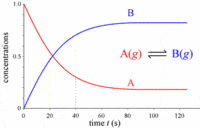
Which is the reactant - and why?
Tags
NGSS.HS-PS1-5
7.
MULTIPLE CHOICE QUESTION
30 sec • 1 pt
For the reaction...
SO2 + O2 <=> SO3
If the concentration of SO2 is increased, the equilibrium position of the reaction will shift ___________.
Tags
NGSS.HS-PS1-6
NGSS.HS-PS1-5

Access all questions and much more by creating a free account
Create resources
Host any resource
Get auto-graded reports

Continue with Google

Continue with Email

Continue with Classlink

Continue with Clever
or continue with

Microsoft
%20(1).png)
Apple

Others
Already have an account?
Similar Resources on Wayground

20 questions
Acids and Bases in Everyday Life

Quiz
•
9th - 12th Grade
10 questions
Anime
Quiz
•
KG - University
15 questions
hoa 11. ĐIỆN LY
Quiz
•
11th - 12th Grade
15 questions
Intro to Stoichiometry
Quiz
•
10th - 12th Grade
10 questions
OCR C2 Chemistry
Quiz
•
KG - University
10 questions
FREE ENERGY
Quiz
•
10th Grade - University
12 questions
Chapter 4 : Metallic Bonding
Quiz
•
11th - 12th Grade
17 questions
Conservation of Momentum Unit Review
Quiz
•
9th - 12th Grade
Popular Resources on Wayground
15 questions
Fractions on a Number Line
Quiz
•
3rd Grade
20 questions
Equivalent Fractions
Quiz
•
3rd Grade
25 questions
Multiplication Facts
Quiz
•
5th Grade
54 questions
Analyzing Line Graphs & Tables
Quiz
•
4th Grade
22 questions
fractions
Quiz
•
3rd Grade
20 questions
Main Idea and Details
Quiz
•
5th Grade
20 questions
Context Clues
Quiz
•
6th Grade
15 questions
Equivalent Fractions
Quiz
•
4th Grade
Discover more resources for Chemistry
20 questions
Types of Chemical Reactions
Quiz
•
9th - 12th Grade
20 questions
electron configurations and orbital notation
Quiz
•
9th - 12th Grade
5 questions
Mole Conversions Made Easy

Interactive video
•
11th Grade
10 questions
16. Limiting Reagent/% Yield Practice
Quiz
•
11th Grade
20 questions
Metric Conversions
Quiz
•
11th Grade
10 questions
PERIODIC TRENDS
Quiz
•
11th Grade
14 questions
Reaction Types, Balancing, and Predicting Products
Quiz
•
9th - 12th Grade
8 questions
Empirical and Molecular Formulas

Lesson
•
9th - 12th Grade