
Rotation Torque
10th - 12th Grade
•36 Qs

Similar activities
test forces 2ESO (Pressió no)
10th Grade
•36 Qs
Physics Form 4_Chap 4.4 Gas Laws
10th - 11th Grade
•35 Qs
Science Trivia Quiz
1st - 12th Grade
•39 Qs
ICP Final Review
5th - 10th Grade
•40 Qs
Physics Challenge 2
11th - 12th Grade
•40 Qs
Work, Power & Simple Machines
9th - 10th Grade
•40 Qs
Chapter 2: Mechanical waves
12th Grade
•40 Qs
Physics Form 4 Challenge 1
11th Grade
•40 Qs

Rotation Torque

Quiz
•
Physics
•
10th - 12th Grade
•
Practice Problem
•
Hard
+3
Standards-aligned

Charles Martinez
FREE Resource

Enhance your content in a minute
36 questions
Show all answers
1.
MULTIPLE CHOICE QUESTION
15 mins • 1 pt

If the torque required to loosen a nut on the wheel of a car has a magnitude of 60.0 N• m, what minimum perpendicular force must be exerted by a mechanic at the end of a 45.0 cm wrench to loosen the nut?
2.
MULTIPLE CHOICE QUESTION
15 mins • 1 pt

Find the magnitude of the torque produced by a 5.0 N force applied to a door at a perpendicular distance of 65 cm from the hinge.
3.
MULTIPLE CHOICE QUESTION
15 mins • 1 pt
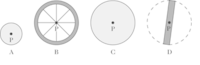
The figure shows scale drawings of four objects, each of the same mass and uniform thickness, with the mass distributed uniformly. Which one has the greatest moment of inertia when rotated at point P?
A because all the mass is close to point P
B because all the mass is far from point P
C because it has a larger radius.
D because it has less mass
4.
MULTIPLE CHOICE QUESTION
15 mins • 1 pt
A solid sphere, solid cylinder, and a hollow pipe all have equal masses and radii. If the three of them are released simultaneously at the top of an inclined plane and do not slip, which one will reach the bottom first?
cylinder because it has uniformly distributed mass.
pipe because it has a high MOI
sphere because it has a small MOI
They all reach the bottom at the same time.
5.
MULTIPLE CHOICE QUESTION
15 mins • 1 pt
The center of mass is in line with:
the exact middle of an object
the heaviest part of an object
a point at which you can balance an object
the idea that mass is evenly concentrated throughout
6.
MULTIPLE CHOICE QUESTION
15 mins • 1 pt

Stars originate as large bodies of slowly rotating gas. Because of gravity, these clumps of gas slowly decrease in size. What happens to the rotational speed of the star as it shrinks?
It rotates faster.
It rotates slower.
It starts to accelerate in the forward direction.
The rotation rate stays the same.
7.
MULTIPLE CHOICE QUESTION
15 mins • 1 pt
A seesaw with mass Z is perfectly balanced with a fulcrum in the center. If mass Z changes uniformly does the net torque change?
Yes, because the Gravitational force increases with more mass, and torque is related to Force
No, because the net torque is still zero despite increases in one of the individual components.
No, because it is balanced that means net torque is zero, a uniform increase in weight keeps it balanced keeping net torque at zero
Yes, any increase in weight will increase torque
Access all questions and much more by creating a free account
Create resources
Host any resource
Get auto-graded reports

Continue with Google

Continue with Email

Continue with Classlink

Continue with Clever
or continue with

Microsoft
%20(1).png)
Apple

Others
Already have an account?
Similar Resources on Wayground
33 questions
Aliens
Quiz
•
9th Grade - University
40 questions
Forces and Motion Practice Test
Quiz
•
9th - 12th Grade
35 questions
Science Form 2_Chap 7.1 Electricity
Quiz
•
8th - 11th Grade
40 questions
NGSS Semester 1 Review
Quiz
•
11th Grade
40 questions
Physics Unit 6 Test
Quiz
•
11th - 12th Grade
32 questions
4.4 gas law F4
Quiz
•
10th Grade
33 questions
Motion Graphs
Quiz
•
10th - 12th Grade
40 questions
G9 MX8 Reviewer
Quiz
•
9th - 12th Grade
Popular Resources on Wayground
15 questions
Fractions on a Number Line
Quiz
•
3rd Grade
20 questions
Equivalent Fractions
Quiz
•
3rd Grade
25 questions
Multiplication Facts
Quiz
•
5th Grade
54 questions
Analyzing Line Graphs & Tables
Quiz
•
4th Grade
22 questions
fractions
Quiz
•
3rd Grade
20 questions
Main Idea and Details
Quiz
•
5th Grade
20 questions
Context Clues
Quiz
•
6th Grade
15 questions
Equivalent Fractions
Quiz
•
4th Grade
Discover more resources for Physics
16 questions
Coulomb's Law
Quiz
•
11th Grade
10 questions
Understanding Heat, Thermal Energy, and Temperature

Interactive video
•
9th - 10th Grade
10 questions
Newton's Laws of Motion
Quiz
•
10th Grade
10 questions
unit 10 -- electric forces and fields

Lesson
•
9th - 12th Grade
21 questions
Diffraction, Reflection, Refraction
Quiz
•
9th - 12th Grade
15 questions
Position vs. Time and Velocity vs. Time Graphs
Quiz
•
10th - 12th Grade
10 questions
Types of Chemical Reactions
Quiz
•
10th Grade
11 questions
Conservation of Momentum: Physics in Motion Video
Interactive video
•
10th Grade