
5.2 Structure and Properties of Matter
10th Grade
•8 Qs

Similar activities
Physical Properties of Transition Elements
10th - 12th Grade
•12 Qs
MODERN PERIODIC TABLE-1
10th Grade
•10 Qs
IONS MONOATOMIC
10th Grade
•13 Qs
Vocabulary Quiz 1
10th - 12th Grade
•10 Qs
Elements and compound
10th Grade
•10 Qs
Chemistry Final Exam Review
10th Grade
•10 Qs
Final Exam Review: Mix of Stuff
9th - 12th Grade
•10 Qs
Periodic Table Groups
9th - 12th Grade
•10 Qs

5.2 Structure and Properties of Matter

Quiz
•
Chemistry
•
10th Grade
•
Practice Problem
•
Medium
Standards-aligned

You Khong
Used 6+ times
FREE Resource

Enhance your content in a minute
8 questions
Show all answers
1.
MULTIPLE CHOICE QUESTION
30 sec • 1 pt
Ionic compounds are formed between...
metals and metals
non-metals and non-metals
metals and non-metals
2.
MULTIPLE SELECT QUESTION
30 sec • 1 pt
Which of the following is an ionic compound?
sodium chloride
carbon dioxide
calcium sulfide
sulfur dioxide
3.
MULTIPLE CHOICE QUESTION
30 sec • 1 pt

Ionic compounds form giant ionic lattices. What forces hold the giant ionic lattices together?
strong frictional forces between the surfaces of the atoms
strong magnetic forces of attraction between the poles of ions
strong electrostatic forces of attraction between oppositely charged ions
Tags
NGSS.HS-PS1-3
4.
MULTIPLE CHOICE QUESTION
30 sec • 1 pt
Why do ionic compounds have high melting and boiling points?
Ability to dissolve in water but cannot dissolve in inorganic solvents.
Presence of mobile ions which allow them to experience high melting points.
Strong electrostatic forces of attraction which require large amounts of energy to overcome.
Weak intermolecular forces of attraction which require little energy to overcome.
Tags
NGSS.HS-PS2-4
5.
MULTIPLE CHOICE QUESTION
30 sec • 1 pt
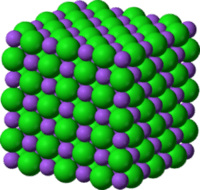
The following properties are all characteristics of ionic compounds EXCEPT
high melting and boiling points
soft
crystal lattice structure
conduct electricity when dissolved in water
Tags
NGSS.HS-PS1-3
6.
MULTIPLE CHOICE QUESTION
30 sec • 1 pt

Why do ionic compounds conduct electricity when they are molten or dissolved?
Their ions are free to move / mobile.
Their ions are held in fixed positions / immobile.
7.
FILL IN THE BLANK QUESTION
1 min • 3 pts
Covalent compounds have ____ melting and boiling points.
Tags
NGSS.HS-PS1-1
Access all questions and much more by creating a free account
Create resources
Host any resource
Get auto-graded reports

Continue with Google

Continue with Email

Continue with Classlink

Continue with Clever
or continue with

Microsoft
%20(1).png)
Apple

Others
Already have an account?
Similar Resources on Wayground
10 questions
IGCSE Coordinated Chemistry Workout 32
Quiz
•
10th - 11th Grade
10 questions
5.1 Redox: Rusting
Quiz
•
10th - 11th Grade
10 questions
Covalent Formulas & Names
Quiz
•
10th Grade
10 questions
9.3 Voltaic cell
Quiz
•
10th - 12th Grade
10 questions
Unit 5: MOLECULE – ELEMENT – COMPOUND Lesson 3
Quiz
•
1st - 12th Grade
10 questions
Science 3, Unit 2 Revision 01, March 2021
Quiz
•
3rd Grade - University
10 questions
Chapter 7 Ionic Bond and Metals Section 1-2
Quiz
•
10th - 12th Grade
10 questions
Unit 3 AP Chem Review
Quiz
•
9th - 12th Grade
Popular Resources on Wayground
15 questions
Fractions on a Number Line
Quiz
•
3rd Grade
20 questions
Equivalent Fractions
Quiz
•
3rd Grade
25 questions
Multiplication Facts
Quiz
•
5th Grade
54 questions
Analyzing Line Graphs & Tables
Quiz
•
4th Grade
22 questions
fractions
Quiz
•
3rd Grade
20 questions
Main Idea and Details
Quiz
•
5th Grade
20 questions
Context Clues
Quiz
•
6th Grade
15 questions
Equivalent Fractions
Quiz
•
4th Grade
Discover more resources for Chemistry
20 questions
Types of Chemical Reactions
Quiz
•
9th - 12th Grade
10 questions
Exploring Stoichiometry Concepts

Interactive video
•
6th - 10th Grade
20 questions
Naming & Writing Chemical Formulas
Quiz
•
10th Grade
20 questions
Practice: E-Con, Orbital Notation, Noble Gas Notation
Quiz
•
10th Grade
20 questions
Covalent Bonding
Quiz
•
10th Grade
10 questions
Periodic Table Families and Groups
Quiz
•
10th Grade
20 questions
electron configurations and orbital notation
Quiz
•
9th - 12th Grade
22 questions
Solubility Curve Practice
Quiz
•
10th Grade