
Amplify Mixtures
Authored by Charles Martinez
Science
7th Grade
NGSS covered


AI Actions
Add similar questions
Adjust reading levels
Convert to real-world scenario
Translate activity
More...
Content View
Student View
12 questions
Show all answers
1.
MULTIPLE CHOICE QUESTION
2 mins • 1 pt

The diagram above shows the repeating groups of atoms that make up two samples. Will the properties of the two samples likely be the same or different? (Examples of properties are smell, color, and the temperature at which a substance melts.)
The properties will likely be different because the repeating groups of atoms that make up each sample are different.
The properties will likely be different because there are more repeating groups of atoms in Sample 2.
The properties will likely be the same because the repeating groups of atoms that make up the two samples have the same number of atoms.
The properties will likely be the same because the repeating groups of atoms that make up the two samples have two of the same types of atoms.
Tags
NGSS.MS-PS1-1
NGSS.MS-PS1-2
2.
MULTIPLE CHOICE QUESTION
2 mins • 1 pt

Serena mixed two samples together: a gray solid that smells like flowers and a gray solid that smells like bleach. She analyzed the results and found two ending substances. One of the ending substances was a white solid. This ending substance is made up of the repeating group of atoms shown above. Which of the diagrams to the left shows the repeating groups of atoms that make up the samples Serena mixed together?




Tags
NGSS.MS-PS1-1
NGSS.MS-PS1-2
NGSS.MS-PS1-5
3.
MULTIPLE CHOICE QUESTION
2 mins • 1 pt

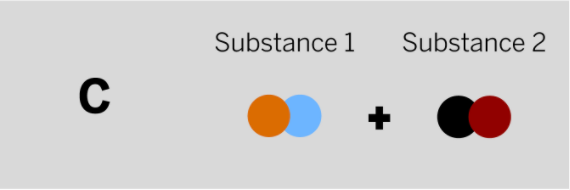
Tiana is a chemist who is making a chemical to add to swimming pools in order to make the water safer. She mixed two solid substances together in a sealed container. The diagram above shows the repeating groups of atoms that make up the two starting substances.
After mixing, Tiana found two liquid substances in the sealed container. (Nothing had escaped.) Which of the diagrams to the left shows the repeating groups of atoms that make up the ending substances?



Tags
NGSS.MS-PS1-1
NGSS.MS-PS1-2
NGSS.MS-PS1-5
4.
MULTIPLE CHOICE QUESTION
2 mins • 1 pt

The diagram above shows the repeating groups of atoms that make up two samples. Will the properties of the two samples likely be the same or different? (Examples of properties are smell, color, and the temperature at which a substance melts.)
The properties will likely be different because the repeating groups of atoms that make up each sample are different.
The properties will likely be different because there are more repeating groups of atoms in Sample 1.
The properties will likely be the same because the repeating groups of atoms that make up the two samples have one of the same types of atoms.
The properties will likely be the same because the repeating groups of atoms that make up the two samples have the same number of atoms.
Tags
NGSS.MS-PS1-1
NGSS.MS-PS1-2
5.
MULTIPLE CHOICE QUESTION
2 mins • 1 pt





Tags
NGSS.MS-PS1-1
NGSS.MS-PS1-2
NGSS.MS-PS1-5
6.
MULTIPLE CHOICE QUESTION
2 mins • 1 pt

Santiago is a chemist working to make a new kind of antacid, which is a medicine that helps with stomach pain. He mixed two powdery solid substances together in a sealed container. The diagram above shows the repeating groups of atoms that make up the two starting substances.
After mixing, Santiago found two liquid substances in the sealed container. (Nothing had escaped.) Which of the diagrams to the left shows the repeating groups of atoms that make up the ending substances?




Tags
NGSS.MS-PS1-1
NGSS.MS-PS1-2
NGSS.MS-PS1-5
7.
MULTIPLE CHOICE QUESTION
2 mins • 1 pt

The diagram above shows the repeating groups of atoms that make up two samples. Both samples are liquid at room temperature. Will the properties of the two samples likely be the same or different? (Examples of properties are smell, color, and the temperature at which a substance melts.)
The properties will likely be the same because the repeating groups of atoms that make up the two samples have the same types of atoms.
The properties will likely be the same because both samples are liquids at room temperature.
The properties will likely be different because the repeating groups of atoms that make up the two samples have different numbers of atoms.
The properties will likely be different because there are more repeating groups of atoms in Sample 1.
Tags
NGSS.MS-PS1-1
NGSS.MS-PS1-2











Access all questions and much more by creating a free account
Create resources
Host any resource
Get auto-graded reports

Continue with Google

Continue with Email

Continue with Classlink

Continue with Clever
or continue with

Microsoft
%20(1).png)
Apple

Others
Already have an account?
Similar Resources on Wayground

15 questions
Types Of Energy

Quiz
•
5th - 8th Grade
15 questions
How Matter Can Change Quiz
Quiz
•
6th Grade - University
17 questions
Ecosystems & Interactions topics 1-3
Quiz
•
7th Grade
10 questions
Change Over Time Vocab
Quiz
•
7th Grade
12 questions
Laboratory Report Terminology
Quiz
•
5th - 7th Grade
10 questions
MOTION IN ONE DIMENSION
Quiz
•
7th Grade
10 questions
Section 4: Prokaryotic Cell Structure
Quiz
•
7th Grade
15 questions
Adapations and food chain
Quiz
•
6th - 7th Grade
Popular Resources on Wayground
15 questions
Fractions on a Number Line
Quiz
•
3rd Grade
10 questions
Probability Practice
Quiz
•
4th Grade
15 questions
Probability on Number LIne
Quiz
•
4th Grade
20 questions
Equivalent Fractions
Quiz
•
3rd Grade
25 questions
Multiplication Facts
Quiz
•
5th Grade
22 questions
fractions
Quiz
•
3rd Grade
6 questions
Appropriate Chromebook Usage

Lesson
•
7th Grade
10 questions
Greek Bases tele and phon
Quiz
•
6th - 8th Grade
Discover more resources for Science
6 questions
Appropriate Chromebook Usage
Lesson
•
7th Grade
42 questions
Academic Bowl Questions - Round 2
Quiz
•
7th Grade
10 questions
Exploring the Rock Cycle

Interactive video
•
6th - 8th Grade
12 questions
Ecological Succession
Quiz
•
7th Grade
8 questions
Newton's Second Law
Lesson
•
6th - 8th Grade
10 questions
Exploring the Rock Cycle: Types and Formation
Interactive video
•
6th - 8th Grade
25 questions
Cell Structure
Lesson
•
7th Grade
25 questions
Evolution and Natural Selection Review
Quiz
•
6th - 8th Grade