
Photoelectron Spectroscopy
Authored by Charles Martinez
Chemistry
10th - 12th Grade
NGSS covered


AI Actions
Add similar questions
Adjust reading levels
Convert to real-world scenario
Translate activity
More...
Content View
Student View
10 questions
Show all answers
1.
MULTIPLE CHOICE QUESTION
2 mins • 2 pts
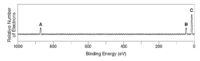
Refer to the photoelectron spectrum of neon shown below to answer the question.
Peaks A, B, and C represent the binding energies of electrons in which subshells of neon?
1s, 2s, 2p
2p, 2s, 1s
1s, 1s, 1s
2s, 2p, 2p
Tags
NGSS.HS-PS1-1
NGSS.HS-PS1-2
2.
MULTIPLE CHOICE QUESTION
2 mins • 2 pts
Refer to the photoelectron spectrum of neon shown below to answer the question.
Which of the following statements best accounts for peak A being to the left of peaks B and C?
The electron configuration of neon is 1s2 2s2 2p6.
Neon has 8 electrons located in its valence shell.
Core electrons of an atom experience a much higher effective nuclear charge than valence electrons
Peaks B and C show first ionisation energies in neon, whereas peak A shows the second ionisation energy of neon
Tags
NGSS.HS-PS1-1
NGSS.HS-PS1-2
3.
MULTIPLE CHOICE QUESTION
2 mins • 2 pts
Refer to the photoelectron spectrum of neon shown below to answer the question.
Which of the following statements best accounts for peak C being three time the height of peak B?
The intensity of the photoelectron signal at a given energy is a measure of the number of electrons in that energy level.
Electrons represented by peak B have approximately triple the binding energy than those represented by peak C
In a photoelectron spectrum, as binding energy increases the relative number of electrons decreases.
The height of peaks in a photoelectron spectrum does not have any relation to the structure of the atom
Tags
NGSS.HS-PS1-1
4.
MULTIPLE CHOICE QUESTION
2 mins • 2 pts
Nitrogen shows 3 peaks in its photoelectron spectrum. These 3 peaks correspond to the binding energies of nitrogen's 1s, 2s, and 2p electrons. The relative heights of the 1s, 2s, and 2p peaks in the PES spectrum of nitrogen will be:
1, 1, 1
2, 2, 3
1, 1, 2
2, 2, 5
Tags
NGSS.HS-PS1-1
5.
MULTIPLE CHOICE QUESTION
2 mins • 2 pts
If the binding energy of an electron is between 0 - 10 eV, it can be assumed that the electron originated in:
an s orbital
a p orbital
a core electron
a valence orbital
6.
MULTIPLE CHOICE QUESTION
2 mins • 2 pts

Using the data in the two PES, what do you expect the binding energy of the 1s electrons in oxygen (atomic number 8) to be?
0 - 50 eV
50 - 400 eV
400 - 700 eV
700 - 1000 eV
Tags
NGSS.HS-PS1-1
NGSS.HS-PS1-2
7.
MULTIPLE CHOICE QUESTION
2 mins • 2 pts

What is the identity of element Z?
Boron
Carbon
Neon
Magnesium
Tags
NGSS.HS-PS1-1

Access all questions and much more by creating a free account
Create resources
Host any resource
Get auto-graded reports

Continue with Google

Continue with Email

Continue with Classlink

Continue with Clever
or continue with

Microsoft
%20(1).png)
Apple

Others
Already have an account?
Similar Resources on Wayground

10 questions
Carbon compounds

Quiz
•
11th Grade
10 questions
A level electrochemical cells
Quiz
•
12th Grade
10 questions
Periodic Table Groups
Quiz
•
10th - 12th Grade
15 questions
5.8 (4) Quiz: VSEPR
Quiz
•
10th - 12th Grade
10 questions
IGCSE Coordinated Chemistry Workout 4
Quiz
•
10th Grade
10 questions
Kimia Unsur Gas Mulia
Quiz
•
12th Grade
14 questions
Men of Chem Unit 1
Quiz
•
10th - 12th Grade
Popular Resources on Wayground
15 questions
Fractions on a Number Line
Quiz
•
3rd Grade
10 questions
Probability Practice
Quiz
•
4th Grade
15 questions
Probability on Number LIne
Quiz
•
4th Grade
20 questions
Equivalent Fractions
Quiz
•
3rd Grade
25 questions
Multiplication Facts
Quiz
•
5th Grade
22 questions
fractions
Quiz
•
3rd Grade
6 questions
Appropriate Chromebook Usage

Lesson
•
7th Grade
10 questions
Greek Bases tele and phon
Quiz
•
6th - 8th Grade
Discover more resources for Chemistry
20 questions
Predicting Products
Quiz
•
9th - 12th Grade
10 questions
Exploring Types of Chemical Reactions

Interactive video
•
6th - 10th Grade
19 questions
Stoichiometry, % yield, Limiting Reactants
Quiz
•
10th Grade
20 questions
Types of Chemical Reactions
Quiz
•
9th - 12th Grade
10 questions
Exploring Ionic and Covalent Bonding Concepts
Interactive video
•
6th - 10th Grade
7 questions
GCSE Chemistry - Balancing Chemical Equations #4
Interactive video
•
9th - 10th Grade
24 questions
Unit 2 (Part 1) Bonding Review
Quiz
•
12th Grade
12 questions
Percent Yield
Quiz
•
10th Grade