
Compare Exponential Functions and Linear Functions
Authored by Anthony Clark
Mathematics
9th Grade
CCSS covered


AI Actions
Add similar questions
Adjust reading levels
Convert to real-world scenario
Translate activity
More...
Content View
Student View
20 questions
Show all answers
1.
MULTIPLE CHOICE QUESTION
1 min • 1 pt
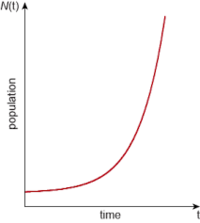
Is the pictured graph growth, decay, or linear or none?
Exponential Growth
Exponential Decay
Linear
None
Tags
CCSS.HSF-IF.C.7E
2.
MULTIPLE CHOICE QUESTION
1 min • 1 pt

Monica did an experiment to compare two method of warming an object. The results are shown in the table above. Which statement best describes her results?
The temperature using both methods changed at a constant rate.
The temperature using both methods changed at an exponential rate.
The temperature using Method 2 changed at a constant rate.
The temperature using Method 2 changed at an exponential rate.
Tags
CCSS.HSF-LE.A.1B
3.
MULTIPLE CHOICE QUESTION
1 min • 1 pt

A
B
C
D
Tags
CCSS.8.F.A.2
CCSS.HSF.IF.C.9
4.
MULTIPLE CHOICE QUESTION
1 min • 1 pt

Which equation best fits the data in the table?
y = 15940x - 2423.6
y = 267.71x2 -3494.46 + 16500
y = 16500(0.80)x
Tags
CCSS.HSF.LE.A.2
5.
MULTIPLE CHOICE QUESTION
1 min • 1 pt

Which statement below describes the comparison of the linear function f(x) and the exponential function g(x)?
The value of g(x) is always greater than the value of f(x).
The value of g(x) is never greater than the value of f(x).
The value of g(x) will eventually exceed the value of f(x).
There is not enough information to compare the value of f(x) to the value of g(x).
6.
MULTIPLE CHOICE QUESTION
1 min • 1 pt

Which statement is true?
A
B
C
D
Tags
CCSS.8.F.A.2
CCSS.HSF.IF.C.9
7.
MULTIPLE CHOICE QUESTION
1 min • 1 pt

Which statement below describes the comparison of rate of change between the linear function f(x) and the exponential function g(x).
g(x) rate of change is ALWAYS greater than f(x) rate of change.
g(x) is NEVER greater than f(x) rate of change.
g(x) will eventually exceed the rate of change of f(x).
There is not enough information to compare the rate of change of f(x) to g(x).
Tags
TEKS.MATH.8.5C


Access all questions and much more by creating a free account
Create resources
Host any resource
Get auto-graded reports

Continue with Google

Continue with Email

Continue with Classlink

Continue with Clever
or continue with

Microsoft
%20(1).png)
Apple

Others
Already have an account?
Similar Resources on Wayground

15 questions
Multiplying powers

Quiz
•
8th - 11th Grade
20 questions
Funkcje
Quiz
•
9th - 10th Grade
20 questions
Unit 8 Review
Quiz
•
9th Grade
20 questions
quiz 3
Quiz
•
7th Grade - University
15 questions
GEOMETRICAL TERMS
Quiz
•
10th - 11th Grade
15 questions
Average Round Quiz Bee - IMD
Quiz
•
University
17 questions
Quadratic Equations: Standard Form
Quiz
•
10th - 11th Grade
19 questions
Operations on polynomials
Quiz
•
10th Grade
Popular Resources on Wayground
7 questions
History of Valentine's Day

Interactive video
•
4th Grade
15 questions
Fractions on a Number Line
Quiz
•
3rd Grade
20 questions
Equivalent Fractions
Quiz
•
3rd Grade
25 questions
Multiplication Facts
Quiz
•
5th Grade
22 questions
fractions
Quiz
•
3rd Grade
15 questions
Valentine's Day Trivia
Quiz
•
3rd Grade
20 questions
Main Idea and Details
Quiz
•
5th Grade
20 questions
Context Clues
Quiz
•
6th Grade
Discover more resources for Mathematics
20 questions
Graphing Inequalities on a Number Line
Quiz
•
6th - 9th Grade
20 questions
Exponent Properties
Quiz
•
9th Grade
15 questions
Combine Like Terms and Distributive Property
Quiz
•
8th - 9th Grade
20 questions
Function or Not a Function
Quiz
•
8th - 9th Grade
10 questions
Factor Quadratic Expressions with Various Coefficients
Quiz
•
9th - 12th Grade
10 questions
Elijah McCoy: Innovations and Impact in Black History
Interactive video
•
6th - 10th Grade
21 questions
Factoring Trinomials (a=1)
Quiz
•
9th Grade
5 questions
Triangle Congruence Theorems
Interactive video
•
9th - 12th Grade