
Solving Quadratic Equations with Complex Roots
Authored by Anthony Clark
Mathematics
11th Grade
CCSS covered


AI Actions
Add similar questions
Adjust reading levels
Convert to real-world scenario
Translate activity
More...
Content View
Student View
13 questions
Show all answers
1.
MULTIPLE CHOICE QUESTION
1 min • 1 pt
What is the quadratic formula used for?
To find the solutions or roots of a quadratic equation.
To find the sum of two numbers.
To calculate the area of a triangle.
To determine the slope of a line.
Answer explanation
The quadratic formula is used to find the solutions or roots of a quadratic equation.
Tags
CCSS.HSA-REI.B.4B
2.
MULTIPLE CHOICE QUESTION
1 min • 1 pt
When does a quadratic equation have complex solutions?
When the discriminant is positive.
When the quadratic equation has only one solution.
When the discriminant is zero.
When the discriminant is negative.
Answer explanation
A quadratic equation has complex solutions when the discriminant is negative.
Tags
CCSS.HSA-REI.B.4B
3.
MULTIPLE CHOICE QUESTION
1 min • 1 pt
Avery, Ethan, and Rohan are having a heated debate about quadratic equations. They are trying to figure out the difference between real and complex solutions. Can you help them out?
Real solutions are complex numbers, while complex solutions involve real numbers.
Real solutions are rational numbers, while complex solutions involve irrational numbers.
Real solutions are real numbers, while complex solutions involve imaginary numbers.
Real solutions are positive numbers, while complex solutions involve negative numbers.
Answer explanation
Real solutions are real numbers, while complex solutions involve imaginary numbers.
Tags
CCSS.HSN.CN.A.1
4.
MULTIPLE CHOICE QUESTION
1 min • 1 pt
If the discriminant is negative, then the quadratic has:
1 Real Solution
2 Real Solutions
Half a Solution
2 Complex (imaginary) Solutions
Tags
CCSS.HSA-REI.B.4B
5.
MULTIPLE CHOICE QUESTION
1 min • 1 pt
The discriminant is
aX2 + bX + c
b - 4ac
b2 - 4ac
b2 + 4ac
Tags
CCSS.HSA-REI.B.4B
6.
MULTIPLE CHOICE QUESTION
1 min • 1 pt
Determine the value of the discriminant and describe the number and type roots for the following:
x2 + 7x + 13
101, 2 real roots
3, 2 real roots
-101, 2 imaginary roots
-3, 2 imaginary roots
Tags
CCSS.HSA-REI.B.4B
7.
MULTIPLE CHOICE QUESTION
1 min • 1 pt
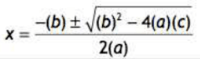
What is this formula?
This is the speed of light formula.
This is the quadratic formula.
This is the zero product property.
This is scary.
Tags
CCSS.HSA-REI.B.4B
Access all questions and much more by creating a free account
Create resources
Host any resource
Get auto-graded reports

Continue with Google

Continue with Email

Continue with Classlink

Continue with Clever
or continue with

Microsoft
%20(1).png)
Apple

Others
Already have an account?
Similar Resources on Wayground

15 questions
Latihan

Quiz
•
12th Grade
10 questions
Ulangan Harian Persamaan Garis Singgung Lingkaran
Quiz
•
11th Grade
10 questions
CLASS-IX MATHS
Quiz
•
9th - 12th Grade
15 questions
Gegar Minda
Quiz
•
University
12 questions
Integrale
Quiz
•
12th Grade
11 questions
Інтеграли
Quiz
•
12th Grade
10 questions
Wang (tambah)
Quiz
•
10th - 12th Grade
18 questions
Funciones Trigonometricas
Quiz
•
12th Grade
Popular Resources on Wayground
7 questions
History of Valentine's Day

Interactive video
•
4th Grade
15 questions
Fractions on a Number Line
Quiz
•
3rd Grade
20 questions
Equivalent Fractions
Quiz
•
3rd Grade
25 questions
Multiplication Facts
Quiz
•
5th Grade
22 questions
fractions
Quiz
•
3rd Grade
15 questions
Valentine's Day Trivia
Quiz
•
3rd Grade
20 questions
Main Idea and Details
Quiz
•
5th Grade
20 questions
Context Clues
Quiz
•
6th Grade
Discover more resources for Mathematics
10 questions
Factor Quadratic Expressions with Various Coefficients
Quiz
•
9th - 12th Grade
10 questions
Evaluating Piecewise Functions Practice
Quiz
•
11th Grade
5 questions
Triangle Congruence Theorems
Interactive video
•
9th - 12th Grade
15 questions
Exponential Growth and Decay Word Problems Practice
Quiz
•
9th - 12th Grade
21 questions
Converting between Logs and Exponents
Quiz
•
11th Grade
20 questions
Classifying polynomials
Quiz
•
11th Grade
20 questions
special right triangles
Quiz
•
9th - 12th Grade
20 questions
Interpreting Scatter Plots
Quiz
•
8th - 12th Grade