
AP Statistics Unit 9
Authored by Anthony Clark
Mathematics
12th Grade


AI Actions
Add similar questions
Adjust reading levels
Convert to real-world scenario
Translate activity
More...
Content View
Student View
15 questions
Show all answers
1.
MULTIPLE CHOICE QUESTION
1 min • 5 pts
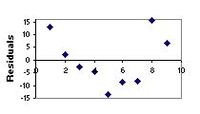
Shown is a residual plot. Would a linear regression model of the data be most appropriate?
YES
NO
2.
MULTIPLE SELECT QUESTION
1 min • 5 pts
The ___________________ measures the percent of the variability in the response variable that is accounted for by the least-squares regression line.
coefficient of determination
coefficient of relaxation
3.
MULTIPLE CHOICE QUESTION
1 min • 5 pts
You are analyzing a scatter plot that has a negative correlation. What is true of the of the x and y values?
As x increases, y decreases
As x increases, y increases
As x decreases, y decreases
4.
MULTIPLE CHOICE QUESTION
1 min • 1 pt

Recent revenue shortfalls in a Midwestern state led to a reduction in the state budget for higher education. To offset the reduction, the largest state university proposed a 25% tuition increase. It was determined that such an increase was needed simply to compensate for the lost support from the state. Separate random samples of 50 freshmen, 50 sophomores, 50 juniors, and 50 seniors from the university were asked whether or not they were strongly opposed to the increase, given that it was the minimum increase necessary to maintain the university’s budget at the current levels. The results are given in the table. Which hypotheses would be appropriate for performing a chi-square test?
The null hypothesis is that the closer students get to graduation, the less likely they are to be opposed to tuition increases. The alternative is that how close students are to graduation makes no difference in their opinions.
The null hypothesis is that the mean number of students who are strongly opposed is the same for each of the four years. The alternative is that the mean is different for at least two of the four years.
The null hypothesis is that the distribution of student opinion about the proposed tuition increase is the same for each of the four years at this university. The alternative is that the distribution is different for at least two of the four years.
The null hypothesis is that year in school and student opinion about the tuition increase in the sample are independent. The alternative is that these variables are dependent.
The null hypothesis is that there is an association between year in school and opinion about the tuition increase at this university. The alternative hypothesis is that these variables are not associated.
5.
MULTIPLE CHOICE QUESTION
1 min • 1 pt
Recent revenue shortfalls in a Midwestern state led to a reduction in the state budget for higher education. To offset the reduction, the largest state university proposed a 25% tuition increase. It was determined that such an increase was needed simply to compensate for the lost support from the state. Separate random samples of 50 freshmen, 50 sophomores, 50 juniors, and 50 seniors from the university were asked whether or not they were strongly opposed to the increase, given that it was the minimum increase necessary to maintain the university’s budget at the current levels. The results are given in the table. The conditions for carrying out the chi-square test is: I. Separate random samples from the populations of interest II. Expected counts large enough III. The samples themselves and the individual observations in each sample are independent. Which of the conditions is (are) satisfied in this case?
I only
II only
I and II only
II and III only
I, II and III
6.
MULTIPLE CHOICE QUESTION
1 min • 1 pt

A random sample of traffic tickets given to motorists in a large city is examined. The tickets are classified according to the race of the driver. The results are summarized in the table. We wish to test H0: The racial distribution of traffic tickets in the city is the same as the racial distribution of the city’s population. Assuming H0 is true, the expected number of Hispanic drivers who would receive a ticket is
8
10.36
11
11.84
12
7.
MULTIPLE CHOICE QUESTION
1 min • 1 pt
A random sample of traffic tickets given to motorists in a large city is examined. The tickets are classified according to the race of the driver. The results are summarized in the table. We wish to test H0: The racial distribution of traffic tickets in the city is the same as the racial distribution of the city’s population. We compute the value of X2 to be 6.58. Assuming the conditions for inference are met, the p-value of our test is
greater than 0.2
between 0.10 and 0.20
between 0.05 and 0.10
between 0.01 and 0.05
less than 0.01

Access all questions and much more by creating a free account
Create resources
Host any resource
Get auto-graded reports

Continue with Google

Continue with Email

Continue with Classlink

Continue with Clever
or continue with

Microsoft
%20(1).png)
Apple

Others
Already have an account?
Similar Resources on Wayground

17 questions
The Definite Integral

Quiz
•
12th Grade
10 questions
Ch. 2-1 Deductions from Gross Pay
Quiz
•
11th - 12th Grade
10 questions
Summer Camp Quiz Prepared By- Dr. Meenu
Quiz
•
9th - 12th Grade
15 questions
Equivalent Fraction
Quiz
•
5th Grade - University
15 questions
Probability Practice
Quiz
•
11th - 12th Grade
10 questions
Percentages, fractions and decimals
Quiz
•
9th - 12th Grade
10 questions
Basic Chain Rule Practice
Quiz
•
11th - 12th Grade
20 questions
Statistics and Probability 4th Quarter Assessment Reviewer
Quiz
•
11th - 12th Grade
Popular Resources on Wayground
7 questions
History of Valentine's Day

Interactive video
•
4th Grade
15 questions
Fractions on a Number Line
Quiz
•
3rd Grade
20 questions
Equivalent Fractions
Quiz
•
3rd Grade
25 questions
Multiplication Facts
Quiz
•
5th Grade
22 questions
fractions
Quiz
•
3rd Grade
15 questions
Valentine's Day Trivia
Quiz
•
3rd Grade
20 questions
Main Idea and Details
Quiz
•
5th Grade
20 questions
Context Clues
Quiz
•
6th Grade
Discover more resources for Mathematics
10 questions
Factor Quadratic Expressions with Various Coefficients
Quiz
•
9th - 12th Grade
5 questions
Triangle Congruence Theorems
Interactive video
•
9th - 12th Grade
15 questions
Exponential Growth and Decay Word Problems Practice
Quiz
•
9th - 12th Grade
20 questions
special right triangles
Quiz
•
9th - 12th Grade
20 questions
Interpreting Scatter Plots
Quiz
•
8th - 12th Grade
15 questions
Writing Ratios
Quiz
•
6th - 12th Grade
21 questions
Apply Polynomial Multiplication Techniques
Quiz
•
9th - 12th Grade
30 questions
Quad Properties Identify Only
Quiz
•
9th - 12th Grade