
Waves
6th Grade
•35 Qs

Similar activities
Unit 5 Energy vocab quiz 1-10
6th Grade
•31 Qs
Weather and Water practice
6th - 7th Grade
•32 Qs
Earth Space Chapter 28 Review
6th - 8th Grade
•40 Qs
Sc. Ch. 11 Review, Newton's Laws
6th Grade
•30 Qs
PMA 2 : Geologic Processes and Geologic Time
6th - 8th Grade
•30 Qs
Getting to know Plants
6th Grade
•35 Qs
Life Sciences 8 Midterm Review
6th - 8th Grade
•33 Qs
Classification Study Guide
6th Grade
•37 Qs
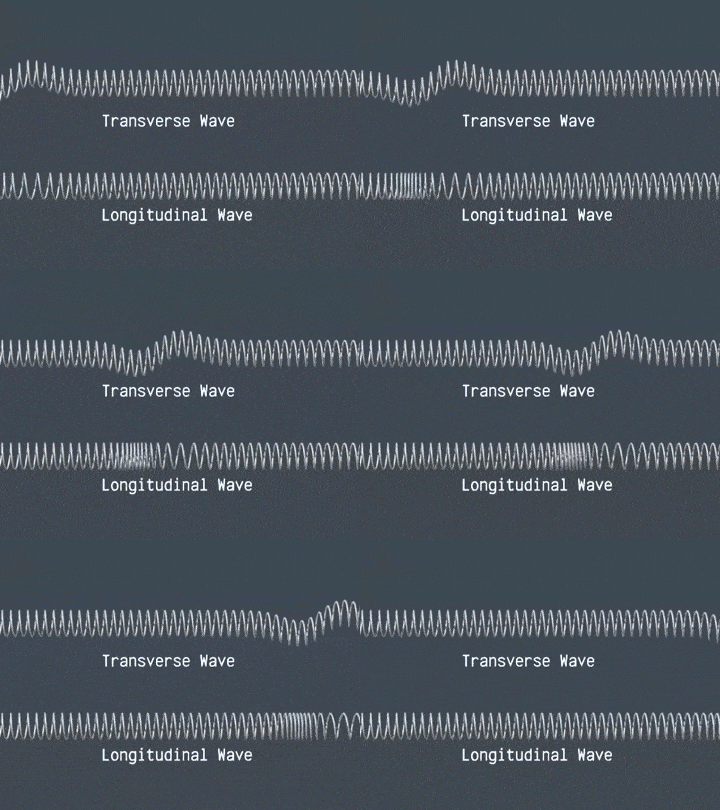
Waves

Quiz
•
Science
•
6th Grade
•
Practice Problem
•
Medium
+3
Standards-aligned

Marsha O'Hare
Used 1+ times
FREE Resource

Enhance your content in a minute
35 questions
Show all answers
1.
MULTIPLE CHOICE QUESTION
5 mins • 1 pt

Which statement best explains the results of the investigation for wave 2?
The wave traveled faster in the denser media because the particles in the media are closer together.
The wave traveled slower in the denser media because the particles in the media are closer together.
The wave traveled faster in the denser media because the particles in the media are farther apart.
The wave traveled slower in the denser media because the particles in the media are farther apart.
Tags
NGSS.MS-PS4-2
2.
MULTIPLE CHOICE QUESTION
5 mins • 1 pt
As light travels through air and strikes water, which picture shows what happens to the light ray?


Tags
NGSS.MS-PS4-2
3.
MULTIPLE CHOICE QUESTION
5 mins • 1 pt

Which statement BEST describes how changing the energy of a wave affects its amplitude and loudness?
Decreasing the wave's energy causes the loudness to decrease and the amplitude to increase.
Decreasing the wave's energy causes the loudness to decrease and the amplitude to decrease.
Increasing the wave's energy causes the loudness to increase but the amplitude to remain the same.
Increasing the wave's energy causes the loudness to decrease but the amplitude to remain the same.
Tags
NGSS.MS-PS4-1
4.
MULTIPLE CHOICE QUESTION
5 mins • 1 pt

Name the wave interaction
absorption
transmission
reflection
refraction
diffraction
Tags
NGSS.MS-PS4-2
5.
MULTIPLE CHOICE QUESTION
5 mins • 1 pt

Name the wave interaction
absorption
transmission
reflection
refraction
diffraction
Tags
NGSS.MS-PS4-2
6.
MULTIPLE CHOICE QUESTION
5 mins • 1 pt

Name the wave interaction
absorption
transmission
reflection
refraction
diffraction
Tags
NGSS.MS-PS4-2
7.
MULTIPLE CHOICE QUESTION
5 mins • 1 pt
Click on the wave that has the loudest sound quality.


Tags
NGSS.MS-PS4-1


Access all questions and much more by creating a free account
Create resources
Host any resource
Get auto-graded reports

Continue with Google

Continue with Email

Continue with Classlink

Continue with Clever
or continue with

Microsoft
%20(1).png)
Apple

Others
Already have an account?
Similar Resources on Wayground
30 questions
Sorting materials into Groups
Quiz
•
6th Grade
31 questions
Unit 5 Energy vocab quiz 1-10
Quiz
•
6th Grade
37 questions
KS3 Space - Keywords
Quiz
•
6th - 9th Grade
30 questions
Stage 3 Science Quiz - It's Electric!
Quiz
•
6th Grade
40 questions
KSN IPA (Fisika)
Quiz
•
4th - 8th Grade
35 questions
Getting to know Plants
Quiz
•
6th Grade
33 questions
Life Sciences 8 Midterm Review
Quiz
•
6th - 8th Grade
32 questions
Brainpop: Simple Machines
Quiz
•
6th - 8th Grade
Popular Resources on Wayground
15 questions
Fractions on a Number Line
Quiz
•
3rd Grade
20 questions
Equivalent Fractions
Quiz
•
3rd Grade
25 questions
Multiplication Facts
Quiz
•
5th Grade
54 questions
Analyzing Line Graphs & Tables
Quiz
•
4th Grade
22 questions
fractions
Quiz
•
3rd Grade
20 questions
Main Idea and Details
Quiz
•
5th Grade
20 questions
Context Clues
Quiz
•
6th Grade
15 questions
Equivalent Fractions
Quiz
•
4th Grade
Discover more resources for Science
20 questions
Cell Organelles and Functions
Quiz
•
6th - 8th Grade
33 questions
Grade 6 Quarter 3 PMA 5 Review
Quiz
•
6th - 8th Grade
20 questions
Rocks and The Rock Cycle
Quiz
•
6th Grade
20 questions
Thermal Energy - Heat Transfer
Quiz
•
6th Grade
10 questions
Exploring the Rock Cycle: Types and Formation

Interactive video
•
6th - 8th Grade
10 questions
Exploring the Layers of the Earth
Interactive video
•
6th - 10th Grade
15 questions
Punnett Squares
Quiz
•
6th Grade
10 questions
Exploring the Rock Cycle
Interactive video
•
6th - 8th Grade