
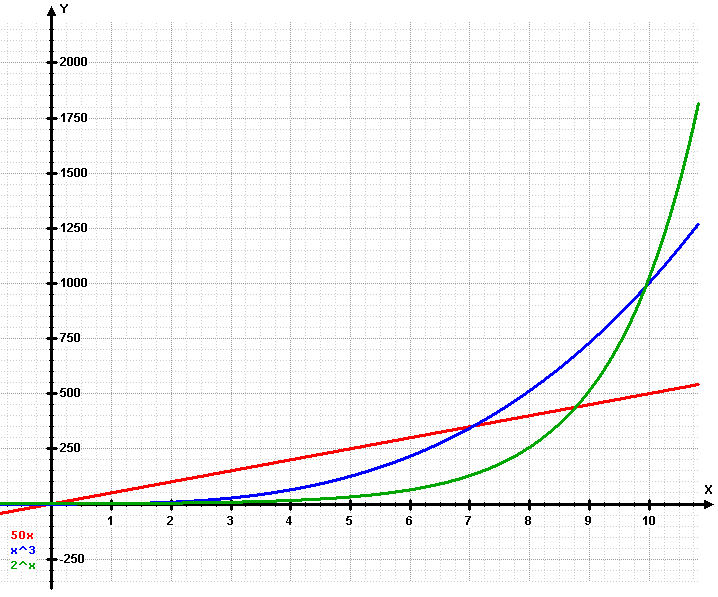
Exponential Modeling

Flashcard
•
Mathematics
•
9th - 12th Grade
•
Practice Problem
•
Hard
+1
Standards-aligned

Wayground Content
FREE Resource
Student preview

15 questions
Show all answers
1.
FLASHCARD QUESTION
Front
What is exponential modeling?
Back
Exponential modeling is a mathematical technique used to describe situations where a quantity grows or decays at a rate proportional to its current value, often represented by the function y = a(1 + r)^t, where 'a' is the initial amount, 'r' is the growth rate, and 't' is time.
2.
FLASHCARD QUESTION
Front
What is the formula for compound interest?
Back
The formula for compound interest is A = P(1 + r/n)^(nt), where A is the amount of money accumulated after n years, P is the principal amount (the initial investment), r is the annual interest rate (decimal), n is the number of times that interest is compounded per year, and t is the number of years the money is invested or borrowed.
3.
FLASHCARD QUESTION
Front
How do you calculate the future value of an investment compounded quarterly?
Back
To calculate the future value of an investment compounded quarterly, use the formula A = P(1 + r/4)^(4t), where P is the principal, r is the annual interest rate, and t is the number of years.
4.
FLASHCARD QUESTION
Front
What does it mean for a population to grow exponentially?
Back
Exponential population growth means that the population increases by a fixed percentage over a specific period, leading to faster growth as the population size increases.
Tags
CCSS.HSF-LE.A.1A
5.
FLASHCARD QUESTION
Front
What is the difference between linear and exponential growth?
Back
Linear growth increases by a constant amount over time, while exponential growth increases by a constant percentage, resulting in a rapid increase as the quantity grows.
6.
FLASHCARD QUESTION
Front
How do you write an exponential growth function?
Back
An exponential growth function can be written in the form y = a(1 + r)^t, where 'a' is the initial value, 'r' is the growth rate, and 't' is time.
7.
FLASHCARD QUESTION
Front
What is the initial value in an exponential function?
Back
The initial value in an exponential function is the starting amount before any growth or decay occurs, represented by 'a' in the function y = a(1 + r)^t.
Access all questions and much more by creating a free account
Create resources
Host any resource
Get auto-graded reports

Continue with Google

Continue with Email

Continue with Classlink

Continue with Clever
or continue with

Microsoft
%20(1).png)
Apple

Others
Already have an account?
Similar Resources on Wayground

12 questions
Hazard Profiles and Tectonic Hazards Flashcard
Flashcard
•
11th Grade - University
10 questions
ENGLISH
Flashcard
•
KG
10 questions
Key Terms in Cost Management
Flashcard
•
KG - University
13 questions
Types and Components of Computer Systems
Flashcard
•
9th - 12th Grade
13 questions
Money
Flashcard
•
9th - 12th Grade
15 questions
cars
Flashcard
•
KG - University
12 questions
Biblia (nat2020 kerettantervi alapfogalmak)
Flashcard
•
9th Grade - University
15 questions
Small Talk in Business Contexts
Flashcard
•
KG - University
Popular Resources on Wayground
15 questions
Fractions on a Number Line

Quiz
•
3rd Grade
20 questions
Equivalent Fractions
Quiz
•
3rd Grade
25 questions
Multiplication Facts
Quiz
•
5th Grade
29 questions
Alg. 1 Section 5.1 Coordinate Plane
Quiz
•
9th Grade
22 questions
fractions
Quiz
•
3rd Grade
11 questions
FOREST Effective communication

Lesson
•
KG
20 questions
Main Idea and Details
Quiz
•
5th Grade
20 questions
Context Clues
Quiz
•
6th Grade
Discover more resources for Mathematics
29 questions
Alg. 1 Section 5.1 Coordinate Plane
Quiz
•
9th Grade
20 questions
Graphing Inequalities on a Number Line
Quiz
•
6th - 9th Grade
20 questions
Box and Whisker Plots
Quiz
•
9th Grade
18 questions
Exponential Growth and Decay
Quiz
•
9th Grade
20 questions
Function or Not a Function
Quiz
•
8th - 9th Grade
20 questions
SSS/SAS
Quiz
•
9th - 12th Grade
14 questions
Making Inferences From Samples
Quiz
•
7th - 12th Grade
23 questions
CCG - CH8 Polygon angles and area Review
Quiz
•
9th - 12th Grade