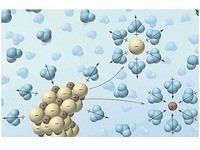
Intermolecular Forces Practice

Flashcard
•
Chemistry
•
10th - 12th Grade
•
Practice Problem
•
Hard

Wayground Content
FREE Resource
Student preview

15 questions
Show all answers
1.
FLASHCARD QUESTION
Front
What are intermolecular forces?
Back
Intermolecular forces are the forces of attraction or repulsion between neighboring particles (molecules, atoms, or ions). They play a crucial role in determining the physical properties of substances, such as boiling and melting points.
2.
FLASHCARD QUESTION
Front
What is a hydrogen bond?
Back
A hydrogen bond is a strong type of dipole-dipole attraction that occurs between a hydrogen atom covalently bonded to a highly electronegative atom (like fluorine, oxygen, or nitrogen) and another electronegative atom.
3.
FLASHCARD QUESTION
Front
Which type of intermolecular force is the weakest?
Back
London dispersion forces are the weakest type of intermolecular forces, arising from temporary dipoles that occur when electron distribution around atoms or molecules is uneven.
4.
FLASHCARD QUESTION
Front
What is the significance of boiling points in relation to intermolecular forces?
Back
Boiling points are influenced by the strength of intermolecular forces; stronger intermolecular forces result in higher boiling points due to the increased energy required to separate the molecules.
5.
FLASHCARD QUESTION
Front
What is a polar molecule?
Back
A polar molecule is a molecule that has a net dipole moment due to the presence of polar bonds, resulting in a distribution of electrical charge that leads to partial positive and negative charges.
6.
FLASHCARD QUESTION
Front
What are dipole-dipole interactions?
Back
Dipole-dipole interactions are attractive forces between the positive end of one polar molecule and the negative end of another polar molecule.
7.
FLASHCARD QUESTION
Front
How do London dispersion forces arise?
Back
London dispersion forces arise from the momentary distribution of electrons around atoms or molecules, creating temporary dipoles that induce similar dipoles in neighboring particles.
Access all questions and much more by creating a free account
Create resources
Host any resource
Get auto-graded reports

Continue with Google

Continue with Email

Continue with Classlink

Continue with Clever
or continue with

Microsoft
%20(1).png)
Apple

Others
Already have an account?
Similar Resources on Wayground

11 questions
H Chem: Chemical Analysis
Flashcard
•
KG
11 questions
Mostly Irrelevant Presidential Trivia
Flashcard
•
9th - 12th Grade
13 questions
Wives of Prophet Muhammad Flashcard
Flashcard
•
10th Grade - University
15 questions
LT 1.2-1.3 - Photosynthesis
Flashcard
•
11th - 12th Grade
15 questions
Past Simple VS Prsent Perfect
Flashcard
•
KG - University
14 questions
Deviance
Flashcard
•
11th Grade
10 questions
Algebra
Flashcard
•
12th Grade
Popular Resources on Wayground
7 questions
History of Valentine's Day

Interactive video
•
4th Grade
15 questions
Fractions on a Number Line

Quiz
•
3rd Grade
20 questions
Equivalent Fractions
Quiz
•
3rd Grade
25 questions
Multiplication Facts
Quiz
•
5th Grade
22 questions
fractions
Quiz
•
3rd Grade
15 questions
Valentine's Day Trivia
Quiz
•
3rd Grade
20 questions
Main Idea and Details
Quiz
•
5th Grade
20 questions
Context Clues
Quiz
•
6th Grade
Discover more resources for Chemistry
25 questions
Unit 8 Stoichiometry Review
Quiz
•
10th Grade
20 questions
Types of Chemical Reactions
Quiz
•
9th - 12th Grade
19 questions
Stoichiometry, Limiting Reactants, and Percent Yield
Quiz
•
10th Grade
20 questions
Stoichiometry Practice
Quiz
•
12th Grade
15 questions
Balancing Chemical Equations
Quiz
•
10th - 12th Grade
20 questions
Naming & Writing Chemical Formulas
Quiz
•
10th Grade
10 questions
Identifying types of reactions
Quiz
•
9th - 12th Grade
20 questions
Periodic Trends
Quiz
•
10th Grade