
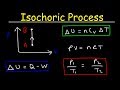
Understanding Isochoric Processes and Thermodynamics

Interactive Video
•
Physics, Chemistry, Science
•
10th - 12th Grade
•
Practice Problem
•
Easy

Olivia Brooks
Used 1+ times
FREE Resource
Read more
10 questions
Show all answers
1.
MULTIPLE CHOICE QUESTION
30 sec • 1 pt
What type of process is characterized by a constant volume where no work is done by the gas?
Adiabatic
Isobaric
Isochoric
Isothermal
2.
MULTIPLE CHOICE QUESTION
30 sec • 1 pt
In an isochoric process, if the pressure of a gas triples, what happens to the temperature?
It remains constant
It doubles
It halves
It triples
3.
MULTIPLE CHOICE QUESTION
30 sec • 1 pt
Which equation is used to calculate the change in internal energy of a gas?
PV = nRT
Q = ΔU + W
W = PΔV
ΔU = nCvΔT
4.
MULTIPLE CHOICE QUESTION
30 sec • 1 pt
For a diatomic gas, what is the molar heat capacity at constant volume?
7/2 R
5/2 R
R
3/2 R
5.
MULTIPLE CHOICE QUESTION
30 sec • 1 pt
In an isochoric process, how is the heat energy transferred related to the change in internal energy?
Q = ΔU
Q = ΔU - W
Q = W
Q = 0
6.
MULTIPLE CHOICE QUESTION
30 sec • 1 pt
If the internal energy of a system increases by 62,370 joules, how much heat energy is transferred into the system?
31,185 joules
62,370 joules
124,740 joules
0 joules
7.
MULTIPLE CHOICE QUESTION
30 sec • 1 pt
What indicates that heat energy has flowed into a system during an isochoric process?
The temperature increases
The volume increases
The temperature decreases
The pressure decreases
Access all questions and much more by creating a free account
Create resources
Host any resource
Get auto-graded reports

Continue with Google

Continue with Email

Continue with Classlink

Continue with Clever
or continue with

Microsoft
%20(1).png)
Apple

Others
Already have an account?


