
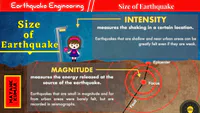
Earthquake Magnitude and Intensity

Passage
•
Science
•
9th - 12th Grade
•
Practice Problem
•
Easy

Pamela Slater
Used 3+ times
FREE Resource
5 questions
Show all answers
1.
MULTIPLE CHOICE QUESTION
30 sec • 1 pt
What does the magnitude of an earthquake measure?
The energy released at the source of the earthquake
The strength of shaking at a specific location
The observable damage caused by the earthquake
The distance from the fault rupture area
2.
MULTIPLE CHOICE QUESTION
30 sec • 1 pt
Which scale is most commonly used today to measure the magnitude of earthquakes?
Richter scale
Moment magnitude scale (Mw)
Modified Mercalli Intensity Scale
Isoseismal curves
3.
MULTIPLE CHOICE QUESTION
30 sec • 1 pt
What does the Modified Mercalli Intensity (MMI) Scale describe?
The energy released at the earthquake's source
The effects of an earthquake in terms of observable damage
The physical properties of the earthquake
The amplitude on a seismogram
4.
MULTIPLE CHOICE QUESTION
30 sec • 1 pt
How does the magnitude scale differ from intensity scales?
Magnitude is based on seismic records, while intensity is based on observable data
Magnitude varies from place to place, while intensity is a single value
Magnitude measures observable damage, while intensity measures energy released
Magnitude is subjective, while intensity is objective
5.
MULTIPLE CHOICE QUESTION
30 sec • 1 pt
What are isoseismal curves used for in the context of earthquakes?
To connect points of equal intensity
To measure the energy released at the earthquake's source
To describe the effects of an earthquake in terms of observable damage
To determine the magnitude of an earthquake
Access all questions and much more by creating a free account
Create resources
Host any resource
Get auto-graded reports

Continue with Google

Continue with Email

Continue with Classlink

Continue with Clever
or continue with

Microsoft
%20(1).png)
Apple

Others
Already have an account?



