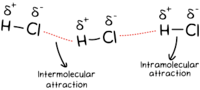
Intermolecular Forces IMF

Flashcard
•
Chemistry
•
10th - 11th Grade
•
Practice Problem
•
Hard

Wayground Content
FREE Resource
Student preview

15 questions
Show all answers
1.
FLASHCARD QUESTION
Front
What is hydrogen bonding and why is it considered a strong intermolecular force?
Back
Hydrogen bonding is an attraction between a small, weakly electronegative hydrogen atom and a large, strongly electronegative atom such as fluorine, nitrogen, or oxygen. This strong attraction arises due to the significant difference in electronegativity between hydrogen and these atoms.
2.
FLASHCARD QUESTION
Front
What type of intermolecular forces are present in ICl?
Back
ICl predominantly consists of dipole-dipole forces due to the polar nature of the molecule.
3.
FLASHCARD QUESTION
Front
What is an ion-dipole interaction?
Back
An ion-dipole interaction is a type of intermolecular force that occurs between an ion and a polar molecule, where the charged ion interacts with the dipole of the polar molecule.
4.
FLASHCARD QUESTION
Front
What are London dispersion forces?
Back
London dispersion forces are weak intermolecular forces that arise from temporary dipoles created when electron distributions in atoms or molecules fluctuate.
5.
FLASHCARD QUESTION
Front
Which molecule is likely to have London dispersion forces as the most significant intermolecular force: Br2, HCl, H2S, or NH3?
Back
Br2 is likely to have London dispersion forces as the most significant intermolecular force because it is a nonpolar molecule and only exhibits dispersion forces.
6.
FLASHCARD QUESTION
Front
What factors influence the strength of hydrogen bonds?
Back
The strength of hydrogen bonds is influenced by the electronegativity of the atom bonded to hydrogen, the size of the atom, and the distance between the hydrogen atom and the electronegative atom.
7.
FLASHCARD QUESTION
Front
How do dipole-dipole forces differ from London dispersion forces?
Back
Dipole-dipole forces occur between polar molecules due to their permanent dipoles, while London dispersion forces occur between all molecules, regardless of polarity, due to temporary dipoles.
Access all questions and much more by creating a free account
Create resources
Host any resource
Get auto-graded reports

Continue with Google

Continue with Email

Continue with Classlink

Continue with Clever
or continue with

Microsoft
%20(1).png)
Apple

Others
Already have an account?
Similar Resources on Wayground

15 questions
Ionic and Covalent Bonding - Properties + Naming
Flashcard
•
9th - 12th Grade
15 questions
Properties of Water
Flashcard
•
10th Grade
15 questions
Newton's Laws of Motion
Flashcard
•
10th Grade
15 questions
Descriptive and Inference Statistics
Flashcard
•
10th Grade
10 questions
English 10 (Final Round)
Flashcard
•
10th Grade
15 questions
Nuclear Equations-10A-2024
Flashcard
•
10th Grade
15 questions
Semester 1 test 2024 -2025 AP chemistry
Flashcard
•
10th Grade
Popular Resources on Wayground
7 questions
History of Valentine's Day

Interactive video
•
4th Grade
15 questions
Fractions on a Number Line

Quiz
•
3rd Grade
20 questions
Equivalent Fractions
Quiz
•
3rd Grade
25 questions
Multiplication Facts
Quiz
•
5th Grade
22 questions
fractions
Quiz
•
3rd Grade
15 questions
Valentine's Day Trivia
Quiz
•
3rd Grade
20 questions
Main Idea and Details
Quiz
•
5th Grade
20 questions
Context Clues
Quiz
•
6th Grade
Discover more resources for Chemistry
25 questions
Unit 8 Stoichiometry Review
Quiz
•
10th Grade
20 questions
Types of Chemical Reactions
Quiz
•
9th - 12th Grade
19 questions
Stoichiometry, Limiting Reactants, and Percent Yield
Quiz
•
10th Grade
15 questions
Balancing Chemical Equations
Quiz
•
10th - 12th Grade
20 questions
Naming & Writing Chemical Formulas
Quiz
•
10th Grade
10 questions
Identifying types of reactions
Quiz
•
9th - 12th Grade
20 questions
Periodic Trends
Quiz
•
10th Grade
20 questions
electron configurations and orbital notation
Quiz
•
9th - 12th Grade