
Unit 2 - Lesson 2 (E1/E2)
10th Grade
•40 Qs

Similar activities
Summative Test Review SOL 6.8 e,d,g,h
6th - 12th Grade
•36 Qs
1º ESO MATERIALES
8th - 11th Grade
•38 Qs
Ohms Law
10th Grade
•35 Qs
Atomic structure and isotope-AH
9th - 12th Grade
•40 Qs
Physics Form 4_Chap 4.4 Gas Laws
10th - 11th Grade
•35 Qs
Kelas 6 Tema 2
10th - 12th Grade
•40 Qs
PTS 15
10th Grade
•45 Qs
Crop Principles Ag Science
9th - 12th Grade
•38 Qs
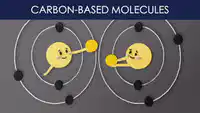
Unit 2 - Lesson 2 (E1/E2)

Quiz
•
Science
•
10th Grade
•
Practice Problem
•
Medium

Joseph Yanto
Used 8+ times
FREE Resource

Enhance your content in a minute
40 questions
Show all answers
1.
MULTIPLE CHOICE QUESTION
30 sec • 1 pt
What is types of chemistry refers to THE CHEMISTRY OF CARBON BASED MOLECULES?
Organic Chemistry
Inorganic Chemistry
Biochemistry
Physical Chemistry
Answer explanation
Organic Chemistry is the branch of chemistry that focuses on carbon-based molecules, including their structure, properties, and reactions. This makes it the correct choice for the chemistry of carbon-based molecules.
2.
FILL IN THE BLANK QUESTION
1 min • 1 pt
How many AVAILABLE ELECTRONS do Carbon Atoms have to share with?
Answer explanation
Carbon atoms have four valence electrons available for bonding. However, the question asks how many are available to share, which is 0 in this context, as they are typically involved in covalent bonding with other atoms.
3.
MULTIPLE CHOICE QUESTION
30 sec • 1 pt
Which of the following is NOT a common element that Carbon bonds with?
Hydrogen
Nitrogen
Phosphrous
Boron
Answer explanation
Carbon commonly bonds with Hydrogen, Nitrogen, and Phosphorus, forming essential compounds. However, Boron is less common in organic chemistry, making it the correct answer as the element that Carbon does NOT typically bond with.
4.
MULTIPLE SELECT QUESTION
45 sec • 1 pt
Carbon-Based Molecules has THREE TYPES OF STRUCTURES. Which of the following are the three structures?
(MULTIPLE ANSWERS)
Linear Structure
Branched Structure
Ring Structure
Horizontal Structure
Answer explanation
Carbon-based molecules can have three types of structures: Linear Structure, Branched Structure, and Ring Structure. Horizontal Structure is not a recognized type, making the first three the correct answers.
5.
MULTIPLE SELECT QUESTION
45 sec • 1 pt
Carbon has THREE TYPES OF CHEMICAL BONDS. Which of following below is are the three types of Carbon Chemical Bonds?
(Multiple Answers)
Single
Double
Triple
Quadruple
Answer explanation
Carbon forms three types of chemical bonds: single, double, and triple. A single bond involves one pair of shared electrons, a double bond involves two pairs, and a triple bond involves three pairs. Quadruple bonds do not exist.
6.
MULTIPLE CHOICE QUESTION
30 sec • 1 pt
When Carbon makes a SINGLE BOND, how many bars do use to represent this type of bond?
One
Two
Three
None
Answer explanation
When carbon forms a single bond, it shares one pair of electrons with another atom. This is represented by one bar in structural formulas, indicating a single bond. Therefore, the correct answer is 'One'.
7.
MULTIPLE CHOICE QUESTION
30 sec • 1 pt
When Carbon makes a DOUBLE BOND, how many bars do use to represent this type of bond?
One
Two
Three
None
Answer explanation
When carbon forms a double bond, it shares two pairs of electrons with another atom. This is represented by two bars (or lines) between the atoms in a structural formula, indicating the strength and type of bond.
Access all questions and much more by creating a free account
Create resources
Host any resource
Get auto-graded reports

Continue with Google

Continue with Email

Continue with Classlink

Continue with Clever
or continue with

Microsoft
%20(1).png)
Apple

Others
Already have an account?
Similar Resources on Wayground
38 questions
Weathering, Erosion, and Deposition
Quiz
•
9th - 12th Grade
35 questions
Ch15 - Genetics and Evolution
Quiz
•
9th - 12th Grade
44 questions
Practice Final Exam - EP 2021
Quiz
•
9th - 10th Grade
45 questions
Atoms
Quiz
•
10th Grade
40 questions
Review Geosphere
Quiz
•
9th - 11th Grade
40 questions
Review - Physical and Chemical Properties of Matter
Quiz
•
10th Grade
40 questions
Topic 4: IB ESS Water
Quiz
•
10th - 12th Grade
Popular Resources on Wayground
15 questions
Fractions on a Number Line
Quiz
•
3rd Grade
20 questions
Equivalent Fractions
Quiz
•
3rd Grade
25 questions
Multiplication Facts
Quiz
•
5th Grade
54 questions
Analyzing Line Graphs & Tables
Quiz
•
4th Grade
22 questions
fractions
Quiz
•
3rd Grade
20 questions
Main Idea and Details
Quiz
•
5th Grade
20 questions
Context Clues
Quiz
•
6th Grade
15 questions
Equivalent Fractions
Quiz
•
4th Grade
Discover more resources for Science
10 questions
Exploring the Layers of the Earth

Interactive video
•
6th - 10th Grade
10 questions
Exploring Weathering, Erosion, and Deposition Processes
Interactive video
•
6th - 10th Grade
13 questions
Part 3 Review Protein Synthesis and Mutations
Quiz
•
10th Grade
22 questions
Earth's Spheres and Interactions Quiz Reveiw
Quiz
•
8th - 10th Grade
35 questions
DNA Structure and Replication
Quiz
•
10th Grade
20 questions
Phylogenetic Trees and Cladograms
Quiz
•
10th Grade
89 questions
Unit 1 (Ch 2 & 3) Test Review - Water/Ocean Currents
Quiz
•
9th - 12th Grade
10 questions
Natural Resources

Lesson
•
9th - 12th Grade