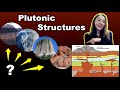
Igneous Structures and Processes

Interactive Video
•
Science
•
10th - 12th Grade
•
Practice Problem
•
Hard

Mia Campbell
FREE Resource
Read more
10 questions
Show all answers
1.
MULTIPLE CHOICE QUESTION
30 sec • 1 pt
What is the primary difference between igneous textures and structures?
Textures are only found in volcanic rocks, while structures are only found in plutonic rocks.
Textures are related to chemical composition, while structures are related to physical form.
Textures describe small-scale features, while structures describe large-scale features.
Textures describe large-scale features, while structures describe small-scale features.
2.
MULTIPLE CHOICE QUESTION
30 sec • 1 pt
Which of the following is a characteristic of hypabyssal igneous structures?
They are only found in oceanic crust.
They are exclusively volcanic.
They are shallow intrusive rocks.
They are formed deep within the Earth's crust.
3.
MULTIPLE CHOICE QUESTION
30 sec • 1 pt
How do volcanic necks form?
Through the solidification of magma in a horizontal layer.
By the rapid cooling of lava at the surface.
Through the erosion of the surrounding cone, leaving the vent exposed.
By the accumulation of pyroclastic material.
4.
MULTIPLE CHOICE QUESTION
30 sec • 1 pt
What distinguishes a batholith from a pluton?
Batholiths are formed from mafic magmas.
Batholiths are only found in volcanic regions.
Batholiths are composed of multiple plutons and are much larger.
Batholiths are smaller than plutons.
5.
MULTIPLE CHOICE QUESTION
30 sec • 1 pt
What are chilled margins in dikes and sills?
Zones where the rock is more colorful.
Areas where the rock is coarser due to slow cooling.
Regions where the rock is finer due to rapid cooling.
Sections where the rock is more porous.
6.
MULTIPLE CHOICE QUESTION
30 sec • 1 pt
What is a xenolith?
A fragment of a different rock type incorporated into the host rock.
A fragment of the same rock type as the host rock.
A type of volcanic rock.
A mineral found in igneous rocks.
7.
MULTIPLE CHOICE QUESTION
30 sec • 1 pt
How do autoliths differ from xenoliths?
Autoliths are larger than xenoliths.
Autoliths are formed from sedimentary rocks.
Autoliths are found only in volcanic rocks.
Autoliths are fragments from the same rock, while xenoliths are from different rocks.
Access all questions and much more by creating a free account
Create resources
Host any resource
Get auto-graded reports

Continue with Google

Continue with Email

Continue with Classlink

Continue with Clever
or continue with

Microsoft
%20(1).png)
Apple

Others
Already have an account?
Similar Resources on Wayground

6 questions
Mirrors: the Science of Reflection
Interactive video
•
KG - University
6 questions
Exploring the Depths: Uncovering the World's Largest Underwater Lava Flow
Interactive video
•
KG - University
8 questions
The Sixth Extinction
Interactive video
•
11th Grade - University
8 questions
What a Dinosaur Looks Like Under a Microscope
Interactive video
•
11th Grade - University
6 questions
The Hunt For Green Helium
Interactive video
•
11th Grade - University
6 questions
Ozonolysis
Interactive video
•
11th Grade - University
6 questions
4 Awesome Discoveries You Probably Didn’t Hear About - Episode 38
Interactive video
•
11th Grade - University
6 questions
Unlocking the Secrets of Photosynthesis: Towards Cheap Hydrogen Production
Interactive video
•
KG - University
Popular Resources on Wayground
15 questions
Fractions on a Number Line

Quiz
•
3rd Grade
20 questions
Equivalent Fractions
Quiz
•
3rd Grade
25 questions
Multiplication Facts
Quiz
•
5th Grade
22 questions
fractions
Quiz
•
3rd Grade
20 questions
Main Idea and Details
Quiz
•
5th Grade
20 questions
Context Clues
Quiz
•
6th Grade
15 questions
Equivalent Fractions
Quiz
•
4th Grade
20 questions
Figurative Language Review
Quiz
•
6th Grade
Discover more resources for Science
10 questions
Exploring the Layers of the Earth
Interactive video
•
6th - 10th Grade
14 questions
Natural Selection and Adaptation

Lesson
•
9th - 12th Grade
10 questions
Exploring the Ring of Fire: Volcanoes and Earthquakes
Interactive video
•
6th - 10th Grade
38 questions
Water Cycle and Groundwater
Quiz
•
9th - 12th Grade
10 questions
Exploring Spring and Neap Tides
Interactive video
•
6th - 10th Grade
12 questions
Cell Organelles and Their Functions
Lesson
•
9th - 12th Grade
12 questions
Homeostasis: Positive and Negative Feedback Loops
Interactive video
•
11th Grade
22 questions
Earth's Spheres and Interactions Quiz Reveiw
Quiz
•
8th - 10th Grade