
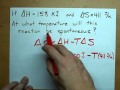
Gibbs Free Energy and Spontaneity

Interactive Video
•
Chemistry, Science
•
10th - 12th Grade
•
Practice Problem
•
Hard

Sophia Harris
FREE Resource
Read more
10 questions
Show all answers
1.
MULTIPLE CHOICE QUESTION
30 sec • 1 pt
What is the key factor in determining if a reaction is spontaneous?
Entropy change
Gibbs free energy
Enthalpy change
Temperature
2.
MULTIPLE CHOICE QUESTION
30 sec • 1 pt
Which of the following is NOT needed to calculate Gibbs free energy?
Temperature
Pressure
Entropy change
Enthalpy change
3.
MULTIPLE CHOICE QUESTION
30 sec • 1 pt
What does a negative Gibbs free energy indicate about a reaction?
The reaction is spontaneous
The reaction requires a catalyst
The reaction is non-spontaneous
The reaction is at equilibrium
4.
MULTIPLE CHOICE QUESTION
30 sec • 1 pt
In the given example, what is the value of Delta H?
411 kJ
158 J
411 J/K
158 kJ
5.
MULTIPLE CHOICE QUESTION
30 sec • 1 pt
Why is it necessary to convert Delta H to joules in the example problem?
To match the units of Delta S
To simplify the calculation
To match the units of temperature
To make the value smaller
6.
MULTIPLE CHOICE QUESTION
30 sec • 1 pt
What is the formula used to calculate Gibbs free energy?
Delta G = Delta H + T Delta S
Delta G = Delta H - T Delta S
Delta G = Delta H * T Delta S
Delta G = Delta H / T Delta S
7.
MULTIPLE CHOICE QUESTION
30 sec • 1 pt
What must be true for a reaction to be spontaneous in terms of Delta G?
Delta G must be positive
Delta G must be zero
Delta G must be negative
Delta G must be greater than Delta H
Access all questions and much more by creating a free account
Create resources
Host any resource
Get auto-graded reports

Continue with Google

Continue with Email

Continue with Classlink

Continue with Clever
or continue with

Microsoft
%20(1).png)
Apple

Others
Already have an account?

