
Waves Intro
Authored by Brianna Nixon
Science
6th - 8th Grade
NGSS covered
Used 1+ times


AI Actions
Add similar questions
Adjust reading levels
Convert to real-world scenario
Translate activity
More...
Content View
Student View
26 questions
Show all answers
1.
MULTIPLE CHOICE QUESTION
30 sec • 1 pt
Sound is produced when something ______________
Vibrates
Moves through empty space
Answer explanation
Sound is produced when something vibrates. Vibrations create pressure waves in the air, which we perceive as sound. Therefore, the correct answer is 'Vibrates'.
Tags
NGSS.MS-PS4-1
2.
MULTIPLE CHOICE QUESTION
30 sec • 1 pt

This picture is an example of a
longitudinal wave
transverse wave
i do not know and do not wish to answer.
Answer explanation
This picture represents a transverse wave, where the oscillations occur perpendicular to the direction of wave travel, unlike longitudinal waves where oscillations are parallel to the direction of travel.
Tags
NGSS.MS-PS4-1
3.
MULTIPLE CHOICE QUESTION
45 sec • 1 pt
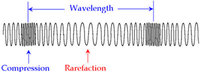
This picture is an example of which type of wave?
transverse wave
longitudinal wave
ocean wave
I do not know and do not wish to answer.
Answer explanation
The picture depicts a longitudinal wave, where the particles of the medium move parallel to the direction of wave propagation. This is characteristic of sound waves, distinguishing it from transverse waves where particle movement is perpendicular.
Tags
NGSS.MS-PS4-1
4.
MULTIPLE CHOICE QUESTION
1 min • 1 pt
These waves need a medium to travel through.
Transverse
Electromagnetic
Mechanical
Light
Answer explanation
Mechanical waves require a medium, such as air or water, to travel through. In contrast, transverse and electromagnetic waves can propagate through a vacuum, making 'Mechanical' the correct choice.
5.
MULTIPLE CHOICE QUESTION
1 min • 1 pt

What type of wave is this?
Transverse wave
Longitudinal wave
Electromagnetic wave
Mechanical wave
Answer explanation
A transverse wave is characterized by particle motion that is perpendicular to the direction of wave propagation. This distinguishes it from longitudinal waves, where particle motion is parallel to the wave direction.
Tags
NGSS.MS-PS4-1
6.
MULTIPLE CHOICE QUESTION
1 min • 1 pt

What type of wave is this?
Mechanical
Electromagnetic
Transverse
Longitudinal
Answer explanation
The correct answer is 'Longitudinal' because longitudinal waves are characterized by particle displacement parallel to the direction of wave propagation, such as sound waves, unlike transverse waves where displacement is perpendicular.
Tags
NGSS.MS-PS4-1
7.
MULTIPLE CHOICE QUESTION
1 min • 1 pt
These waves move in an up and down motion.
Transverse
Longitudinal
Answer explanation
Transverse waves move in an up and down motion, where the particle displacement is perpendicular to the direction of wave propagation. In contrast, longitudinal waves move in a back and forth motion.
Tags
NGSS.MS-PS4-1

Access all questions and much more by creating a free account
Create resources
Host any resource
Get auto-graded reports

Continue with Google

Continue with Email

Continue with Classlink

Continue with Clever
or continue with

Microsoft
%20(1).png)
Apple

Others
Already have an account?



