
Igneous rocks, Earth's Layers, & Continental Drift
Authored by Emily Holodak
Science
9th - 12th Grade
NGSS covered
Used 3+ times


AI Actions
Add similar questions
Adjust reading levels
Convert to real-world scenario
Translate activity
More...
Content View
Student View
15 questions
Show all answers
1.
MULTIPLE CHOICE QUESTION
30 sec • 1 pt
What happens to pressure, density, and temperature as you get closer to Earth's core?
they all increase
they all decrease
only pressure increases
2.
MULTIPLE CHOICE QUESTION
30 sec • 1 pt
What type of data do scientists use to infer characteristics about Earths interior?
volcanic activity
seismic waves
X-rays
3.
MULTIPLE CHOICE QUESTION
30 sec • 1 pt
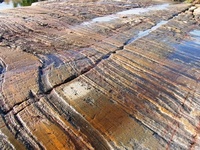
This is a picture of glacier scars found in Africa. What are these evidence for?
Tags
NGSS.MS-ESS2-3
NGSS.MS-ESS2-2
4.
MULTIPLE CHOICE QUESTION
30 sec • 1 pt

According to the continental drift hypothesis, the presence of similar fossils in South America and Africa supports which scientific idea?
Animals easily and frequently travel from Africa to South America.
Species of animals probably traveled between continents on natural rafts (such as trees destroyed in tsunamis).
Land bridges once existed that connected the continents.
South America and Africa were once connected together.
Tags
NGSS.MS-ESS2-3
NGSS.MS-LS4-1
5.
MULTIPLE CHOICE QUESTION
30 sec • 1 pt

The size of crystals in Igneous Rocks depends upon
pressure
the presence of air
the presence of water
cooling rate
Tags
NGSS.MS-PS3-4
6.
MULTIPLE CHOICE QUESTION
30 sec • 1 pt

Rocks that are formed from magma or lava are called
sedimentary
metamorphic
igneous
clastic
7.
MULTIPLE CHOICE QUESTION
30 sec • 1 pt

Extrusive rocks are formed
underwater
in a lab
deep underground
above the surface of a volcano


Access all questions and much more by creating a free account
Create resources
Host any resource
Get auto-graded reports

Continue with Google

Continue with Email

Continue with Classlink

Continue with Clever
or continue with

Microsoft
%20(1).png)
Apple

Others
Already have an account?



