
photochemical smog
Authored by Brooke Crigger
Science
11th - 12th Grade
NGSS covered
Used 23+ times


AI Actions
Add similar questions
Adjust reading levels
Convert to real-world scenario
Translate activity
More...
Content View
Student View
19 questions
Show all answers
1.
MULTIPLE CHOICE QUESTION
30 sec • 1 pt

Which below is considered an air pollutant?
stratospheric ozone
tropospheric ozone
exospheric ozone
mesospheric ozone
thermospheric ozone
Tags
NGSS.HS-ESS3-4
2.
MULTIPLE CHOICE QUESTION
30 sec • 1 pt

78% of the Earth's atmosphere is made up of
H2O
SO2
N2
CO2
Ar
Tags
NGSS.MS-ESS2-5
3.
MULTIPLE CHOICE QUESTION
30 sec • 1 pt
Which below is a source of particulate matter?
burning wood
dust from gravel roads
volcanoes
forest fires
all of these are sources of particulate matter
4.
MULTIPLE CHOICE QUESTION
30 sec • 1 pt

Photochemical smog results from a reaction between
nitrogen, oxygen and sunlight
nitrogen, carbon and sunlight
oxygen, water and lead
sunlight, sulfur and carbon
carbon, hydrogen, and methane
Tags
NGSS.HS-PS1-5
NGSS.HS-ESS3-1
5.
MULTIPLE CHOICE QUESTION
15 mins • 1 pt

Which is NOT a criteria air pollutant?
6.
MULTIPLE CHOICE QUESTION
15 mins • 1 pt

High levels of photochemical smog are due to
I nitrogen dioxide
II sulfur dioxide
III VOC's
Tags
NGSS.HS-PS1-5
7.
MULTIPLE CHOICE QUESTION
15 mins • 1 pt

Thermal inversions
Tags
NGSS.HS-ESS3-4
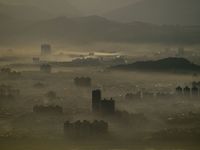
Access all questions and much more by creating a free account
Create resources
Host any resource
Get auto-graded reports

Continue with Google

Continue with Email

Continue with Classlink

Continue with Clever
or continue with

Microsoft
%20(1).png)
Apple

Others
Already have an account?

