
Earth Science: Constructive and Destructive Forces
Authored by Lisa Stokes
Science
5th Grade
NGSS covered
Used 63+ times


AI Actions
Add similar questions
Adjust reading levels
Convert to real-world scenario
Translate activity
More...
Content View
Student View
23 questions
Show all answers
1.
MULTIPLE CHOICE QUESTION
30 sec • 1 pt
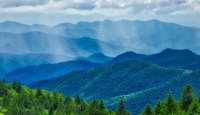
What type of process most likely created the mountain chain seen here?
Volcanic eruptions created the mountains over millions of years.
Tectonic plates pushed together forcing one plate under the other and then pushing the land upward.
Earthquakes broke the earth into pieces and parts of it fell into cracks between faults.
A river flowed through the land and created the valleys between the mountains making them appear taller.
Tags
NGSS.MS-ESS2-2
2.
MULTIPLE CHOICE QUESTION
30 sec • 1 pt

A seismograph tells us what information about an earthquake?
How deep within the earth the earthquake occurred.
How far a tsunami will travel
How much damage the earthquake caused
How strong the earthquake is
Tags
NGSS.MS-ESS3-2
3.
MULTIPLE CHOICE QUESTION
30 sec • 1 pt

What are the primary purposes for the use of dams?
To prevent droughts and reverse the flow of a river.
To keep unwanted marine organisms from moving down stream.
To control floodwaters and store water for people to use.
To make lakes so that people have a place to go fish.
Tags
NGSS.MS-ETS1-1
NGSS.MS-ESS2-4
4.
MULTIPLE CHOICE QUESTION
30 sec • 1 pt
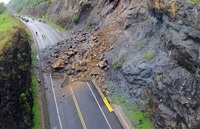
The picture here shows a landslide. What can you infer from the picture?
Landslides are a destructive process that break apart the surface of the earth.
Landslides are a constructive process that build new mountains and dams on the surface of the earth.
Landslides are caused by volcanic eruptions,
Landslides are helpful to road crews.
Tags
NGSS.MS-ESS2-2
NGSS.MS-ESS3-2
5.
MULTIPLE CHOICE QUESTION
30 sec • 1 pt
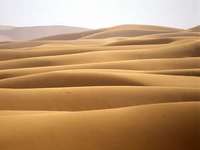
Sand dunes can be viewed in the picture. What is the best way to simulate the formation of sand dunes?
Use a hair dryer to blow sand into piles showing how wind can deposit sand in new locations.
Use ice to move sand from one place to another the way that a glacier would on the earth's surface.
Use water and sand to show how water can move sand from one place to another through the process of erosion.
Use sand and a shaky table to show how earthquakes can move parts of the earths surface.
Tags
NGSS.MS-ESS2-2
NGSS.MS-ESS2-1
6.
MULTIPLE CHOICE QUESTION
30 sec • 1 pt
How can plants cause the weathering of rocks?
roots can grow into or near rocks causing the rocks to break down over a period of time.
plants can chemically break down rocks using photosynthesis
plant roots can use the rocks as a source of nutrients and break them down over time
plants can release water vapor into the air that causes the rocks to break down over time.
Tags
NGSS.4-ESS2-1
7.
MULTIPLE CHOICE QUESTION
30 sec • 1 pt
What is something that humans can do to control water in areas that regularly experience floods?
Dig wells to hold excess water.
allow erosion to occur in order to make larger deltas
build and use storm drains to move water to other areas.
use a seismograph to see how much water is coming so that we can prepare for it's arrival.
Tags
NGSS.MS-ETS1-1
NGSS.MS-ETS1-2
Access all questions and much more by creating a free account
Create resources
Host any resource
Get auto-graded reports

Continue with Google

Continue with Email

Continue with Classlink

Continue with Clever
or continue with

Microsoft
%20(1).png)
Apple

Others
Already have an account?

