
Fossils /Grade 3
Authored by Amani almugrbi
Science
3rd Grade
NGSS covered
Used 1K+ times


AI Actions
Add similar questions
Adjust reading levels
Convert to real-world scenario
Translate activity
More...
About
This quiz focuses on fossils and paleontology, covering fundamental concepts appropriate for Grade 3 elementary science students. The questions assess students' understanding of fossil formation processes, fossil types including trace fossils and amber preservation, and the distinction between organisms and their fossilized remains. Students need to grasp the sequential nature of fossilization, starting with organism death and progressing through sediment burial to mineral replacement. The quiz evaluates comprehension of key vocabulary terms such as organism, extinct species, paleontologists, and the difference between body fossils and trace fossils like footprints. Students must also understand relative dating principles through rock layer analysis, recognizing that deeper layers represent older time periods, and identify the types of organic materials most likely to fossilize, particularly hard parts like bones, teeth, and shells. Created by Amani almugrbi, a Science teacher in AE who teaches grade 3. This assessment serves as an excellent tool for measuring student comprehension after a unit on fossils and Earth's history. Teachers can deploy this quiz as a formative assessment to gauge understanding before moving to more complex geological concepts, or use it as a summative evaluation following hands-on fossil activities and paleontology lessons. The varied question formats, including sequencing, vocabulary matching, and visual interpretation, make it suitable for review sessions, homework assignments, or warm-up activities that reinforce prior learning. The quiz effectively addresses Next Generation Science Standards 2-LS4-1, which focuses on using information from several sources to provide evidence that Earth events can occur quickly or slowly, and supports foundational understanding for future study of geological time scales and evolutionary processes.
Content View
Student View
16 questions
Show all answers
1.
MULTIPLE CHOICE QUESTION
20 sec • 1 pt
In order for a fossil to form, which of the following events must happen FIRST?
Tags
NGSS.MS-LS4-1
2.
MULTIPLE CHOICE QUESTION
20 sec • 1 pt

_____ is any living thing, plant or animal, even you!
Tags
NGSS.MS-LS1-1
3.
MULTIPLE CHOICE QUESTION
5 mins • 1 pt
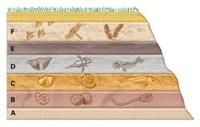
Which rock layer in the diagram is the oldest?
F
E
B
A
Tags
NGSS.MS-ESS1-4
4.
MULTIPLE CHOICE QUESTION
30 sec • 1 pt
A fossilized dinosaur footprint is a __________.
cast
amber
trace fossil
Tags
NGSS.3-LS4-1
NGSS.4-ESS1-1
5.
MULTIPLE CHOICE QUESTION
30 sec • 1 pt
What word do we use to describe a species which has no members still living?
Tags
NGSS.MS-LS4-1
6.
MULTIPLE CHOICE QUESTION
30 sec • 1 pt
an organism no longer found on Earth
Tags
NGSS.MS-LS4-1
7.
MULTIPLE CHOICE QUESTION
30 sec • 1 pt
the remains or traces of an organism that lived long ago
Tags
NGSS.MS-LS4-1
NGSS.MS-LS4-2
Access all questions and much more by creating a free account
Create resources
Host any resource
Get auto-graded reports

Continue with Google

Continue with Email

Continue with Classlink

Continue with Clever
or continue with

Microsoft
%20(1).png)
Apple

Others
Already have an account?
Similar Resources on Wayground

15 questions
Fossils

Quiz
•
3rd - 8th Grade
15 questions
Rocks and Minerals (Grade 3)
Quiz
•
3rd Grade
14 questions
Grade 3 Science Baseline
Quiz
•
3rd Grade
20 questions
Formation of Soil and Resources
Quiz
•
3rd Grade
19 questions
Food chains in Habitats
Quiz
•
2nd - 3rd Grade
12 questions
Fossils and Rock layers
Quiz
•
3rd - 5th Grade
16 questions
Ecosystems & Food Chains
Quiz
•
3rd - 5th Grade
20 questions
Grade 3 Assessment
Quiz
•
3rd Grade
Popular Resources on Wayground
7 questions
History of Valentine's Day

Interactive video
•
4th Grade
15 questions
Fractions on a Number Line
Quiz
•
3rd Grade
20 questions
Equivalent Fractions
Quiz
•
3rd Grade
25 questions
Multiplication Facts
Quiz
•
5th Grade
22 questions
fractions
Quiz
•
3rd Grade
15 questions
Valentine's Day Trivia
Quiz
•
3rd Grade
20 questions
Main Idea and Details
Quiz
•
5th Grade
20 questions
Context Clues
Quiz
•
6th Grade
Discover more resources for Science
15 questions
Earthly Ecosystems Unit Review
Quiz
•
3rd Grade
28 questions
4th Grade The Need for Speed
Quiz
•
3rd - 5th Grade
11 questions
Unit 7 Science Review: Our Solar System
Quiz
•
3rd Grade
10 questions
Identifying Physical and Chemical Changes
Interactive video
•
1st - 5th Grade
10 questions
Exploring the 11 Human Body Systems
Interactive video
•
1st - 5th Grade
20 questions
Week 19 and 20 Practice Review
Quiz
•
3rd Grade
12 questions
Ecosystems
Quiz
•
3rd - 5th Grade
11 questions
Forms of Energy and Light Interaction
Quiz
•
3rd Grade