
Unit 5 - Collisions - AP Physics
Authored by Barby Coulter
Science, Physics, Other
11th Grade
NGSS covered
Used 10+ times


AI Actions
Add similar questions
Adjust reading levels
Convert to real-world scenario
Translate activity
More...
Content View
Student View
17 questions
Show all answers
1.
MULTIPLE CHOICE QUESTION
30 sec • 1 pt
In order to determine motion of two objects after they collide you must know
the motion before they collide.
know which direction they are moving.
that they are at rest
their mass only.
2.
MULTIPLE CHOICE QUESTION
30 sec • 1 pt
Mechanical energy is conserved only when objects
stick together.
bounce off each other.
start from rest.
are moving very fast right before the collision.
3.
MULTIPLE CHOICE QUESTION
30 sec • 1 pt
Momentum is conserved
always.
in elastic collisions.
in inelastic collisions.
any of these will work.
4.
MULTIPLE CHOICE QUESTION
30 sec • 1 pt
Consider 2 cars moving at different speeds and then they collide. We do not know if they stick together or bounce off each other. What can we determine about the speed of the 2 car system after the collision?
The speed of the system remains the same.
The speed slows down if they stick together and speeds up if they bounce off.
The speed slows down if they bounce off each other and speeds up if the stick together.
Mechanical energy stays the same.
5.
MULTIPLE CHOICE QUESTION
30 sec • 1 pt

A force acted upon an object for 3 s as shown in the graph below.
What is the magnitude of the impulse on the object?
6.
MULTIPLE CHOICE QUESTION
30 sec • 1 pt
A 10kg toy truck moves at 5m/s East. It collides and bounces off of a 5kg toy car moving 10 m/s moving west. Which equation would you use to solve for the final velocity of the car?
Tags
NGSS.HS-PS2-2
7.
MULTIPLE CHOICE QUESTION
2 mins • 1 pt
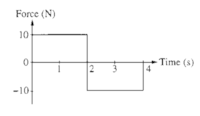
The graph shows the force on an object of mass M as a function of time. For the time interval 0 to 4 s, the total change in the momentum of the object is
Tags
NGSS.HS-PS2-1
Access all questions and much more by creating a free account
Create resources
Host any resource
Get auto-graded reports

Continue with Google

Continue with Email

Continue with Classlink

Continue with Clever
or continue with

Microsoft
%20(1).png)
Apple

Others
Already have an account?
Similar Resources on Wayground

15 questions
Your Family

Quiz
•
9th - 12th Grade
17 questions
Fundamental Rights Bharat #12
Quiz
•
7th - 12th Grade
15 questions
Icebreaker - Geological & Hydrometeorological Hazards Quiz
Quiz
•
11th - 12th Grade
15 questions
What I Know (Pretest)
Quiz
•
11th Grade
15 questions
The UN
Quiz
•
11th - 12th Grade
15 questions
21st Century Literature (Midterms Reviewer)
Quiz
•
11th Grade
21 questions
Photo Composition
Quiz
•
10th - 12th Grade
20 questions
Warm and Cold Fronts
Quiz
•
6th - 12th Grade
Popular Resources on Wayground
15 questions
Fractions on a Number Line
Quiz
•
3rd Grade
10 questions
Probability Practice
Quiz
•
4th Grade
15 questions
Probability on Number LIne
Quiz
•
4th Grade
20 questions
Equivalent Fractions
Quiz
•
3rd Grade
25 questions
Multiplication Facts
Quiz
•
5th Grade
22 questions
fractions
Quiz
•
3rd Grade
6 questions
Appropriate Chromebook Usage

Lesson
•
7th Grade
10 questions
Greek Bases tele and phon
Quiz
•
6th - 8th Grade
Discover more resources for Science
14 questions
Natural Selection and Adaptation
Lesson
•
9th - 12th Grade
30 questions
Unit 2C Progress Check (Biosphere 3)
Quiz
•
9th - 12th Grade
15 questions
Punnett Square & Pedigree Charts- Review
Quiz
•
9th - 12th Grade
12 questions
Cellular Respiration

Interactive video
•
11th Grade
10 questions
ACT Science #1
Quiz
•
11th Grade
28 questions
Asexual vs. Sexual Reproduction
Quiz
•
9th - 12th Grade
12 questions
Homeostasis: Positive and Negative Feedback Loops
Interactive video
•
11th Grade
25 questions
Heredity and Punnett Squares
Quiz
•
9th - 12th Grade