
Metabolism & Enzymes

Metabolism & Enzymes

10th - 12th Grade

20 Qs

quiz-placeholder

Similar activities

Rate of transpiration

Rate of transpiration

9th - 12th Grade

15 Qs

THE CIRCULATORY SYSTEM & THE HEART

THE CIRCULATORY SYSTEM & THE HEART

10th - 11th Grade

19 Qs

Cell: Structure and Function

Cell: Structure and Function

11th Grade

20 Qs

QUARTER 3_RECITATION

QUARTER 3_RECITATION

10th Grade

20 Qs

Food webs and energy flows

Food webs and energy flows

9th - 10th Grade

20 Qs

Coordination in life processes

Coordination in life processes

10th Grade

20 Qs

Rep, Transcription, Translation

Rep, Transcription, Translation

10th - 12th Grade

20 Qs

CH 30 DIGESTION

CH 30 DIGESTION

9th - 10th Grade

25 Qs

Metabolism & Enzymes

Metabolism & Enzymes

Assessment

Quiz

Biology

10th - 12th Grade

Practice Problem

Easy

NGSS
MS-LS1-7, HS-PS1-5, MS-PS1-2

Standards-aligned

Created by

koh hohoho

Used 2K+ times

FREE Resource

AI

Enhance your content in a minute

Add similar questions
Adjust reading levels
Convert to real-world scenario
Translate activity
More...

20 questions

Show all answers

1.

MULTIPLE CHOICE QUESTION

1 min • 1 pt
What is a substance called if it speeds up a chemical reaction?

reusable
catalyst
specific
fragile

2.

MULTIPLE CHOICE QUESTION

1 min • 1 pt

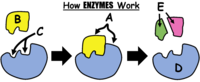
Media Image

In the diagram, what is letter A? 

product
substrate
enzyme-substrate complex
active site

3.

MULTIPLE CHOICE QUESTION

1 min • 1 pt

Enzymes are...

nucleic acids
proteins
lipids
carbohydrates

Tags

NGSS.MS-LS1-7

4.

MULTIPLE CHOICE QUESTION

2 mins • 1 pt

What is the function of an enzyme?

enzymes break themselves into small pieces
enzymes slow down chemical reactions
enzymes speed up chemical reactions
enzymes combine products to form reactants 

Tags

NGSS.MS-PS1-2

5.

MULTIPLE CHOICE QUESTION

1 min • 1 pt

With what 3 letters do enzymes typically end?

-ose
-ase
-ese
-tic

Tags

NGSS.MS-LS1-7

6.

MULTIPLE CHOICE QUESTION

1 min • 1 pt

Where do substrates bind on an enzyme?

voltage-gated channels
surface receptor
calcium channels
active site

7.

MULTIPLE CHOICE QUESTION

2 mins • 1 pt

The "lock and key hypothesis" attempts to explain the mechanism of?

Vacuole formation
Pinocytosis
Sharing of electrons
Enzyme specificity 

Create a free account and access millions of resources

Create resources

Host any resource

Get auto-graded reports

Google

Continue with Google

Email

Continue with Email

Classlink

Continue with Classlink

Clever

Continue with Clever

or continue with

Microsoft

Microsoft

Apple

Apple

Others

Others

Already have an account?




