Search Header Logo
  1. Resource Library
  2. Science
  3. Physics
  4. Kinetic Energy
  5. Temperature & Kinetic Energy
Temperature & Kinetic Energy

Temperature & Kinetic Energy

Assessment

Presentation

Science

6th - 8th Grade

Practice Problem

Medium

NGSS
MS-PS1-4, MS-PS3-4, MS-PS3-3

+2

Standards-aligned

Created by

Amanda Taylor

Used 9+ times

FREE Resource

15 Slides • 16 Questions

1

Multiple Choice

Question image

Which explanation best describes what happens to the metal ball from step 1 to step 3 in the demonstration?

1

The particles in the ball gained kinetic energy when the temperature increased, and this caused them to spread out and increase the size of the ball.

2

The particles in the ball gained kinetic energy when the temperature increased, and this caused each particle to increase in size, so the ball expanded.

3

The particles in the ball lost kinetic energy to the air when the temperature increased, which caused the particles to spread out and make the ball larger.

4

The heat added particles to the ball, which made the ball increase in size.

2

media

3

Open Ended

How does the concept of thermal expansion help us understand changes in everyday objects when they are heated or cooled?

4

media

5

media

6

media

7

Fill in the Blank

The temperature at which all molecular motion stops is called ___.

8

Multiple Choice

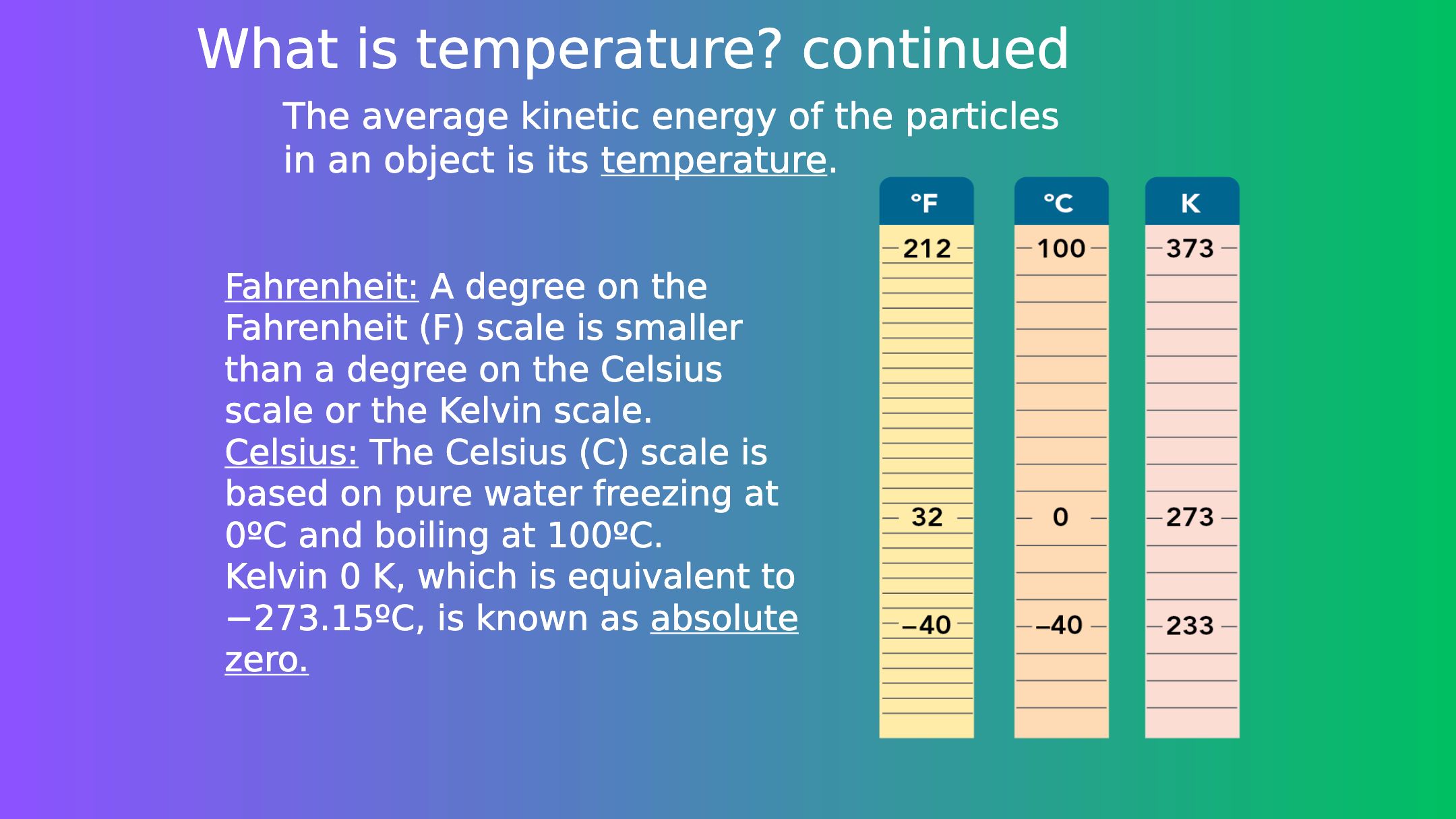
Which of the following best describes temperature?

1

The total energy of all particles in an object

2

The average kinetic energy of the particles in an object

3

The amount of heat required to raise the temperature of an object

4

The speed at which particles move in a solid

9

Open Ended

Question image

How does temperature relate to the movement of particles in a substance?

10

media

11

Labelling

Drag to the correct spot

Drag labels to their correct position on the image

32°

98.6°

68°

20°

37°

12

media

13

media

14

Fill in the Blank

Fill in the blank: The kinetic energy of the particles in warmer objects is ___ than that of the particles in cooler objects.

15

Multiple Choice

Which of the following best describes thermal energy?

1

The total kinetic energy of the particles in an object or system.

2

The amount of heat required to raise the temperature of an object.

3

The potential energy stored in chemical bonds.

4

The force that holds particles together in a solid.

16

media

17

Open Ended

How is thermal energy different from temperature?

18

Labelling

Type question here including an ​ ​

Drag labels to their correct position on the image

Greater average KE

Both greater

Greater TE

Greater TE

Greater  average KE

19

media

20

Multiple Select

Which of the following are true about the relationship between mass, temperature, and thermal energy?

1

An object with more mass at the same temperature has more thermal energy.

2

An object with higher temperature but less mass can have less thermal energy than a cooler, larger object.

3

Thermal energy depends on both the temperature and the amount of matter in an object.

4

Temperature alone determines the thermal energy of an object.

21

media

22

Open Ended

When comparing two systems, what does it mean if both have greater thermal energy and greater average kinetic energy?

23

media

24

Multiple Choice

Which of the following statements about thermal expansion is correct?

1

When an object gets warmer, its particles move faster and spread out, causing the object to expand.

2

When an object gets colder, its particles move faster and spread out, causing the object to expand.

3

When an object gets warmer, its particles slow down and get closer together, causing the object to contract.

4

Thermal expansion only occurs in liquids.

25

Open Ended

Question image

What happens to the particles of a material when it’s heated?

26

Dropdown

Question image
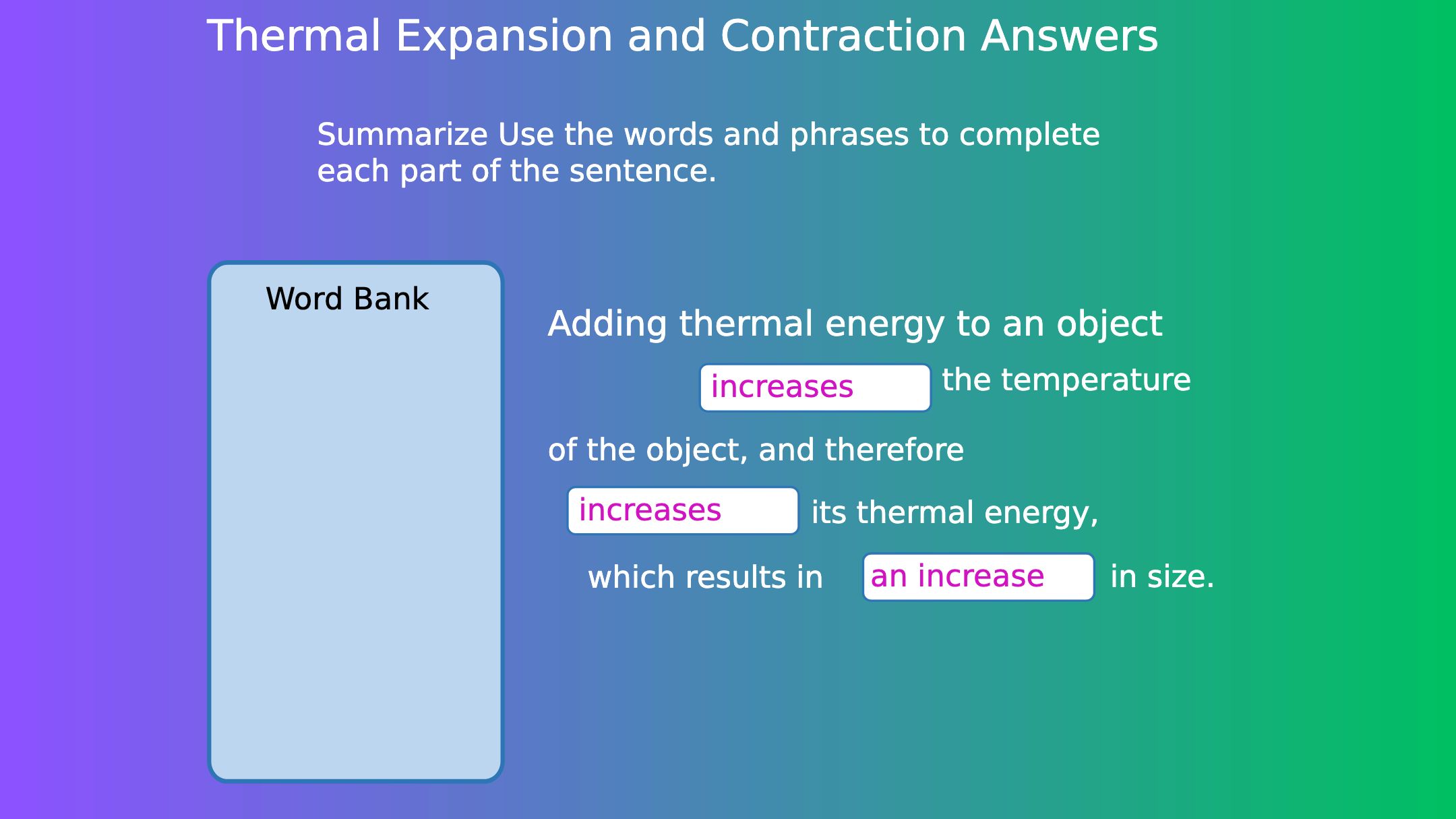
Adding thermal energy to an object

the temperature of the object and therefore​
its thermal energy, which results in ​
in size.

27

media

28

media

29

media

30

Open Ended

Reflecting on today’s lesson about temperature, kinetic energy, and thermal expansion, what is one question you still have or something you would like to know more about?

31

☕ Closure – Tuesday, Oct. 21

CO: I will explain how temperature affects the motion and spacing of particles and describe how heat causes materials to expand.
LO: I will discuss how adding or removing heat energy changes particle motion and temperature using science vocabulary.

“Today I learned that when heat is added, particles ________, and when heat is removed, particles ________.”

Question image

Which explanation best describes what happens to the metal ball from step 1 to step 3 in the demonstration?

1

The particles in the ball gained kinetic energy when the temperature increased, and this caused them to spread out and increase the size of the ball.

2

The particles in the ball gained kinetic energy when the temperature increased, and this caused each particle to increase in size, so the ball expanded.

3

The particles in the ball lost kinetic energy to the air when the temperature increased, which caused the particles to spread out and make the ball larger.

4

The heat added particles to the ball, which made the ball increase in size.

Show answer

Auto Play

Slide 1 / 31

MULTIPLE CHOICE