

The First Continental Congress (1774): A Turning Point in Colonial America

Presentation
•
Social Studies
•
6th - 8th Grade
•
Practice Problem
•
Medium

Cathy L Davis-Jaeger
Used 8+ times
FREE Resource
19 Slides • 20 Questions
1

2
Multiple Choice
Why was the First Continental Congress in 1774 considered a turning point in colonial America?
Because it marked the first time the colonies acted together against British rule
Because it was the first time taxes were imposed on the colonies
Because it resulted in immediate independence from Britain
Because it was the first time colonial leaders met in Philadelphia
3

4
Open Ended
How did the Boston Tea Party influence the relationship between the American colonies and Britain?
5

6
Multiple Choice
Which of the following was NOT a reason British lawmakers enacted the Intolerable Acts against Massachusetts?
To punish Massachusetts for the Tea Party
To force Massachusetts back into line through severe penalties
To reward Massachusetts for loyalty
To set an example for other colonies
7
8
Multiple Choice
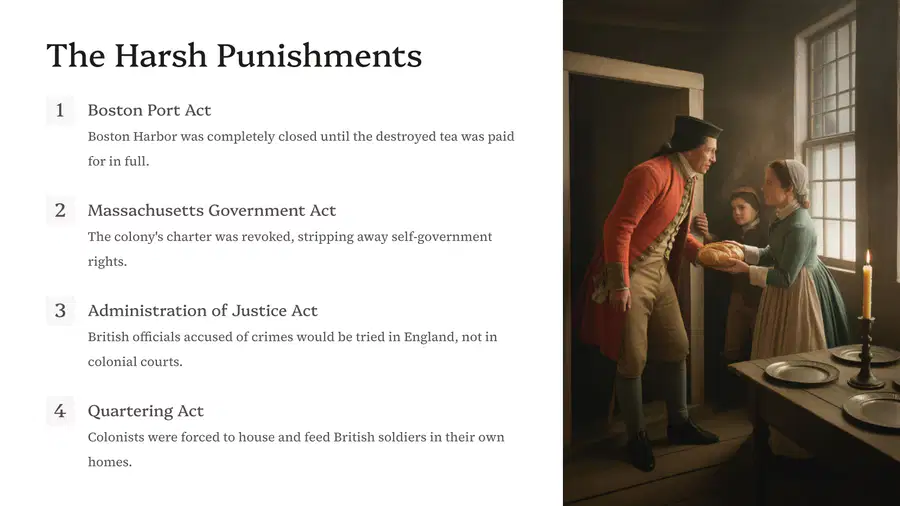
Which of the following acts closed Boston Harbor until the destroyed tea was paid for in full?
Quartering Act
Boston Port Act
Massachusetts Government Act
Administration of Justice Act
9
10
Multiple Select
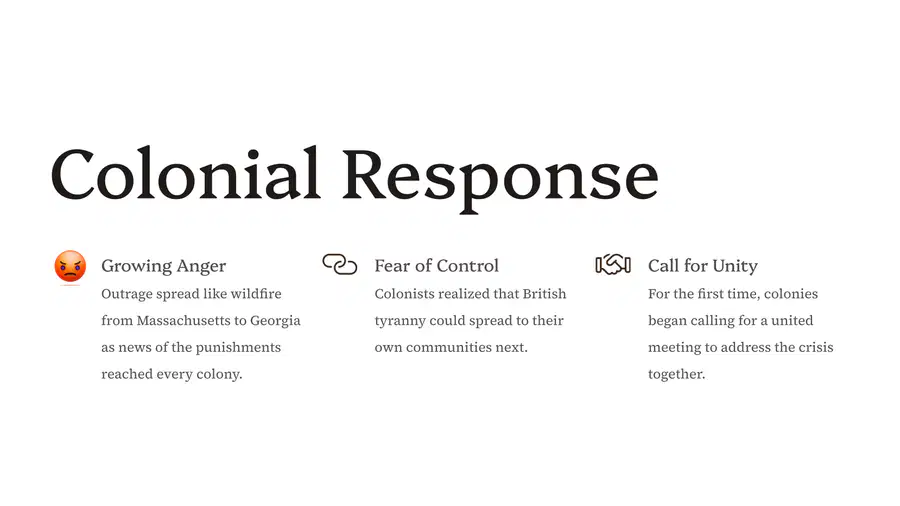
Which of the following were direct responses by the colonies to the Intolerable Acts?
Growing anger among colonists
Fear that British control could spread
Immediate surrender to British demands
Call for unity among the colonies
11

12
Fill in the Blanks
13
14
Multiple Choice
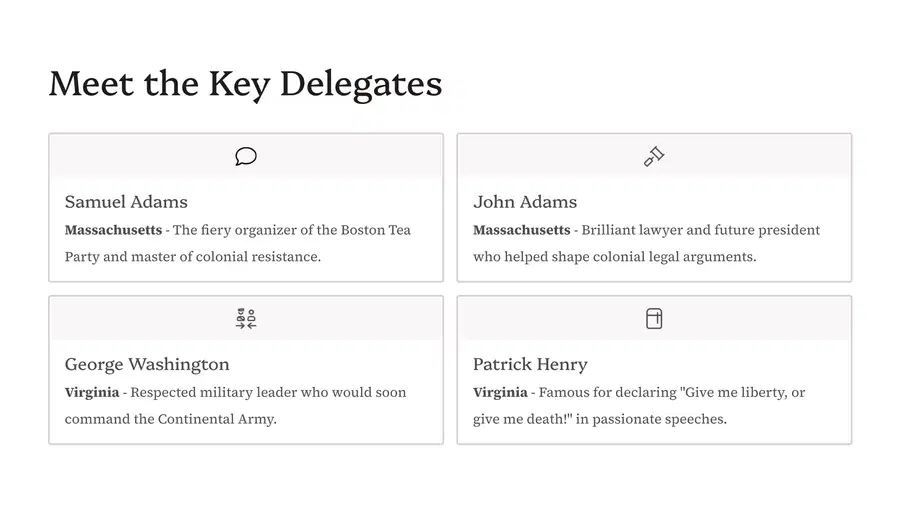
Who was the fiery organizer of the Boston Tea Party and a master of colonial resistance?
John Adams
George Washington
Samuel Adams
Patrick Henry
15
16
17
Multiple Choice
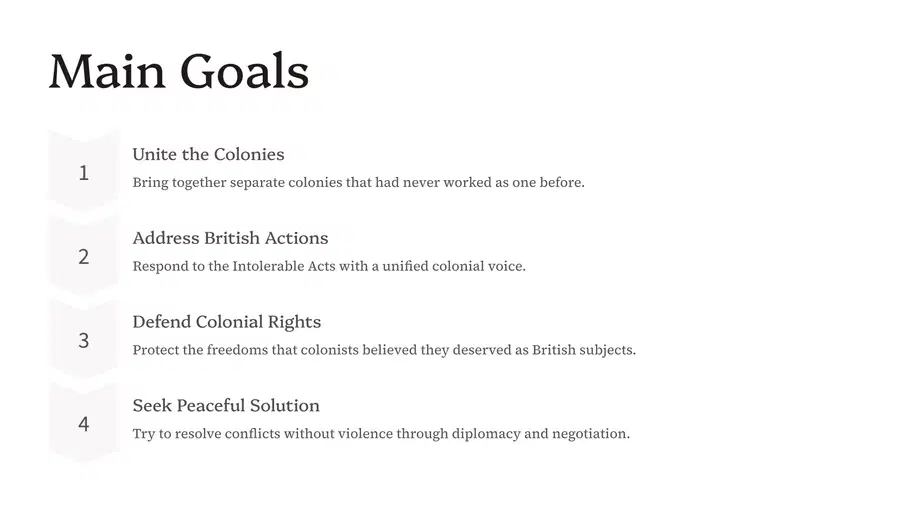
Which of the following was NOT one of the main goals of the colonies as listed in the image?
Unite the Colonies
Defend Colonial Rights
Expand British Territory
Seek Peaceful Solution
18
19
Multiple Choice
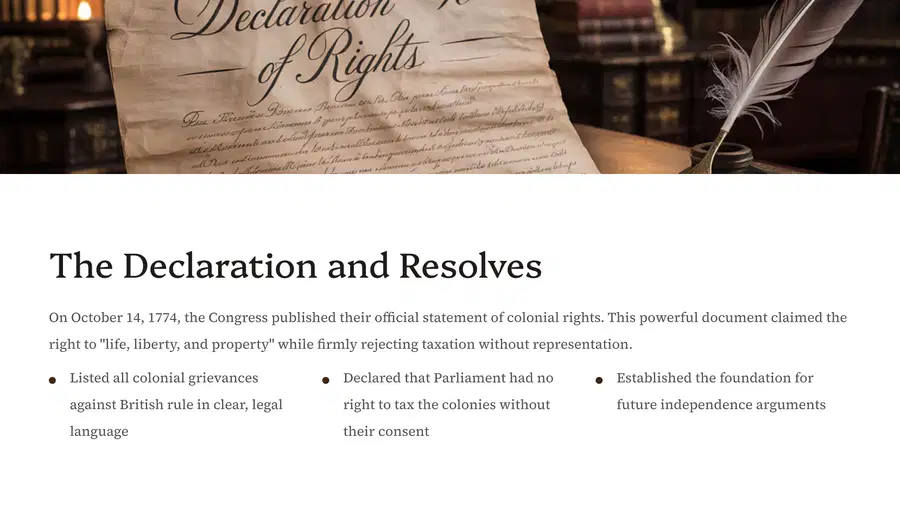
Which of the following rights was claimed in the Declaration and Resolves?
The right to trial by British courts
The right to self-government through colonial assemblies
The right to free trade with Britain only
The right to have British soldiers in peacetime
20

21
Multiple Select
Which rights did the colonists claim in their official statements? Select all that apply.
Self-Government
Fair Trials
Freedom of Religion
No Standing Armies
22
23
Fill in the Blanks
24

25
Open Ended
What were the key components included in the petition to King George III, and why were they important for the colonial cause?
26
27
Multiple Choice
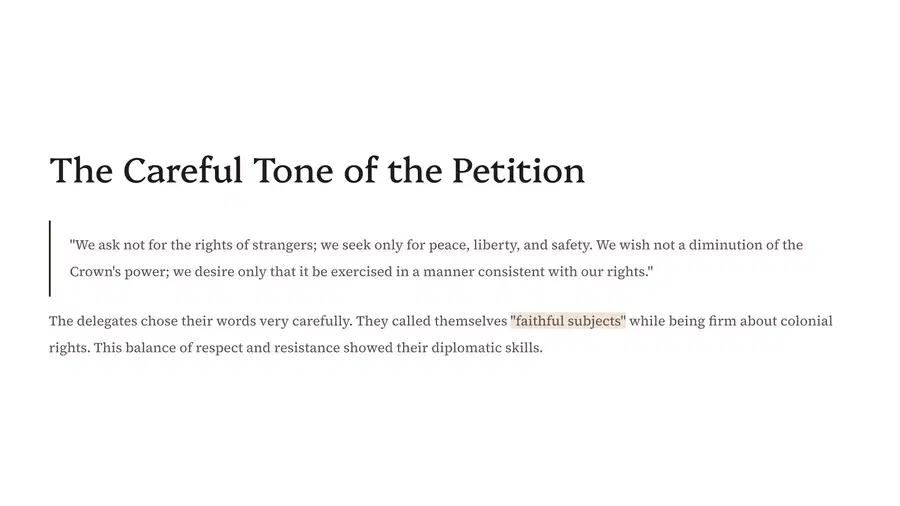
Why was the Petition to King George III carefully worded?
Colonists wanted to overthrow the king
Colonists wanted to show loyalty while demanding rights
Colonists were afraid of angering France
Colonists hoped to avoid paying taxes forever
28
29
Multiple Select
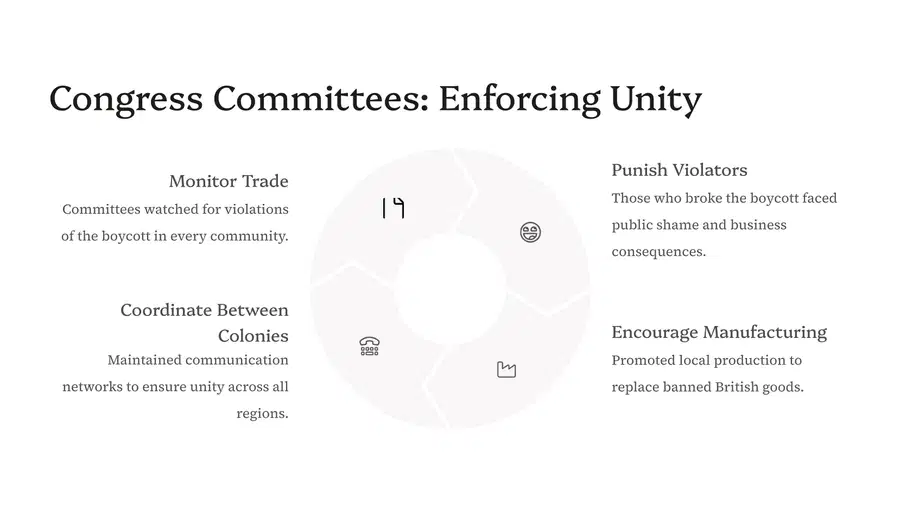
Which actions taken by the Congress Committees helped maintain unity among the colonies?
Coordinating communication between colonies
Encouraging local manufacturing
Punishing violators of the boycott
Increasing British military presence
30
Multiple Choice
Which of the following was NOT a role of the Congress Committees in enforcing unity among the colonies?
Monitor trade for boycott violations
Punish violators with public shame
Encourage local manufacturing
Negotiate peace with Britain
31
32
Fill in the Blanks
Type answer...
33
34
Multiple Choice
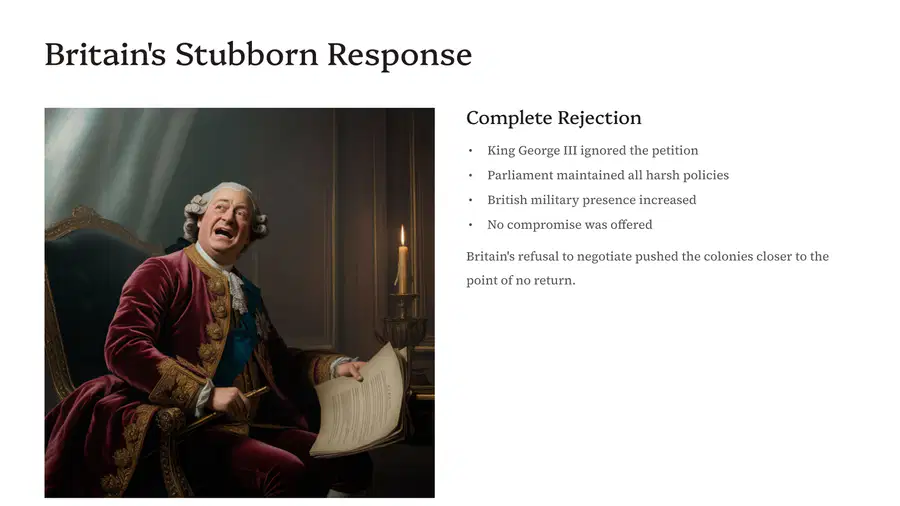
What was Britain's response to the colonial petition?
Accepted the petition and negotiated
Ignored the petition and maintained harsh policies
Reduced military presence in the colonies
Offered a compromise
35
36
37
Open Ended
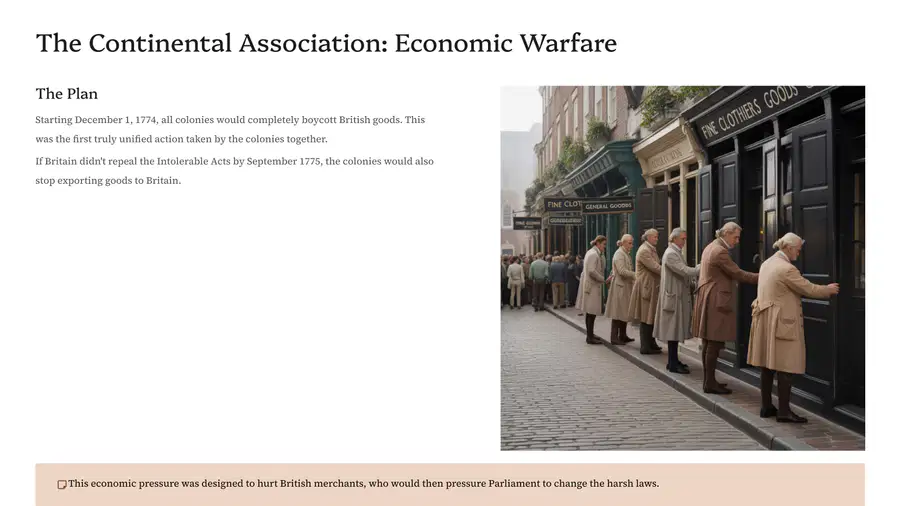
Why was the Continental Association significant? Analyze the impact of their economic boycott strategy on both Britain and the colonies.
38
Multiple Choice
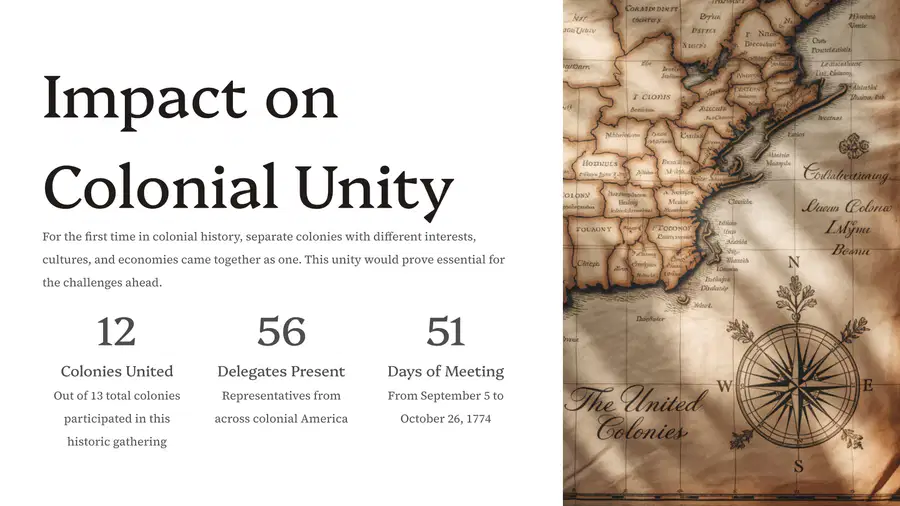
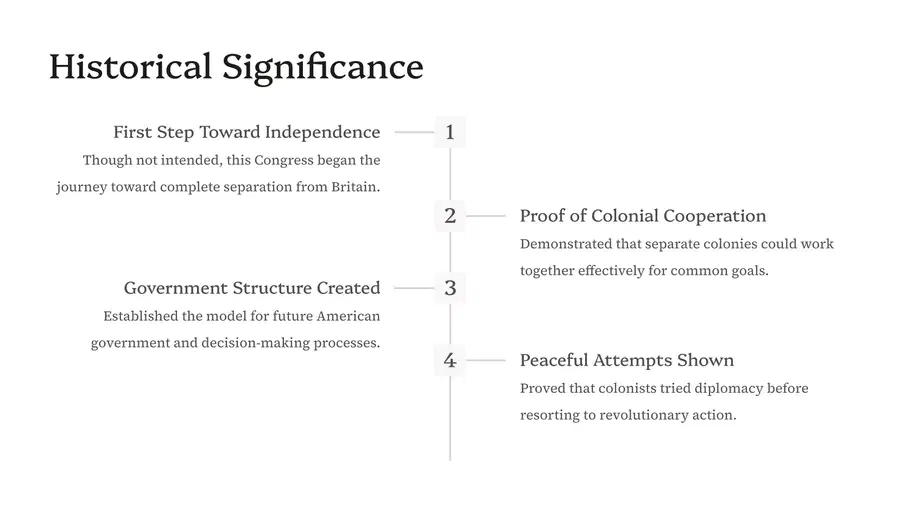
Which of the following BEST explains why the First Continental Congress was a turning point?
It created the U.S. Constitution
It marked the colonies’ first united action against Britain
It ended the Revolutionary Wa
It forced Britain to repeal the Intolerable Acts
39
Multiple Choice
How did the First Continental Congress in 1774 change the course of American history?
It united the thirteen colonies against British rule.
It led to the immediate declaration of independence.
It resulted in the end of British taxation.
It caused the colonies to return to British control.
Show answer
Auto Play
Slide 1 / 39
SLIDE
Similar Resources on Wayground

30 questions
End of the Civil War
Presentation
•
6th - 8th Grade
35 questions
Q2. Assessment 1 Practice: Quiz
Presentation
•
KG
36 questions
Civil Rights Movement
Presentation
•
7th Grade
30 questions
"Over the Top" Realities of WWI
Presentation
•
6th - 8th Grade
34 questions
1.D5 Citizenship Quizziz Slides
Presentation
•
6th - 8th Grade
34 questions
8.9 Presidential Reconstruction
Presentation
•
6th - 8th Grade
34 questions
australia
Presentation
•
7th Grade
36 questions
How a Bill Becomes a Law
Presentation
•
5th - 8th Grade
Popular Resources on Wayground
25 questions
The Ultimate College Knowledge Quiz

Quiz
•
8th Grade
20 questions
Math Review
Quiz
•
3rd Grade
15 questions
Fast food
Quiz
•
7th Grade
20 questions
Math Review
Quiz
•
6th Grade
20 questions
Context Clues
Quiz
•
6th Grade
20 questions
Inferences
Quiz
•
4th Grade
19 questions
Classifying Quadrilaterals
Quiz
•
3rd Grade
20 questions
Figurative Language Review
Quiz
•
6th Grade
Discover more resources for Social Studies
20 questions
The United States 2000s
Quiz
•
6th - 8th Grade
26 questions
Ancient ROME CSA Review
Quiz
•
6th Grade
25 questions
Media and Problem-Solving Quiz
Quiz
•
7th Grade
28 questions
Ancient Rome
Quiz
•
6th Grade
10 questions
Exploring the Three Branches of Government and Checks and Balances

Interactive video
•
6th - 10th Grade
27 questions
Lesson 33 & 34: Rise of the Roman Republic and The Roman Empire
Quiz
•
6th Grade
10 questions
Exploring the Age of Exploration: Key Events and Figures
Interactive video
•
6th - 10th Grade
50 questions
US Capitals - All 50 States
Quiz
•
7th Grade