Search Header Logo
  1. Resource Library
  2. Science
  3. Physics
  4. Fission And Fusion
  5. Nuclear Fission & Fusion
Nuclear Fission & Fusion

Nuclear Fission & Fusion

Assessment

Presentation

Science

9th - 12th Grade

Medium

NGSS
HS-PS1-8, HS-ESS1-1, MS-PS1-1

+1

Standards-aligned

Created by

Allison Boggess

Used 2+ times

FREE Resource

15 Slides • 29 Questions

1

Nuclear Fission & Fusion

Unit 4: Nuclear Theory

2

Isotope Recap

  • Isotopes are elements with the same number of protons and different numbers of neutrons

  • Different numbers of neutrons means different mass

  • Mass = Protons + Neutrons

  • Isotopes are named for their different mass number

  • Ex. Carbon-12 has a mass of 12 and Carbon-13 has a mass of 13

3

Multiple Choice

Isotopes are atoms of the same element with different ____________.

1

Number of Neutrons & Mass Number

2

Number of Protons & Atomic Number

3

Number of Protons, Neutrons, and Electrons

4

Number of Electrons & Mass Number

4

Multiple Choice

Question image

What is the ATOMIC MASS of the isotope Carbon-14?

1

14

2

6

3

12

4

20

5

Multiple Choice

Question image

Carbon-14 has ____ protons, ____ electrons, and _____ neutrons.

1

6, 6, 8

2

6, 6, 6

3

6, 6, 14

4

6, 10, 14

6

Multiple Choice

Isotopes of the same element have the same number of ________ but a different number of _______.

1

protons, neutrons

2

neutrons, protons

3

protons, electrons

4

electrons, neutrons

7

Multiple Choice

Question image

By studying the picture, you can determine that Carbon-13 has ____ protons.

1

6

2

13

3

12

4

14

8

Multiple Choice

Question image

Using the picture, you can determine that Carbon-13 has ____ neutrons.

1

13

2

6

3

12

4

7

9

media

A radioactive isotope:

• Has an unstable nucleus

• Spontaneously emits a particle and

decays into another element (to become
more stable)

10

Unstable Nuclei = Radiation

  • Atoms with more than 84 protons are unstable

  • Radioactivity is the emission of particles/energy from the nucleus

  • The nucleus is too big

  • This gradually makes more stable isotopes

media

11

media
media

When are nuclei unstable? (naturally radioactive)

a.

Large nuclei (Z (atomic mass) > 82) – electrical forces of repulsion are greater than strong forces of attraction

b.

Wrong neutron : proton ratio

12

media
media

When are nuclei unstable?

Bigger atoms require more neutrons per

proton to keep the atom stable

13

Multiple Select

What are two reasons that a nucleus might be unstable?

1

Too many electrons

2

Too large - mass greater than 82

3

Ratio of protons and neutrons not correct

4

Too few protons

14

Multiple Select

Which of these atoms is most likely to undergo some form of radiation? (you can choose more than 1)

1

Uranium

2

Oxygen

3

Plutonium

4

Calcium

5

Platinum

15

16

media

17

media
media

18

media

19

media

20

Multiple Choice

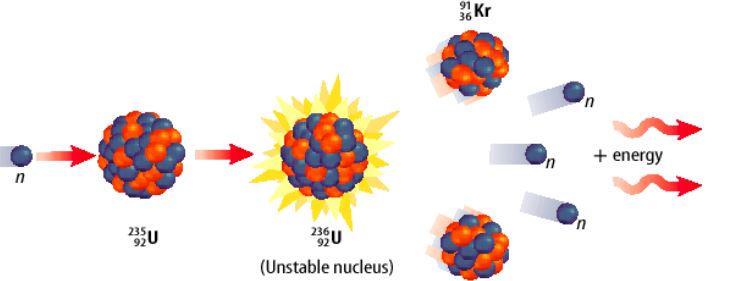
Breaking up the nucleus of an atom is called _________?

1

Fusion

2

Nuclear Reaction

3

Fission

4

Particle Accelerator

21

Multiple Choice

Fission is --

1

fusing together

2

division

22

Multiple Select

Which of the following correctly display nuclear fission?

1
2
3
4
5

23

Multiple Choice

What is a chain reaction?
1
When electrons travel are emitted causing electricity
2
When a nuclear fission reaction occurs, the protons emitted can strike other nuclei in the sample, and cause them to split
3
When a nuclear fission reaction occurs, the neutrons emitted can strike other nuclei in the sample, and cause them to split
4
When a nuclear fission reaction occurs, the electrons emitted can strike other nuclei in the sample, and cause them to split

24

media

25

The Sun

  • a massive ball of plasma.  

  • It is constantly burning so hot that hydrogen is fused together to form helium.

  • This happens at such a rate that a huge amount of energy is released.

media

26

Multiple Choice

The process of combining the nuclei of atoms to make different atoms is called _________?

1

Fission

2

Nuclear Reaction

3

Fusion

4

Particle Accelerator

27

Multiple Choice

Fusion is --

1

fusing together

2

division

28

Multiple Choice

What is true about nuclear fusion? 
1
The mass of the product is less than that of the original nucleus
2
The mass of the product is 100 times less than that of the original nucleus
3
The mass of the product is the same as that of the original nucleus
4
The mass of the product is greater than that of the original nucleus

29

Multiple Select

Which of the following correctly display nuclear fusion?

1
2
3
4
5

30

Multiple Choice

Nuclear fusion releases energy when:
1
heavy ions fuse together
2
very light nuclei fuse together
3
uranium splits into two fragments
4
uranium emits a neutron

31

Multiple Choice

Where does fusion occur naturally?
1
Underwater
2
All around us
3
In the radioactive waste
4

In the sun

32

Fusion or Fission?

33

Multiple Choice

When small nuclei are exposed to intense heat and pressure, they join to create a larger nucleus, releasing huge amounts of energy

1

Nuclear Fusion

2

Nuclear Fission

34

Multiple Choice

In which type of reaction do two lighter nuclei combine to form one heavier nucleus?

1

combustion

2

oxidation

3

nuclear fission

4

nuclear fusion

35

Multiple Choice

Two smaller atoms combine and form a larger, heavier atom.

1

Fusion

2

Fission

36

Multiple Choice

Question image

Scenario A shows--

1

Nuclear Fusion

2

Nuclear Fission

37

Multiple Choice

Question image

Scenario B shows--

1

Nuclear Fusion

2

Nuclear Fission

38

Multiple Choice

Question image

Which type of reaction does the diagram illustrate?

1

Fission

2

Fusion

3

Alpha Decay

4

Beta Decay

39

Multiple Choice

In which process does a heavy nucleus split into two lighter nuclei?

1

freezing

2

condensation

3

fission

4

fusion

40

Multiple Choice

Question image
This is an example of...
1
Fission  reaction
2
Fusion reaction
3
Decomposition reaction
4
Decay

41

Multiple Choice

The splitting of a nucleus into smaller nuclei is
1
fusion
2
fission
3
half-life
4
gamma radiation

42

Multiple Choice

What occurs in both fusion and fission reactions?

1

Small amounts of energy are converted into large amounts of matter.

2

Small amounts of matter are converted into large amounts of energy.

3

Heavy nuclei are split into lighter nuclei.

4

Light nuclei are combined into heavier nuclei.

43

Categorize

Options (16)

Deals with unstable nuclei

Means come together

Creates two smaller nuclei

Creates the most energy

Creates radioactive waste

Creates helium

Is what causes half-life

Requires very high temperatures

Happens in the sun

Means to split

No radioactive waste

Happens in nuclear power plants

Question image
Question image
Question image
Question image

Separate into fission or fusion

Fission
Fusion

44

Complete Fission & Fusion Notes

Complete pages 3 & 4 in your Guided Notes!

Nuclear Fission & Fusion

Unit 4: Nuclear Theory

Show answer

Auto Play

Slide 1 / 44

SLIDE