

Structure of the Universe

Presentation
•
Science
•
8th Grade
•
Hard

Joseph Anderson
FREE Resource
21 Slides • 6 Questions
1
8.8A Components of the Universe
2
Objective
(8.8A) The student is expected to describe components of the universe, including stars, nebulae, and galaxies, and use models such as the Hertzsprung-Russell Diagram for classification.
We will describe components of the universe, including stars, nebulae, and galaxies, by viewing the Quizizz Slides
I will describe components of the universe, including stars, nebulae, and galaxies, by answering questions with 100% accuracy.

3
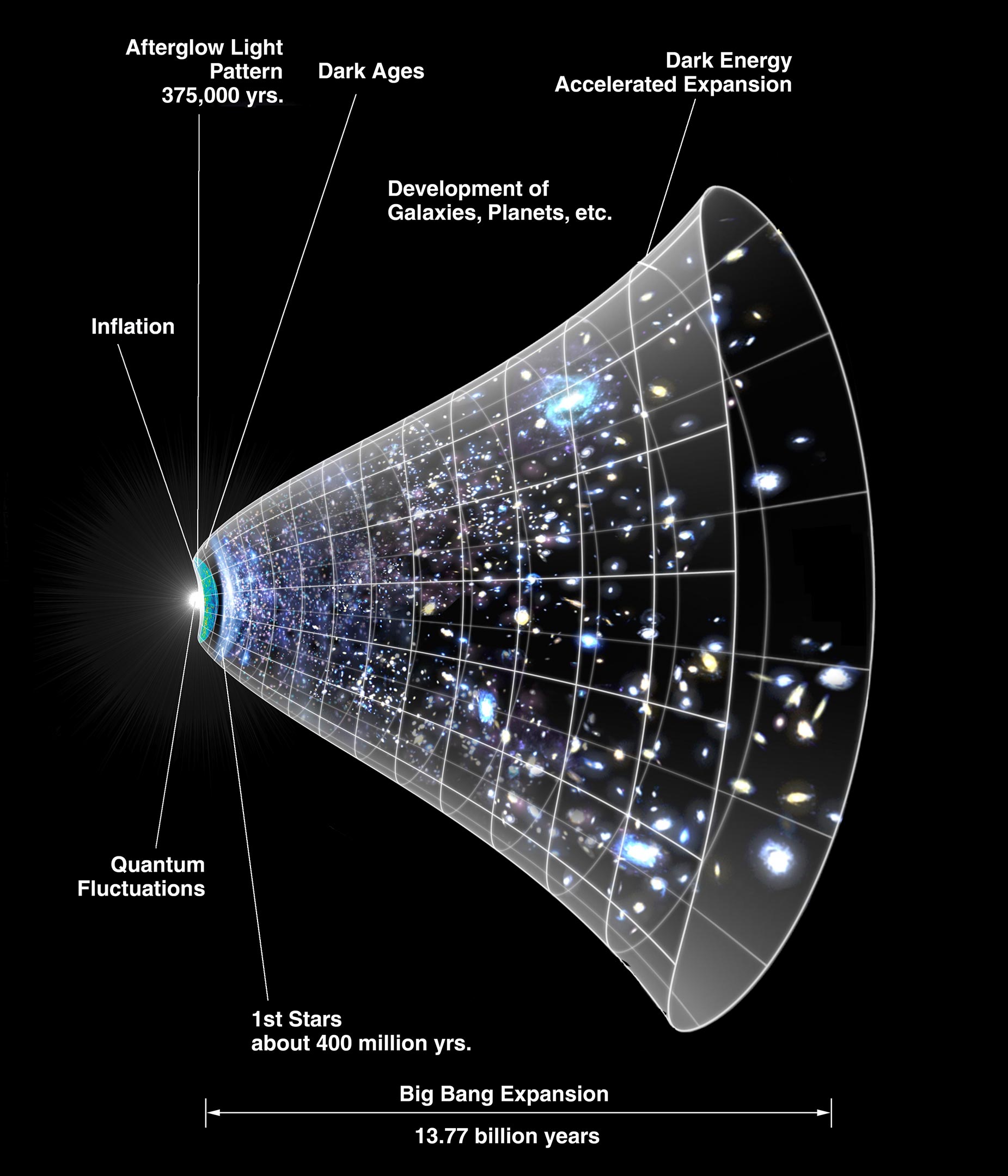
What is the Universe?
The universe is all of space and time and its contents, including planets, stars, galaxies, and all other forms of matter and energy.
The Big Bang Theory is the prevailing cosmological description of the development of the universe.

4
Multiple Choice
5
How big is the Universe?
The universe is considered to be infinite.

6
What are the main components of the Universe?
The main components of the Universe are: Galaxies, Nebulae, Stars, Planets, Satellites/Moons, Asteroids, Meteors, and Comets.

7
What are the biggest parts of the Universe?
Galaxies
A galaxy is a gravitationally bound system of stars, nebulae, stellar remnants, interstellar gas, dust, and dark matter.

8
Are there different types of galaxies?
The three main types of galaxies are Spiral, Elliptical and Irregular.
There are also Barred Spiral, Peculiar, and Lenticular
We live in the spiral galaxy called the Milky Way

9
Multiple Select
10
What are the largest components of galaxies?
Nebulae
A nebula is an interstellar cloud of dust, hydrogen, helium, and other ionized gases, visible in the night sky either as an indistinct bright patch or as a dark silhouette against other luminous matter

11
What are the different types of nebulae?
Planetary Nebula
Emission or "Glowing" Nebula
Reflection Nebula
Dark Nebula or Absorption Nebula

12
13
Multiple Choice
14
What is a Star?
A star is a large celestial body made of mostly hydrogen and helium gases that emits light due to nuclear (fusion) reactions.
What is the star closest to the Earth?
The nearest star to Earth is the Sun.

15
16
Multiple Choice
17
What is a planet?
A planet is a celestial body that (a) is in orbit around a star, (b) (nearly round) shape, and (c) has cleared the neighborhood around its orbit.

18
What are the different types of planets?
A terrestrial planet, telluric planet, or rocky planet is a planet that is composed primarily of silicate rocks or metals.
A gaseous or gas giant is a giant planet composed mainly of hydrogen and helium.
A dwarf planet is a planetary-mass object that does not dominate its region of space and is not a satellite

19
Multiple Select
20
21
What is a moon or natural satellite?
In a generic sense, a moon is a natural satellite that orbits a planet.
In a specific sense, the Moon is the only natural satellite of Earth and the fifth largest such object. It is the brightest object in the Earth's sky after the Sun.

22
23
What are asteroids?
An asteroid is a small irregualar rocky body orbiting the sun.
Large numbers of these, ranging in size from nearly 600 miles (1,000 km) across (Ceres) to dust particles, are found (as the asteroid belt ) especially between the orbits of Mars and Jupiter, though some have more eccentric orbits, and a few pass close to the earth or enter the atmosphere as meteors

24
What is a meteroid?
A meteoroid is a small body moving in the solar system that would become a meteor if it entered the earth's atmosphere.
What is a meteor?
A meteor is a small body of matter from outer space that enters the earth's atmosphere, becoming incandescent as a result of friction and appearing as a streak of light.

25
What is a comet?
A comet is an icy, small Solar System body that, when passing close to the Sun, warms and begins to release gases, a process that is called outgassing.
This produces a visible atmosphere or coma, and sometimes also a tail.

26
27
Open Ended
8.8A Components of the Universe
Show answer
Auto Play
Slide 1 / 27
SLIDE
Similar Resources on Wayground

19 questions
Why Earth's Tilt Matters
Lesson
•
8th Grade
20 questions
Biotechnology
Lesson
•
8th Grade
20 questions
Newton's Laws Extended Day
Lesson
•
8th Grade
20 questions
Light-years and the Milky Way Galaxy
Lesson
•
8th Grade
21 questions
8.L.5 Review
Lesson
•
8th Grade
21 questions
8.8A Components of the Universe, H-R Diagram Review
Lesson
•
8th Grade
21 questions
Motion, Forces, Electricity & Magnetism
Lesson
•
8th Grade
22 questions
Earth/Space Review 4. Earth' Spheres & Earth's Layers
Lesson
•
8th Grade
Popular Resources on Wayground
15 questions
Fractions on a Number Line

Quiz
•
3rd Grade
20 questions
Equivalent Fractions
Quiz
•
3rd Grade
25 questions
Multiplication Facts
Quiz
•
5th Grade
29 questions
Alg. 1 Section 5.1 Coordinate Plane
Quiz
•
9th Grade
22 questions
fractions
Quiz
•
3rd Grade
11 questions
FOREST Effective communication
Lesson
•
KG
20 questions
Main Idea and Details
Quiz
•
5th Grade
20 questions
Context Clues
Quiz
•
6th Grade
Discover more resources for Science
22 questions
Phases of the moon
Quiz
•
8th Grade
10 questions
Exploring the Rock Cycle

Interactive video
•
6th - 8th Grade
20 questions
Waves and Wave Properties
Quiz
•
6th - 8th Grade
10 questions
Understand Ecosystem Roles and Energy Flow
Interactive video
•
6th - 8th Grade
8 questions
Amoeba Sister Asexual vs Sexual Reproduction
Interactive video
•
8th Grade
10 questions
Exploring the Rock Cycle: Types and Formation
Interactive video
•
6th - 8th Grade
20 questions
Heredity Punnett square review
Quiz
•
8th Grade
10 questions
Exploring Weathering, Erosion, and Deposition Processes
Interactive video
•
6th - 10th Grade