

Introduction to the Rock Cycle

Presentation
•
Science
•
7th - 8th Grade
•
Easy
Standards-aligned

Joseph Anderson
Used 1+ times
FREE Resource
18 Slides • 15 Questions
1
Intro to the Rock Cycle
2
3
Open Ended

Look at the picture of the 3 types of rocks. What is one similarity OR one difference between the rocks?
4
Minerals and Rocks
Mineral: a solid that is formed naturally in the earth and normally has a crystal structure
Rock: a solid that is made up of one or more minerals
Minerals are the "building blocks" of rocks.

5
Types of Rocks
Rocks are classified into 3 categories, based on how they are formed
Does anyone know what the three categories are?
Answer: igneous, metamorphic, and sedimentary

6
Multiple Choice
7
1. Igneous Rocks
Igneous rocks are formed by magma/lava.
When a volcano erupts, it spews out hot molten rock called lava. Eventually the lava will cool down and become solid. This forms an extrusive igneous rock.
Igneous rock can also form as magma cools below earth's surface. These are called intrusive igneous rocks.

8
2. Sedimentary Rocks
Sedimentary rocks are formed by years of sediment (small pieces of rocks/minerals) compacting together and becoming hard.
A stream or river will carry lots of sediments to a larger body of water. These pieces will settle at the bottom and over a really long time (perhaps millions of years), they will form into solid rock.
Some examples of sedimentary rocks are shale, limestone, and sandstone.

9
3. Metamorphic Rocks
Metamorphic rocks are formed by heat and pressure.
They are generally found inside the Earth's crust.
Metamorphic rocks are often made from other types of rock. For example, shale, a sedimentary rock, can be changed into a metamorphic rock such as slate.
Other examples of metamorphic rocks include marble and anthracite.

10
11
Multiple Choice
12
Multiple Choice
13
Multiple Choice
14
Multiple Choice
15
The Rock Cycle
The rock cycle is how natural processes (weathering, erosion, deposition, heat, and pressure) can cause rocks to change from one type to another.
The process is very slow but is constant.

16
Weathering and Erosion
Rocks on the surface of the earth are constantly being broken down by wind and water.
The result of all this? Large rocks are worn down to smaller sediments.
When the sediments are broken off a rock and stay in the same area, it is called weathering.
When the sediments are carried somewhere else, it is called erosion.

17
Multiple Choice
18
Multiple Choice
19
Multiple Choice
20
Deposition
Sediments are carried away by wind or by rain, streams, rivers, and oceans. As rivers get deeper or flow into the ocean, their current slows down, and the rock particles (mixed with soil) sink and become a layer of sediment. This is called deposition.

21
Compaction/Cementation
As the layers of sediment stack up (above water or below), the weight and pressure compacts (squashes down) the bottom layers. This is called compaction and cementation.
After years of this, the sediment turns into sedimentary rock.

22
Multiple Choice
23
Metamorphism
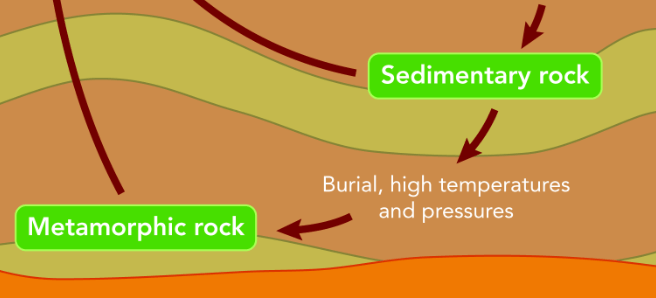
Metamorphism: Over very long periods of time, sedimentary or igneous rocks end up buried deep underground, usually because of the movement of tectonic plates. While underground, these rocks are exposed to high heat and pressure, turning them into metamorphic rock.
24
Multiple Choice
25
Melting and Crystallization
Melting: Metamorphic rocks underground melt to become magma. When a volcano erupts, magma flows out of it.
Crystallization of magma: As the lava cools it hardens and becomes igneous rock.

26

27
28
29
Multiple Choice
30
Multiple Choice
31
Multiple Choice
32
Multiple Choice
33
Intro to the Rock Cycle
Show answer
Auto Play
Slide 1 / 33
SLIDE
Similar Resources on Wayground

27 questions
Ecosystems
Lesson
•
8th Grade
27 questions
Tropisms Notes
Lesson
•
6th - 8th Grade
25 questions
Biomes and Adaptations
Lesson
•
7th Grade
25 questions
Newton's 3rd Law of Motion
Lesson
•
8th Grade
25 questions
Cells
Lesson
•
7th Grade
26 questions
Volcanoes
Lesson
•
8th Grade
26 questions
Mass Extinction
Lesson
•
6th - 8th Grade
27 questions
Genetics / Heredity Review
Lesson
•
6th - 8th Grade
Popular Resources on Wayground
15 questions
Fractions on a Number Line

Quiz
•
3rd Grade
20 questions
Equivalent Fractions
Quiz
•
3rd Grade
25 questions
Multiplication Facts
Quiz
•
5th Grade
29 questions
Alg. 1 Section 5.1 Coordinate Plane
Quiz
•
9th Grade
22 questions
fractions
Quiz
•
3rd Grade
11 questions
FOREST Effective communication
Lesson
•
KG
20 questions
Main Idea and Details
Quiz
•
5th Grade
20 questions
Context Clues
Quiz
•
6th Grade
Discover more resources for Science
22 questions
Phases of the moon
Quiz
•
8th Grade
10 questions
Exploring the Rock Cycle

Interactive video
•
6th - 8th Grade
20 questions
Flow of Energy
Quiz
•
7th Grade
12 questions
Ecological Succession
Quiz
•
7th Grade
20 questions
Waves and Wave Properties
Quiz
•
6th - 8th Grade
8 questions
Amoeba Sister Asexual vs Sexual Reproduction
Interactive video
•
8th Grade
10 questions
Understand Ecosystem Roles and Energy Flow
Interactive video
•
6th - 8th Grade
10 questions
Exploring the Rock Cycle: Types and Formation
Interactive video
•
6th - 8th Grade