


Evidence of Earth's History
Presentation
•
Science
•
7th - 8th Grade
•
Hard

Joseph Anderson
FREE Resource
54 Slides • 14 Questions
1
Fossils and Earth's History Review
2
3
4
5
6
7
8
9
10
11
12
13
14
15
16
17
18
19
20
21
22
23
24
25
26
27
28
29
30
31
32
33
34
35
36
37
38
39
40
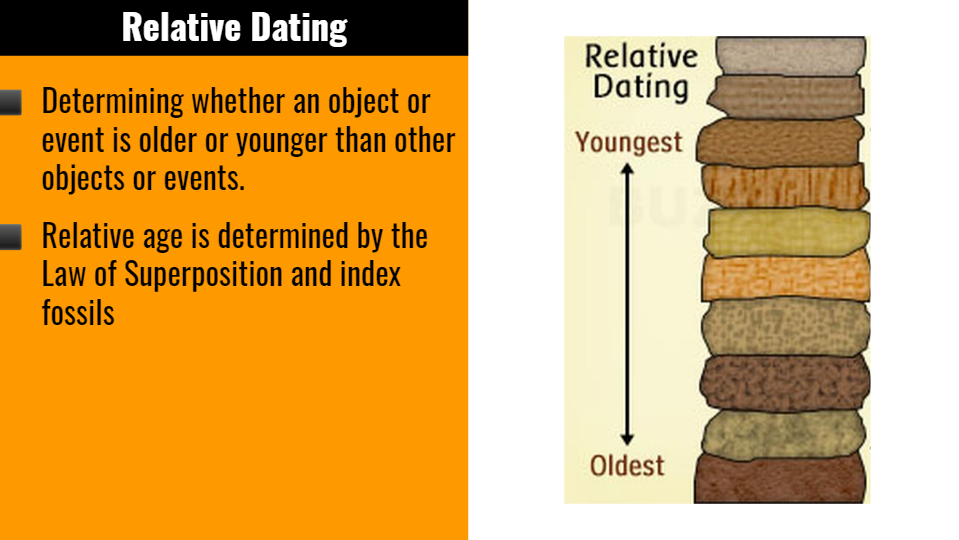
41
42
43
44
45
46
47
48
49
50
51
52
53
54
55
Multiple Choice
A researcher is studying undisturbed, horizontal, sedimentary rock layers in a region. The rock layers have no igneous intrusions. He observes that some of the rock layers contain various kinds of fossils.
How can the researcher use the fossil evidence to help determine the ages of the rock layers?
He can list the number of fossils present in each rock layer and then use the geologic law of uniformitarianism.
He can compare the complexity of index fossils within the rock layers and then use the geologic principle of original horizontality.
He can analyze the depth at which different fossils are present and then use the geologic principle of cross-cutting relationships.
He can research the age of any index fossils found in the rock layers and then use the geologic law of superposition.
56
Multiple Choice
The table shows details of a portion of the Paleozoic Era.
What can be concluded about the Paleozoic Era?
During this era, a large diversity of life forms appeared.
In the middle of this era, period extinction of life forms occurred.
At the beginning of this era, organisms were able to make their own food.
During this era, invertebrates were the dominant group of organisms.
57
Multiple Choice
Review the diagram showing a fault located among layers of sedimentary rock.
What is the relative age of the fault?
The fault is older than layer B.
The fault is older than layer C
The fault is older than layer E.
The fault is older than layer F.
58
Multiple Choice
A paleontologist finds that there are very few recorded fossils of organisms that are approximately 360 million to 345 million years old. This corresponds to the first 15 million years of the Carboniferous Period. However, fossils of earlier and later organisms have been found.
What is a likely reason for the lack of fossil formation during this 15 million-year period?
The remains of the organisms were disturbed, which did not allow fossils to form.
There were no organisms on land, where fossilization only occurs.
Most organisms lived in water, where fossilization cannot occur.
The remains of the organisms were too large, which did not allow fossils to form.
59
Multiple Choice
A 30,000-year-old skull fossil for a saber-tooth tiger was found.
Which process was required in determining the exact age of the fossil?
radioactive dating
recrystallization
relative dating
superposition
60
Multiple Choice
The diagram shows the distribution of fossils in undisturbed layers of silt under the ocean.
Which statement is true about the fossils in the diagram?
The fossil in Layer X is the oldest.
The fossil in Layer Z is the youngest.
The fossil in Layer Y is older than the fossil in Layer X.
The fossil in Layer Y is older than the fossil in Layer Z.
61
Multiple Choice
The diagram shows rock layers taken from two different locations.
The layers with the same letter are believed to be approximately the same age. What is the most likely explanation for why Layer B is missing in Location 1?
It was deposited last.
It eroded.
It evaporated.
It was dug out.
62
Multiple Choice
Scientists are able to conclude that a forested ecosystem existed in Antarctica millions of years ago by studying
the current climate.
the fossil record.
glacial movement.
seafloor spreading.
63
Multiple Choice
The incompleteness of the fossil record results primarily from which phenomenon?
the frequency and irregular timing of organism speciations
the metamorphism of most sedimentary rock by heat and pressure
the geologically rapid cycling of crust material back into the mantle
the rarity with which organic remains are exposed to fossil-forming conditions
64
Multiple Choice
The table shows the units of the geologic time scale.
Which statement about the time scale is not true?
Present day Earth is in the Holocene Epoch.
Cenozoic Era is followed by the Mesozoic Era.
Jurassic is the oldest period of the given time scale.
Geologic history is ongoing and has not ended yet.
65
Multiple Choice
Review the diagram showing an igneous intrusion (D) within layers of sedimentary rock.
What is the relative age of the igneous intrusion?
The igneous intrusion is younger than layer A.
The igneous intrusion is the same age as layer C.
The igneous intrusion is younger than layer E.
The igneous intrusion is the same age as layer F.
66
Multiple Choice
The image shows four fossils found in various layers of rock.
Which statement best interprets the evidence in the rock layers?
Fossil A is the oldest fossil.
Fossil D is the oldest fossil.
Fossil C is older than Fossil B.
Fossil B is older than Fossil A.
67
Multiple Choice
The image shows the fossil record of an animal species found in different rock layers. The image also shows what the species looked like and the changes in the bone size in the forefeet with time.
Which claim is supported by the evidence in the fossil record?
The animal species ate larger food sources over time.
The growth of fossils from the animal species occurred due to tectonic activity over time.
The animal species changed over time.
The geographic distribution of the animal species changes over time.
68
Multiple Choice
Scientists find evidence of a large meteor impact on the coast of the Yucatán Peninsula in Mexico. What can the scientists most likely expect to find in the layers of rock that are about the same age as the impact?
evidence of the mass extinction of many species
evidence of a gradual change of one species over time
evidence of a rapid change in one species
evidence of the stability of many species over time
Fossils and Earth's History Review

Show answer
Auto Play
Slide 1 / 68
SLIDE

Similar Resources on Wayground
60 questions
Electromagnetic Waves
Presentation
•
8th Grade
64 questions
Invasive & Endangered Species
Presentation
•
7th Grade
62 questions
Lesson on 1st Law of Motion
Presentation
•
8th Grade
64 questions
Newton's Second Law Lesson
Presentation
•
7th - 8th Grade
64 questions
Waves Review: 10Feb21
Presentation
•
6th - 8th Grade
63 questions
Chemistry Unit Review
Presentation
•
8th Grade
64 questions
What is an atom?
Presentation
•
7th Grade
63 questions
Basic Chemistry Review
Presentation
•
8th Grade
Popular Resources on Wayground
15 questions
Grade 3 Simulation Assessment 1
Quiz
•
3rd Grade
22 questions
HCS Grade 4 Simulation Assessment_1 2526sy
Quiz
•
4th Grade
16 questions
Grade 3 Simulation Assessment 2
Quiz
•
3rd Grade
19 questions
HCS Grade 5 Simulation Assessment_1 2526sy
Quiz
•
5th Grade
17 questions
HCS Grade 4 Simulation Assessment_2 2526sy
Quiz
•
4th Grade
20 questions
Equivalent Fractions
Quiz
•
3rd Grade
24 questions
HCS Grade 5 Simulation Assessment_2 2526sy
Quiz
•
5th Grade
20 questions
Math Review
Quiz
•
3rd Grade
Discover more resources for Science
20 questions
8th Grade Science STAAR Review
Quiz
•
8th Grade
16 questions
Interactions within Ecosystems
Presentation
•
6th - 8th Grade
20 questions
Earth Day
Quiz
•
3rd - 12th Grade
20 questions
genetics, punnett squares, heredity
Quiz
•
7th Grade
16 questions
Photosynthesis and Cellular Respiration Review
Quiz
•
7th Grade
20 questions
Abiotic & Biotic Factors
Quiz
•
7th Grade
30 questions
GMAS Physical Science Review
Quiz
•
8th Grade
20 questions
Asexual/Sexual Reproduction
Quiz
•
7th Grade