Search Header Logo
  1. Resource Library
  2. Science
  3. Physics
  4. Nuclear Power
  5. Nuclear Power Plant
Nuclear Power Plant

Nuclear Power Plant

Assessment

Presentation

Science

9th - 12th Grade

Hard

Created by

Joseph Anderson

FREE Resource

83 Slides • 86 Questions

1

Review Renewable & Nonrenewable Resources
Is nuclear Power Renewable or Nonrenewable


What is the future of nuclear electricity generation?

As the UK and US aim for net zero by 2050, the mix of electricity generation will change. Nuclear energy is likely to play a role globally in helping nuclear-capable nations achieve these goals.

In the UK, the construction of Hinkley Point C in Somerset has marked the current government’s intention to have nuclear as a pillar of its energy mix. Sizewell C – a sister plant to the active B station – is currently under consultation, with a proposed generation of 3.2GW. As of 2021 in the US, there are plans to ‘uprate’ existing reactors to increase their generation capacity, while two new reactors in Vogtle, Georgia, came online in 2023.

media

2

3

4

media

5

media

6

Poll

What do think the average persons considers when looking for a way to get around?

Efficiency

Reliable

Cost

Environmental impact

looking cool

7

media

8

media

9

Multiple Select

Why is nonrenewable energy so popular? (Check all that you feel apply)

1

Cost to use

2

Reliability

3

Environmental issues

4

Obtainability

5

Third world accessibility

10

Renewable

  • Wind - Free & efficient, but unreliable

  • Solar - Free & efficient, but unreliable

  • Hydro - Free & efficient, but the environmental impact

  • Geothermal - Low cost, no greenhouse gases, again, environmental impact

  • Tidal - predictable, efficient, but limited generation

media

11

media

12

Nonrenewable

  • Oil - reliable, cost and availability; pollution, greenhouse gases

  • Natural Gas - high energy yield; explosive, contamination

  • Coal - inexpensive, reliable; pollution, mining, waste creation

  • Nuclear - produces large amounts of energy; thermal discharge, radioactive waste

media

13

Poll

With that information, which car do you think the average person would buy?

Gas car

Electric car

public transportation

14

So what's the difference?

  • Gas cars - average costs $22,000 est

  • Electric cars - average costs $31,000 est

  • Cost of gas for a year - $4,000 est

  • Cost of charging for a year - $1800 est

  • These are estimates; does not include maintenance or insurance.

media

15

Nonrenewable Resources Examples

  • Coal

  • Petroleum (Oil, Gasoline)

  • Natural Gas

  • Nuclear (Plutonium & Uranium)

  • Coal, Petroleum, and Natural Gas are called Fossil Fuels

16

Is Nuclear Energy Renewable?

Nuclear fuels, such as the element uranium, are not considered renewable as they are a finite material mined from the ground and can only be found in certain locations. But nuclear power stations use a miniscule amount of fuel to generate the same amount of electricity that a coal or gas power station would (1 kg of uranium = 2.7 million kg of coal), so they’re considered a reliable source of energy for decades to come.

There are concerns around what to do with spent fuel from reactors, as there’s still no definitive way to dispose of it indefinitely without risk. However, although the reactors and housing remain untouchable for considerable lengths of time when a nuclear site is decommissioned, a new reactor can be built on the site itself. New technologies allow us to use the spent fuel rods from old reactors to fuel a new generation of reactors. This also reduces the radioactiviy of the waste material.

17

Open Ended

Considering the last slide, would you consider Nuclear to be renewable or non-renewable? tell my why.

18

Multiple Choice

If you were building a new school, and wanted to conserve Fossil Fuels, which of the following would you use?

1

Coal

2

Gasoline

3

Geothermal Energy

4

Petroleum

19

Multiple Choice

Which of the following uses nonrenewable energy?

1

Dam using water power

2

Power station burning coal

3

Solar panels collecting energy from the sun

4

Wind Farm using turbines

20

Multiple Choice

Which form of energy does most of our renewable energy come from?

1

Chemical

2

Solar

3

Sound

4

Light

21

Multiple Choice

What is a disadvantage of solar energy?

1

It causes land to flood

2

Produces Radioactive waste

3

Not always available

4

Causes pollution

22

Multiple Choice

Which is an example of using a renewable resource?

1

Cooking burgers on a gas grill

2

Driving a gasoline-powered scooter.

3

Filling a furnace with coal.

4

Using a wind-powered sailboat to travel

23

Multiple Choice

Which includes ONLY renewable resources?

1

Biomass, Geothermal, Nuclear

2

Solar, Tidal Waves, Wind

3

Biomass, Coal, Hydro

4

Biomass, Natural Gas, Solar

24

Multiple Choice

Which contains ONLY nonrenewable resources?

1

Biomass, Coal, Wind

2

Coal, Geothermal, Natural Gas

3

Geothermal, Petroleum, Wind

4

Coal, Natural Gas, Nuclear

25

Multiple Choice

Energy that powers almost all food chains comes from:

1

Tidal and wave energy

2

Fossil Fuels

3

Sunlight

4

Energy from inside the earth

26

Multiple Choice

Which of the following is NOT a fossil fuel?

1

Coal

2

Natural Gas

3

Nuclear

4

Petroleum

27

media

28

Multiple Choice

Volcanoes are an example of what form of energy?

1

Geothermal

2

Wind

3

Hydro

4

Solar

29

Wouldn’t it be great if people could use the same method as the sun to produce energy? The kind of reactions that power the sun involve the central cores of atoms. The central core of an atom that contains the protons and neutrons is called the NUCLEUS. Reactions that involve nuclei, called nuclear reactions, result in tremendous amounts of energy. Two types of nuclear reactions are:

  1. Nuclear Fission: The splitting of an atom’s nucleus into two smaller nuclei.

  1. Nuclear Fusion: The combining of two atomic nuclei to produce a single larger nucleus.

media

30

Multiple Choice

The central core of an atom that contains the protons and neutrons is called the

1

molecule

2

electron

3

nucleus

31

Fill in the Blank

Two types of nuclear reactions are:

32

Fill in the Blank

Nuclear reactions convert _______ into _________.

33

media

Nuclear reactions convert matter into energy. As part of his theory of relativity, Albert Einstein developed a formula that described the relationship between energy and matter. You have probably seen this famous equation: E = mc2. In the equation, the E represents energy and the m represents mass. The c, which represents the speed of light, is a very large number. This equation states that when matter is changed into energy, an enormous amount of energy is released.​

Nuclear Fission

34

Fill in the Blank

In the equation E=mc2, the E represents _____ and the m represents ____, and the c, represents _______

35

Fission Reactions

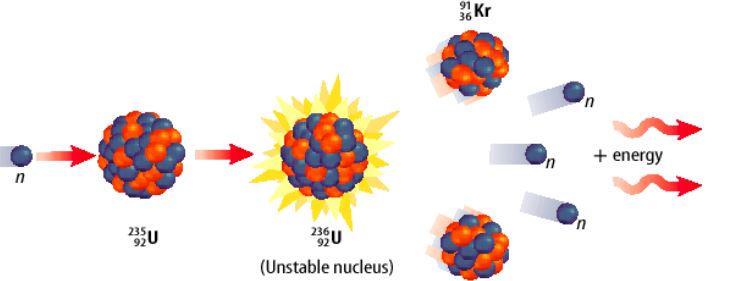
Nuclear fission is the splitting of an atom's nucleus into two smaller nuclei. The nucleus splits apart into two smaller nuclei and two or more neutrons, so the fission reaction has produced more neutrons. If any of these neutrons strikes another nucleus, the fission reaction is repeated. More neutrons and more energy are released. If there are enough nuclei nearby, the process repeats in a chain reaction, just like a row of dominoes falling. In a nuclear chain reaction, the amount of energy released increases rapidly with each step in the chain. 

media

36

Energy From Fission

What happens to all the energy released by these fission reactions? If a nuclear chain reaction is not controlled, the released energy causes a huge explosion. The explosion of an atomic bomb is an uncontrolled nuclear fission reaction. A few kilograms of matter explode with more force than several thousand tons of dynamite. However, if the chain reaction is controlled in a power plant, the energy is released as heat, which can then be used to generate electricity.​

Some text here about the topic of discussion

37

Fill in the Blank

When a nuclear chain reaction is controlled in a power plant, the energy is released as _____, which can then be used to generate ______.

38

Nuclear Fission Reactions in Nature

  • This process causes convection currents

    • moves Earth​'s tectonic plates

  • Generates:

    • Earthquakes

    • Volcanic eruptions​

  • Produces vast quantities of energy.

  • Involves the splitting of harmful radioactive elements.

  • Loss of control leads to harm​ful radiation exposure.

39

media

In a nuclear power plant, the heat released from fission is used to change water into steam. The steam then turns the blades of a turbine to generate electricity.

Some text here about the topic of discussion.

Nuclear Power Plants

40

media

Nuclear fusion is the combining of two atomic nuclei to produce a single larger nucleus. In nuclear fusion, two hydrogen nuclei combine to create a helium nucleus, which has slightly less mass than the two hydrogen nuclei. The lost mass is converted to large amounts of energy. Nuclear fusion is the process by which the sun produces energy. On Earth, fusion is a promising future energy source. Fusion fuels are readily available-water contains a form of hydrogen that could be used. Since its fuel can be found in water, fusion is considered a renewable energy source. Fusion would not produce air pollution. And unlike fission, fusion would not produce long-lived radioactive wastes. However, fusion can take place only at extremely high pressures and temperatures.

Nuclear Fusion

41

Global Alternative Methods to Imported Fossil fuels

  • France has emphasized nuclear power as its response to the energy crisis, and by 2012 it was producing about 83 percent of its electricity from that source one of the highest rates in the world.

  • The discovery of oil and natural gas under the North Sea aided Norway and Britain to pull away from OPEC imported oil.

  • In 2005 Finland began constructing one of the world's largest nuclear reactors, but that project has encountered many delays.

  • Nuclear power worldwide

    There are currently 412 reactors in use worldwide, spread across 32 countries. Even as new reactors are built, older ones are shut down, so the overall number has remained more or less constant for years. Countries such as China, France and the UK have announced new construction. Others want to build small, modern reactors.

42

Multiple Choice

Nuclear fission is the combining of two atomic nuclei to produce a single larger nucleus.

1

TRUE

2

FALSE

43

Multiple Choice

Nuclear Power plants are decreasing in Number.

1

TRUE

2

FALSE

44

Multiple Choice

There are currently 412 reactors in use worldwide, spread across 32 countries.

1

TRUE

2

FALSE

45

Fill in the Blank

In nuclear fusion, two hydrogen nuclei are forced together, forming a helium nucleus, a neutron, and energy. What is released during a fusion reaction?

46

Dropdown

New nuclear technology has proven to be difficult to turn into weapons

47

Multiple Choice

The splitting of a nucleus into smaller nuclei is
1

fusion

2

fission

3

decay

4

gamma radiation

48

Multiple Choice

This happens naturally due to an unstable nucleus.
1
fission
2
fusion
3
radioactive decay
4
K-capture

49

Multiple Choice

Which of the following is true about nuclear fusion?
1

It is easy to implement.

2

It produces less energy than nuclear fission.

3

It produces more energy than nuclear fission.

4

It has the ability to occur easily in everyday life.

50

Multiple Choice

Takes two small nuclei and combines them into a larger nucleus
1

fission

2

fusion

51

Multiple Choice

In which process does a heavy nucleus split into two lighter nuclei?

1

freezing

2

condensation

3

fission

4

fusion

52

Multiple Choice

Which phrase describes a risk associated with producing energy in a nuclear power plant?

1

depletion of atmospheric hydrogen

2

depletion of atmospheric carbon dioxide

3

production of wastes needing long-term storage

4

production of wastes that cool surrounding water supplies

53

Multiple Choice

What occurs in both fusion and fission reactions?

1

Small amounts of energy are converted into large amounts of matter.

2

Small amounts of matter are converted into large amounts of energy.

3

Heavy nuclei are split into lighter nuclei.

4

Light nuclei are combined into heavier nuclei.

54

Dropdown

​ ​ Nuclear power can be used to create weapons of mass destruction

55

Dropdown

Nuclear power produces no air particulates that damage lungs like burning fossil fuels does

56

Dropdown

​ ​ When rules aren't followed, melt downs can occur releasing radioactive material into environment

57

Dropdown

​ ​ Nuclear energy can fill the gaps in energy provided by renewable energy resources

58

Dropdown

​ ​ Nuclear waste is toxic and must be stored far away from people, and food and water supplies

59

Dropdown

​ ​ Building new nuclear power plants is expensive

60

Dropdown

​ ​ Nuclear power requires "behind the scenes" actions like mining, refining, and storing wastes that uses a lot of energy

61

Dropdown

Newer reactor types are able to reduce nuclear waste by recycling the reaction products

62

Dropdown

When following regulations, there is little risk for nuclear power plant workers

63

Dropdown

The output of energy from a nuclear power plant is relatively high (a lot of energy is produced with a small amount of fuel)

64

Dropdown

No carbon dioxide, CO2, or other main greenhouse gases are emitted from a nuclear powerplant

65

Dropdown

​ ​ Nuclear waste must be stored for thousands of years 

66

Dropdown

​ ​ Land exposed to a nuclear melt down will be unused for decades

67

Dropdown

Technology used to develop nuclear power plants has been used to develop technologies in other areas such as pharmaceuticals and medicine

68

Radioactivity and Half-life

In terms of radioactive decay, the half-life is the length of time after which there is a 50% chance that an atom will have undergone nuclear decay.

media

69

media

70

media

71

media

72

media

73

Multiple Choice

In beta becay…..

1

A neutron becomes a proton and an electron

2

A proton becomes a neutrons and an electron

3

A electron becomes a protons and a neutron

4

It's just a wave

74

Multiple Choice

Which type of radiation has 2 protons and 2 neutrons

1

Alpha

2

Beta

3

Gamma

4

Neutron

75

Multiple Choice

Which type of radiation is stopped by lead and concrete?

1

Alpha

2

Beta

3

Gamma

4

Neutron

76

media

77

media

78

media

79

media

80

media

81

media

82

Multiple Choice

Question image

This image shows

1

nuclear fission

2

nuclear fusion

83

Multiple Choice

Question image

This image shows

1

Nuclear fission

2

Nuclear fusion

84

Multiple Choice

How much of a 250g sample would be left after 5 half lives?

1

125g

2

62.5g

3

31.25g

4

7.81g

85

Multiple Choice

Energy in the sun is produced as a result of nuclear ____ reactions.
1
fusion
2
fission
3
waste
4
sub

86

Multiple Choice

If one has 12 kg of Polonium and it undergoes two half-lives, how much do you have left?

1

12 kg

2

3 kg

3

6 kg

87

Multiple Choice

Question image

Using this graph, what is the half-life of the strontium?

1

10 years

2

25 years

3

50 years

4

150 years

88

Multiple Choice

If the radioactivity of a substance starts at 500 Bequerels. What will the radioactivity be after one half life?

1

1000

2

250

3

125

4

500

89

Multiple Choice

Which is the best definition of half-life?

1

Half the mass of the substance is left.

2

Only half the time taken for decay to occur

3

time taken for radioactivity to halve.

4

Half total decay occurs in a certain time.

90

media
  • It is toxic sludge or water mixed with pellets of uranium and other radioactive elements.

  • Nuclear energy produces a brick-sized waste per person, per year.

  • This is a relatively small amount compared to other energy sources.

What is nuclear waste?

91

Comparing Waste

  • Nuclear energy produces 2,000 tons of waste every year in the USA.

    • This is toxic and radioactive, but not harmful to the overall climate.

  • Fossil fuels produce about 5,000,000 tons of CO2 every year in the USA.

    • This is extremely harmful to the overall climate.

92

Nuclear Power!

  • During the 1980s, many countries in Europe began using nuclear power plants to produce cleaner and cheaper energy in order to rely less on fossil fuels.

media

93

media
  • It produces about 10% of the world's total power.

  • Note that fossil fuels currently make up 80%.

  • It is most popular in the USA, making up 20% of USA's energy.

How common is nuclear power?

94

media

95

Multiple Choice

Question image

The nuclear radiation that occurs naturally in the environment.

1

Radioisotopes

2

Background Radiation

3

Cosmic Rays

4

Cosmic Radiation

96

Multiple Choice

Question image
This is an example of...
1
Fission  reaction
2
Fusion reaction
3
Decomposition reaction
4
Decay

97

Multiple Choice

Question image

The nuclear radiation that occurs naturally in the environment.

1

Radioisotopes

2

Background Radiation

3

Cosmic Rays

4

Cosmic Radiation

98

Multiple Choice

Which energy resource DOES NOT produce air pollution?

1

coal

2

oil

3

natural gas

4

nuclear power

99

Multiple Choice

Which type of energy did many countries in Europe begin using during the 1980s?

1

hydroelectric power

2

solar power

3

nuclear power

4

wind power

100

Multiple Choice

Why did many countries in Europe begin using nuclear power during the 1980s?

1

it was cheaper and cleaner than fossil fuels

2

it was more dangerous than fossil fuels

3

it was more expensive than fossil fuels

101

Multiple Choice

Question image

What is a BENEFIT of using nuclear energy?

1

It is renewable

2

It produces radioactive waste.

3

Does not cause air pollution, global warming or acid rain.

102

Multiple Choice

Question image

What product does a nuclear power plant produce for its customers?

1

electricity

2

nuclear bombs

3

steam

4

radioactive waste

103

Multiple Choice

Question image

What is a disadvantage of using nuclear energy?

1

It smells bad

2

There is a risk for nuclear meltdown

3

It requires alot of solar panels

4

It requires building a dam

104

Cause #1

  • Many European countries had strict rules for using dangerous nuclear power. Ukraine did not!

media

105

Cause #2

  • On April 26, 1986, one of the reactors at the Chernobyl nuclear power plant exploded during a safety test.

  • El 26 de abril de 1986, uno de los reactores de la central nuclear de Chernobyl explotó durante una prueba de seguridad.

media

106

1986 Nuclear Disaster in Chernobyl, Ukraine

A reactor core Meltdown at Chernobyl released tons of radioactive waste into the atmosphere. This left a "fall out trail" across Europe.

media
media

107

Effects

  • The explosion released large amounts of deadly invisible radioactive nuclear material into the atmosphere.

  • La explosión liberó grandes cantidades de material nuclear radiactivo invisible mortal a la atmósfera.

media

108

Effects

  • There was an 18 mile evacuation zone.

  • Había una zona de evacuación de 18 millas.

media

109

Effects

  • After 36 hours of being exposed to radiation, the people were finally told to pack their clothing and evacuate their homes.

media

110

Ukraine (1986)

  • Between 1922 and 1991, Ukraine was part of the Soviet Union.

  • It was known for its good farmland and agricultural industry.

  • In Ukraine, 8,4 million hectares of agricultural soil are contaminated with 137Cs, and are subject to countermeasures, mostly the use of fertilizers: The 54 900 hectares in the exclusion zone and the 35 600 ha contaminated soil are exclude from agricultural farming.

  • Nearly 370 farms in Britain are still restricted in the way they use land and rear sheep because of radioactive fallout from the Chernobyl

media

111

Multiple Choice

What was the first cause of the nuclear disaster?

1

Ukraine did not have strict rules for nuclear power.

2

Ukraine had strict rules for nuclear power.

112

Multiple Choice

Which country was Ukraine a part of in 1986?

1

the United States

2

the Soviet Union

3

the United Kingdom

4

Russia

113

Multiple Choice

What happened on April 20, 1986?

1

one of the nuclear reactors exploded!

2

one of the wind turbines exploded!

3

one of the solar panels exploded!

4

one of the windmills exploded!

114

Chernobyl Nuclear Reactor (Before & After the Explosion)

media

115

media

116

media

117

media

118

media

119

media

120

media

121

media

122

media

123

media

124

media

125

media

126

media

127

media

128

media

129

media

130

media

131

media

132

WHAT IS NUCLEAR CONTAMINATION?

Put simply, radioactive contamination is just radioactive material somewhere it shouldn’t be. This could be anything from nuclear fallout from a dirty bomb (the whole purpose of which would be to disperse radioactive contaminant), to a lab worker splashing some of a radioactive solution on his pants and taking them home. The most common source of contamination is from mistakes or accidents in the production of radionuclides, like those used in the medical field or Nuclear energy production.

media
media

133

media

134

Closing Chernobyl

  • Chernobyl continued to produce electricity for another 14 years, until it closed in 2000.

media

135

media

136

Radiation levels are still so high that it's estimated humans cannot safely live here for 20,000 years!

media

Following the 1986 Chernobyl nuclear disaster, the entire population of Pripyat was Evacuated

137

Multiple Choice

Question image
What is the difference between a nuclear bomb and a nuclear power plant?
1
Bomb releases energy all at once, power plant release is slow and controlled.
2
Nothing much... pretty much the same.
3
Power plant releases more energy, faster.
4
One uses nuclear energy, one uses coal.

138

media

139

Open Ended

What were some effects of the 1986 Nuclear Disaster in Chernobyl, Ukraine?

140

Multiple Choice

Question image
Which type of power plant is this?
1
Coal Power Plant
2
Nuclear Power Plant
3
Solar Power Plant
4
Hydroelectric Power Plant

141

Solutions

  • The nuclear reactor was covered with a steel dome in 2016. It will stop radiation from escaping for the next 100 years.

  • El reactor nuclear se cubrió con una cúpula de acero en 2016. Evitará que la radiación escape durante los próximos 100 años.

media

142

media

143

Time for a video!

144

Multiple Choice

Where does fusion occur naturally?
1
Underwater
2
All around us
3
In the radioactive waste
4
On the sun

145

Open Ended

What did you learn about the 1986 Nuclear Disaster in Chernobyl, Ukraine?

146

media

147

Multiple Choice

Three Mile Island differed from Chernobyl and Fukushima because...
1
It wasn't a complete meltdown
2
The core melted down
3
Radiation was released
4
Many people died

148

Multiple Choice

Which subatomic particle is required to start a nuclear fission chain reaction?

1

Electron

2

Proton

3

Neutron

4

Atom

149

media

150

Multiple Choice

Which of the following is considered the worst nuclear disaster ever?
1
The Chernobyl Nuclear Power Plant Disaster
2
The Fukushima Daiichi Nuclear Disaster
3
The Three Mile Island Partial Meltdown
4
The bombings of Nagasaki and Hiroshima

151

Multiple Choice

Question image
This is an example of...
1
Fission  reaction
2
Fusion reaction
3
Decomposition reaction
4
Combustion

152

media

153

Multiple Choice

All of the following are problems of nuclear energy except ---
1
storage of radioactive fuel
2
air pollution
3
security concerns
4
natural disasters (tsunamis, earthquakes, etc.)

154

Multiple Choice

What are the two major forces involved with nuclear energy? 
1
Fission and Fusion
2
Alpha and Beta particles
3
Gamma and Fission
4
Radioactivity and Alpha Decay

155

media

156

Multiple Choice

How do nuclear power-plants work?
1
Fusion
2
Half-life
3
Fission
4
Fusion or fission

157

media

158

Multiple Choice

Takes two small nuclei and combines them into a larger nucleus
1
fission
2
fusion

159

media

160

Multiple Choice

What is a half-life?
1
The average time it takes for any element to disappear completely 
2
The time it takes for a radioactive atom to lose half its neutrons
3
The time it takes for half of any number of radioactive atoms to decay
4
The time it takes for a radioactive atom to lose half its electrons 

161

media

162

Multiple Choice

Question image

Which nuclear power plant was hit by explosions and a nuclear meltdown because of the Tsunami?

1

Sendai

2

Yokohama

3

Nagasaki

4

Fukushima

163

media

Japan releases Fukushima water into the ocean

164

Japan has started releasing radioactive water from the Fukushima nuclear power plant into the ocean. The plant was hit by a huge earthquake and tsunami in March 2011. After the power plant was damaged, the power company stored radioactive water in 1,000 giant tanks. The water has been treated to reduce its radioactivity. It is now being slowly released into the Pacific Ocean through a long sea tunnel. Japan stated that the water is safe and would not harm the environment. The International Atomic Energy Agency (IAEA) said the water meets with international safety standards. It said there would be a "negligible radiological impact on people and the environment".

165

Many people in Japan, as well as countries near Japan, are angry that radioactive water is going into the Pacific. Local fishermen are worried they will not be able to sell their fish. China has already banned seafood from Fukushima and the capital city, Tokyo. China's foreign ministry called the release of the water a "wrongful decision" and asked Japan to stop. A spokesperson said: "Japan is putting its own self-interest over the long-term well-being of all humankind". Hong Kong is also worried about food safety. It said it would "immediately" stop importing some Japanese food products. South Korean activists have also protested, although Seoul understood that the water meets international standards.

166

Multiple Choice

An agency said the water would have almost no impact on people.

1

True

2

False

167

Multiple Choice

The radioactive water will get to the Pacific Ocean via a long tunnel.

1

True

2

False

168

Multiple Choice

China has banned all fish caught in Japanese waters.

1

True

2

False

169

Western Europe's Alternative Methods

  • France has emphasized nuclear power as its response to the energy crisis, and by 2012 it was producing about 83 percent of its electricity from that source one of the highest rates in the world.

  • The discovery of oil and natural gas under the North Sea aided Norway and Britain to pull away from OPEC imported oil.

  • As of 2023, Finland has five operating nuclear reactors in two power plants, all located on the shores of the Baltic Sea. Nuclear power provided about 34% of the country's electricity generation in 2020.

Review Renewable & Nonrenewable Resources
Is nuclear Power Renewable or Nonrenewable


What is the future of nuclear electricity generation?

As the UK and US aim for net zero by 2050, the mix of electricity generation will change. Nuclear energy is likely to play a role globally in helping nuclear-capable nations achieve these goals.

In the UK, the construction of Hinkley Point C in Somerset has marked the current government’s intention to have nuclear as a pillar of its energy mix. Sizewell C – a sister plant to the active B station – is currently under consultation, with a proposed generation of 3.2GW. As of 2021 in the US, there are plans to ‘uprate’ existing reactors to increase their generation capacity, while two new reactors in Vogtle, Georgia, came online in 2023.

media

Show answer

Auto Play

Slide 1 / 169

SLIDE