Search Header Logo
3.5 Universal Gravitation

3.5 Universal Gravitation

Assessment

Presentation

Physics

9th - 12th Grade

Easy

Created by

Karl McMurtry

Used 2+ times

FREE Resource

7 Slides • 10 Questions

1

3.5 Universal Gravitation

media

2

Open Ended

What is the difference between weight and mass?

3

​Mass vs Weight

  • Mass is an inherent quality of objects.

  • It is the amount of matter present in an object.

  • Whether on Earth, in space, or on the moon, this amount remains the same.

  • Weight, on the other hand, is the force acting on an object that has mass.

  • This force is the pull of gravity.

  • Weight is not a property of the object; rather, it is the pull exerted by the surface on which the object exists.

  • Therefore, objects will have different weights on different planets.

4

Open Ended

Are mass and weight vector or scalar quantities? Give reasons for your answers.

5

Calculating Weight

  • Recall that Newton's Second Law states the sum of the forces acting on an object is equal to the mass of the object times its acceleration.

  • Since weight is a force, we can say that: Fg = mg

  • Here Fg is the wieght, m is the mass, and g is the acceleration due to gravity.

  • On a planet then, the weight vector is pointed towards the center of the planet.

  • While there are many units used to measure weight in society, since it is a force, we use the units of newtons (N) in physics.

  • So for example, a 2.0 kg bar would be said to weigh 19.6 N on Earth, since g = -9.8 m/s2

6

Multiple Choice

The value of acceleration due to gravity on the planet Saturn (gSaturn) is about 11.2 m/s2. How much will an object weighing 680 newtons on Earth weigh on Saturn?

1

777 N

2

7616 N

3

61 N

4

595 N

5

560 N

7

Universal Law of Gravitation

  • We know that gravity is a field force, meaning that it doesn't need contact to transmit the force.

  • We also know that the acceleration from gravity is different on different planets.

  • What we haven't mentioned yet is that the acceleration of gravity is different depending on how far we are from the planet's center of mass.

  • The table shows the values for different distances from the Earth's surface.

media

8

Inverse Square Law

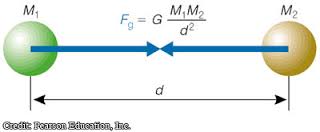
  • Based on the motion of the planets, Newton proposed that the force of gravity (Fg) follows an inverse square law with respect to the distance between two bodies.

  • In other words: Fg ∝ 1/r2

  • This means that if we double the distance between two objects, then the gravitational force decreases by a factor of four.

  • Newton also realized that gravity's pull on an object is not just influenced by its distance from Earth's center, its mass also plays a role.

  • The greater the mass of the object, the greater the pull of gravity.

  • Gravity is directly proportional to the mass of the object.

9

Universal Law of Gravitation

  • Putting all of this together, we can express gravity as: Fg = G(mEmobj)/r2.

  • Where mE is the mass of the Earth, mobj is the mass of the object, and G is the universal gravitational constant.

  • The value of G was found by Lord Henry Cavendish almost a century after Newton's death.

  • He found that the value of the gravitational force between two objects of 1 kilogram each, kept 1 meter apart, would equal just 0.0000000000667 newtons.

  • Thus, the value of G is 6.673 × 10-11 newtons⋅meters2/kilograms2.

  • From the value of this constant you can see that the gravitational force is insignificant for most day–to–day objects you encounter.

10

Multiple Choice

An astronaut is on a spacewalk 300 kilometers above Earth's surface. If the astronaut's mass plus suit is 170 kilograms, what is the force of interaction between Earth and the astronaut? (Earth's radius is 6.38 × 10⁶ meters, Earth's mass = 5.98 × 1024 kg, and G = 6.673 × 10–11 Nm2/ kg2)

1

1670 N

2
2000 N
3
1200 N
4

1520 N

11

12

Multiple Choice

Question image
A person on the Earth weighs 180 pounds. How much will they weigh on the moon? ( Note: The moons "g" is1/6 that of Earth)
1
30 lbs
2
360 lbs
3
0- you are weightless in space
4
18 lbs

13

Multiple Choice

Question image
Complete the following statement: The farther away two planets are the _______ the gravitational force between them.
1
more
2
same
3
dosen't matter
4
less

14

Multiple Choice

Find the distance between two objects whose masses are m1 = 4,500 kg, and m2 = 8,700 kg; if the gravitational force between them is F = 2.0 x 10⁻⁸ N.

1
0.0089 meters
2

0.0028 meters

3
0.0123 meters
4
0.0201 meters

15

Multiple Choice

Doubling the mass of an object...

1

...will double the force of gravity.

2

...will half the force of gravity.

3

...will quadruple the force of gravity.

4

...will quarter the force of gravity.

16

Multiple Choice

Question image

Calculate the gravitational force between two objects when they are 0.750m apart. Each object has a mass of 5.00kg.

1

2.97 x 10⁻⁹ N

2

3.00 x 10⁻⁶ N

3

2.22 x 10⁻⁹ N

4

2.23 x 10⁻⁸ N

17

Multiple Choice

If the sun's mass is 2.0x1030 kg, and its radius is 7.0 x 10⁸ m, what is the strength of its gravitational field, "g"?

1

9.8 m/s2

2

272.2 m/s2

3

27.2 m/s2

4

200 m/s2

3.5 Universal Gravitation

media

Show answer

Auto Play

Slide 1 / 17

SLIDE