Search Header Logo
  1. Resource Library
  2. Science
  3. Physics
  4. Newton's Third Law Of Motion
  5. 8.2.4 Newton's 3rd Law
8.2.4 - Newton's 3rd Law

8.2.4 - Newton's 3rd Law

Assessment

Presentation

Science

8th Grade

Medium

NGSS
MS-ESS1-1, MS-PS2-1, HS-PS2-2

+20

Standards-aligned

Created by

Jessica Freeman

Used 7+ times

FREE Resource

54 Slides • 54 Questions

1

media

2

media

3

media

4

media

5

​Do forces act alone?

Some text here about the topic of discussion

​NO! We talked about forces acting in pairs in Newton's 1st and 2nd Law. Forces always act in pairs, this something we have to remember!

Using your white boards draw a force diagram of you sitting in your chair! Be ready to explain if you are called on! ​

6

Multiple Choice

How do forces act on an object?

1

They usually act alone

2

They act in pairs

7

media

8

Multiple Choice

Newton's 3rd Law of motion states that....

1

A object in motion/rest stays in motion/rest until it is acted upon by an unbalanced force.

2

Force is equal to the mass and the acceleration of an object.

3

For every action there is an equal and opposite reaction.

9

media

10

Newton's Third Law

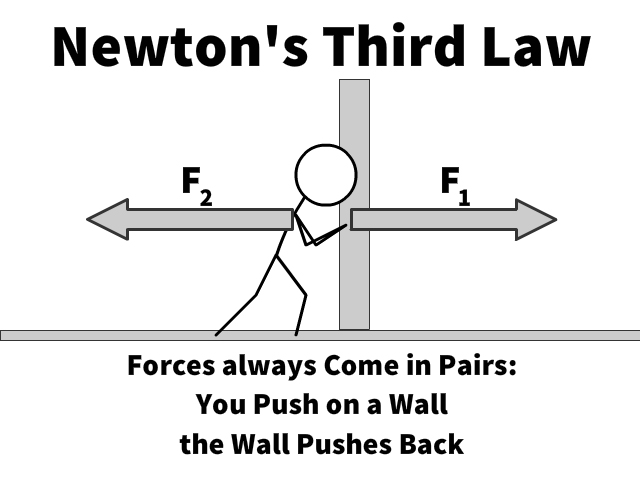
​Action and Reaction forces: These two forces are equal in size and opposite in direction

Use your white boards to explain the action reaction pairs happening in the picture!​

media

11

Multiple Choice

Question image

How is this an example of Newton's Third Law?

1

Only the ball is applying a force to the soccer players head

2

Only the soccer players head is applying the force to the ball

3

The are both exerting an equal force on each other

12

Multiple Choice

Question image

When a small car pushes a big truck, the truck applies an equal and opposite force on the car

1

True

2

False

13

media

14

media

15

The first 2 laws of motion apply to individual objects.

1st Law - an object at rest will stay at rest, an object in motion will stay in motion unless there's an outside force.


2nd Law - an object's acceleration is directly proportional to the force, and inversely proportional to the mass.

16

The third law of motion deals with pairs of objects.

This is because all forces come in pairs.


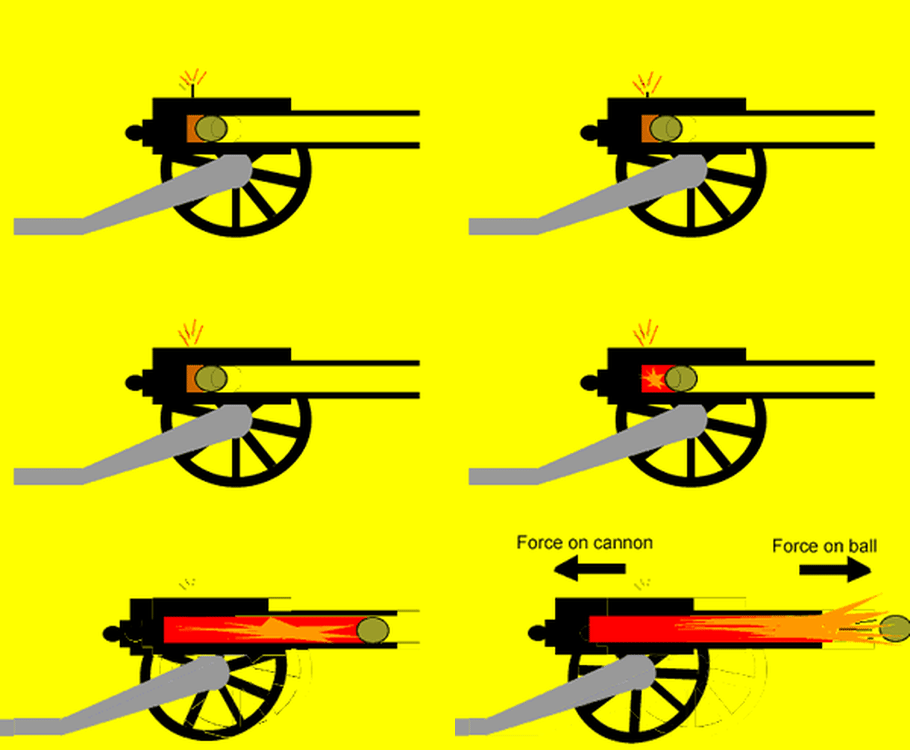
Newton's 3rd Law of Motion - for every action force, there is a force that is 1equal in strength and 2opposite in direction.

17

1Equal in Strength

This image shows the force pairs between the force on the cannon and the force on the ball. Newton's 3rd Law says that they must be equal, which is why the canon is pushed backwards.

media

18

1Equal in Strength

Include this diagram in your notes.

media

19

2Opposite in direction

This image shows the force pairs between the force on the chair and the force on the fire extinguisher. The resulting action is for them to travel in a direction opposite of the extinguisher force.

media

20

2Opposite in direction

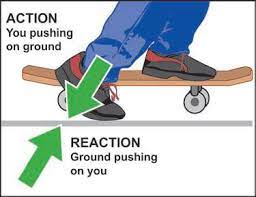
This image shows the force pairs between the force on the ground from your foot, and the force on you from the ground.


The forces that combine to propel you forward are equal and opposite.

media

21

Fill in the Blank

Question image

For any action force, there is an opposite & _______________ reaction force.

22

Fill in the Blank

Question image

Forces always come in _______________________.

23

media

24

media

25

Multiple Choice

Do forces come in pairs when acting on two interacting objects?

1

Yes.

2

No.

26

Multiple Choice

What is another name for Newton's 3rd Law?

1

The Law of Opposites Attract.

2

Fig Newtons.

3

The Law of Action-Reaction.

27

media

28

Multiple Choice

For every action there is an equal and opposite reaction.

1

True.

2

False.

29

Multiple Choice

The size of the force on one object is equal to the size of the force on a second object.

1

True.

2

False.

30

media

31

media

32

Example

A swimmer pushes back on the water and moves forward.

media

33

Multiple Choice

Which is the Action Force in this scenario: "A swimmer pushes back on the water and moves forward."

1

A swimmer pushes back.

2

A swimmer moves forward.

34

Multiple Choice

Which is the Reaction Force in this scenario: "A swimmer pushes back on the water and moves forward."

1

A swimmer pushes back.

2

A swimmer moves forward.

35

Example

A rocket blasting off from the launch pad.

media

36

Multiple Choice

Which is the Reaction Force in this scenario: "A rocket blasting off from the launch pad."

1

A rocket blasting off from the launch pad.

2

The thrust of the fuel against the launch pad.

37

Multiple Choice

Which is the Action Force in this scenario: "A rocket blasting off from the launch pad."

1

A rocket blasting off from the launch pad.

2

The thrust of the fuel against the launch pad.

38

Example

A fireman turns on a hose and is knocked backwards.

media

39

Multiple Choice

Which is the Action Force in this scenario: "A fireman turns on a hose and is knocked backwards."

1

The force of the water from the hose.

2

The fireman is knocked backwards.

40

Multiple Choice

Which is the Reaction Force in this scenario: "A fireman turns on a hose and is knocked backwards."

1

The force of the water from the hose.

2

The fireman is knocked backwards.

41

media

42

media

43

Open Ended

Question image

David pushes the wall to the left with his finger. The wall pushes David to the right. What is the action force and what is the reaction force?

44

media

45

Open Ended

When the tennis ball is dropped and hits the ground why is it that the ball bounces back to you hand?

46

Multiple Choice

Question image

When a cannon fires a cannonball we observe Newton's third law. Which is the reaction force?

1

The cannon moving forward

2

the cannon moving backwards

3

the cannonball moving backwards

4

The cannonball moving forward

47

media

48

media

49

media

50

Multiple Choice

Question image

When a small car pushes a big truck, the truck applies an equal and opposite force on the car.

1

False

2

True

51

Multiple Choice

Newton’s law states that for every action, there is an ________ reaction.

1

unequal and opposite

2

equal and similar

3

stronger and opposite

4

equal and opposite

52

Multiple Choice

A baseball bat hits a baseball with a force of 100 Newtons. What is the force and its direction exerted by the ball on the bat?

1

100 Newtons, same direction

2

100 Newtons, opposite direction

3

200 Newtons, opposite direction

4

200 Newtons, same direction

53

Multiple Choice

Question image

When a heavy football player and a light one run into each other, who exerts more force

1

The light one

2

Their force are equal

3

The heavy one

54

media

55

media

56

Multiple Choice

Momentum is...

1

rolling down a hill.

2

the amount of motion an object has.

3

the force that an object has.

4

the speed of an object.

57

media

58

Multiple Choice

The equation for momentum is?

1

momentum = force - mass

2

momentum = acceleration / mass

3

momentum = mass x acceleration

4

momentum = mass x velocity

59

Multiple Choice

Like velocity, acceleration, and force, momentum is described by its direction as well as its quantity. This Means it is a _______

1

scalar quantity

2

vector quantity

60

media

61

Multiple Choice

What is true about the relationship between mass and momentum.

1

The less mass an object has, the more momentum it will have.

2

The more mass an object has, the less momentum it will have.

3

The more mass an object has, the more momentum it will have.

4

Mass has nothing to do with momentum.

62

Multiple Choice

Even if an object has a smaller mass, it can have a larger momentum if it has a high _______.

1

velocity

2

displacement

3

weight

63

Multiple Choice

1) Momentum is the measurement of _____ in motion?

1

Time

2

Mass

3

Work

4

Power

5

Energy

64

Multiple Choice

2) What letter is typically used to represent momentum in physic equations?

1

m

2

w

3

v

4

b

5

p

65

Multiple Choice

Finish the formula: Momentum = Mass * _________

1

Velocity

2

Acceleration

3

Voltage

4

Power

5

Work

66

Multiple Choice

Which of the following is a unit of measurement for momentum?

1

N

2

N m/s

3

J

4

kg m/s

5

J/s

67

Multiple Choice

Because momentum is a vector measurement, it has both a magnitude and a _______.

1

Direction

2

Velocity

3

Temperature

4

Speed

5

Volume

68

Multiple Choice

Which of the following is true about collisions according to the Law of Momentum Conservation?

1

The total momentum of the objects must remain the same

2

The momentum of each object must stay the same

3

Some momentum will be lost

4

None of the Above

69

media

70

media

71

media

72

media

73

Multiple Choice

What is the momentum of a 3 kg ball moving at the velocity of 5 m/s east?

1

3 kg m/s east

2

5 kg m/s west

3

15 kg m/s west

4

15 kg m/s east

5

0 kg m/s

74

Multiple Choice

If a ball is moving at the velocity of 10 m/s east with a momentum of 50 kg m/s east, what is its mass?1 kg

1

1 kg

2

2.5 kg

3

5 kg

4

25 kg

5

500 kg

75

Multiple Choice

Question image

Distance-Time Graph Review:

During which portion of the graph is the object stationay?

1

A

2

B

3

C

76

​Write this formula at the top of your whiteboard

​Momentum = Mass x Speed

​Kg m/s = kg m/s

77

media

78

Multiple Choice

Question image

Calculate the momentum of the red sled.

1

140 kg*m/s

2

2380 kg*m/s

3

8.2352kg*m/s

79

media

80

media

81

Multiple Choice

Question image

Calculate the momentum of the blue sled.

1

104 kg*m/s

2

80 kg*m/s

3

1920 kg*m/s

82

media

83

Multiple Choice

Which of the following is true about collisions according to the Law of Momentum Conservation?

1

The total momentum of the objects must remain the same

2

The momentum of each object must stay the same

3

Some momentum will be lost

4

None of the Above

84

​Two Types of Collisions

There are two types of collisions: elastic and inelastic collisions. In elastic collisions, the two objects do not stick together, but bounce off each other. Think of the pool balls in the last slide. In inelastic collisions, the two objects stick together.​ Think of a football player tackling another player. In either of these cases, the total momentum of the group from before the collision is conserved.

85

Multiple Choice

True or False:

Force pairs, since they are equal in magnitude and opposite forces, cancel each other out.

1

True

2

False

86

Multiple Choice

For every action,  there is an equal and opposite...

1

response

2

reaction

3

correction

4

correlation

87

media

88

media

89

media

90

media

91

media

92

media

93

media

94

Multiple Choice

A large moving ball collides with a small stationary ball. The momentum

1

of the large ball decreases, and the momentum of the small ball increases.

2

of the small ball decreases, and the momentum of the large ball increases.

3

of the large ball decreases, and the momentum of the small ball decreases.

4

does not change for either ball.

95

Multiple Choice

If 2 objects collide and stick together, what will happen to their velocities?
1
velocities will increase
2
velocities will decrease
3
velocities will stay the same
4
none of the above

96

Multiple Choice

Question image
What do we call the section of a car that absorbs energy in a collision?
1
windshield
2
bumper
3
hood
4
crumple zone

97

Multiple Choice

No collision is either perfectly elastic or perfectly inelastic.

1

True

2

False

98

Multiple Choice

While playing pool, Emma notices that the pool balls bounce apart.  What type of collision is this?
1
Elastic
2
Inelastic
3
Explosive
4
Force

99

Multiple Choice

Jorge noticed a collision outside the coffee shop where two cars collided and stuck together.  What type of collision did he observe?
1
Elastic
2
Inelastic
3
Completely inelastic
4
none

100

Multiple Choice

If two objects have the same mass, then the faster moving object has ____________ momentum.
1
more 
2
less
3
the same

101

Multiple Choice

The momentum of an object depends upon the object's ___________&_____________.

1

size and shape

2

mass and speed

3

mass and veloctiy

4

mass and energy

102

media

103

media
media

© Kesler Science, LLC

Newton’s Laws of Motion

Newton’s Third Law or the
Law of Action/Reaction

For every action there is an equal
and opposite reaction

Ex. – A rocket taking off

104

media
media

© Kesler Science, LLC

Newton’s Laws of Motion

Newton’s Third Law (Cont.)

How does Newton’s Third
Law relate to the Earth’s
plate movements?

Unbalanced forces
create earthquakes,
volcanoes, rift
valleys and other
geological features
when plate are
under tension

105

Fill in the Blank

Newton's 3rd Law is also called the Law of ____

/

106

Multiple Choice

Which law involves action/reaction pairs?

1

1st

2

2nd

3

3rd

107

Multiple Choice

Which law explains how rockets take off?

1

1st

2

2nd

3

3rd

108

Poll

How do we feel about Newton's Third Law of Motion?

I'm feeling great, because I'm a pro

I'm a little confused but I think I pretty much have it figured out

I'm lost... point blank period

What class is this?

media

Show answer

Auto Play

Slide 1 / 108

SLIDE