03.18.24 Populations and Carrying Capacity
Presentation
•
Biology
•
9th - 12th Grade
•
Medium
+1
Standards-aligned
Brandon Bowman
Used 22+ times
FREE Resource
12 Slides • 13 Questions
1
03.18.24 Populations and Carrying Capacity Review
Do Now: What is carrying capacity? In what ways can it be increased/raised? In what ways can it be decreased/lowered?
2
Open Ended
Do Now: What is carrying capacity? In what ways can it be increased/raised? In what ways can it be decreased/lowered?
3
4
Multiple Choice
Occurs when organisms MOVE in from another environment.
Immigration
Emmigration
5
Multiple Choice
Occurs when part of the population LEAVES the environment
Immigration
Emmigration
6
7
8
9
Multiple Choice
Carrying capacity is...
The maximum number of individuals that can fit into an area
The greatest # of individuals an area can support over time.
Ability of an area to accommodate a growing population
The maximum number of species that can co-exist in an area
10
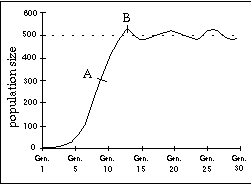
On a population graph, the carrying capacity is represented by a flat line
May also be a small "wave"
Follows a period of exponential growth; a J-shaped curve where the population keeps increasing
The line represents population size, so it decreases in response to a limiting factor
11
Multiple Choice
A population always stays exactly at its carrying capacity.
True
False
12
Multiple Choice
What happens if a population grows past its carrying capacity?
The population keeps growing
The population starts to die off
The entire species will go extinct
The carrying capacity just increases
13
Multiple Choice
Which graph depicts exponential growth in a population?
14
Multiple Choice
What is the carrying capacity of the graph?
around 500
more than 800
less than 300
around 700
15
Limiting factors are any factor that reduces or the size of a population or keeps it from increasing
May be a resource, another species, the environment, etc.
Example: food is a limiting factor because you can't have more individuals than food to feed them
16
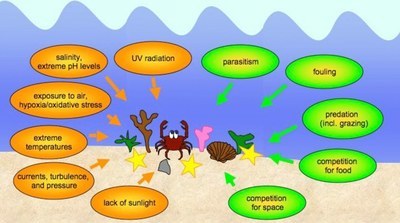
Limiting factors that DO NOT depend on population size are called density-independent
Include climate, weather, natural disasters, and pollution
Affect all populations the same, whether they are large or small
17
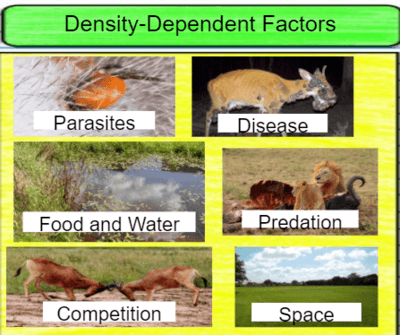
Limiting factors whose effect depends on the size of the population are called density-dependent
Includes natural resources (food, water, space), diseases, and predators
Tend to have a greater effect on large, dense populations because of increased competition and more opportunity to attract predators and disease
18
19
Multiple Choice
An environmental factor such as storms and extreme heat or cold that decrease a population are considered to be -
density-dependent factor
population density
dispersion
density-independent factor
20
Multiple Choice
This may cause a population to increase
increase of food supply
removal of predators
removal of disease
all of these
21
Multiple Choice
Something that regulates the size of a population is called...
a limiting measure
a limiting factor
carrying capacity
biodiversity
22
Multiple Choice
23
Keystone Species
A keystone species is an organism that helps define an entire ecosystem.
Without its keystone species, the ecosystem would be dramatically different or cease to exist altogether.
The removal of a keystone species REDUCES the BIODIVERSITY of the ecosystem.
24
Keystone Examples
The keystone species in this habitat is the sea otter.
The sea otter eat urchins and therefore keep the population of sea urchins low. Sea otters also build dams which create wetlands for other organisms to live in.
Without sea otters, sea urchins over populate and eat all of the kelp. Wetlands are destroyed and biodiversity decreases.
25
Open Ended
Exit Ticket: Describe the importance of keystone species in helping an ecosystem function normally.
03.18.24 Populations and Carrying Capacity Review
Do Now: What is carrying capacity? In what ways can it be increased/raised? In what ways can it be decreased/lowered?
Show answer
Auto Play
Slide 1 / 25
SLIDE

Similar Resources on Wayground
20 questions
The Heart
Lesson
•
9th - 12th Grade
20 questions
Interactions between Organisms
Lesson
•
9th - 12th Grade
20 questions
Food Chains, Food Webs, and Energy Pyramids
Lesson
•
9th - 12th Grade
19 questions
Anaerobic Respiration
Lesson
•
9th - 12th Grade
17 questions
Factors affecting bloodflow
Lesson
•
9th - 12th Grade
20 questions
Cellular Respiration
Lesson
•
9th - 12th Grade
17 questions
3.3.1 Gel Electrophoresis & DNA Fingerprinting
Lesson
•
9th - 12th Grade
Popular Resources on Wayground
10 questions
5.P.1.3 Distance/Time Graphs
Quiz
•
5th Grade
10 questions
Fire Drill
Quiz
•
2nd - 5th Grade
20 questions
Equivalent Fractions
Quiz
•
3rd Grade
15 questions
Hargrett House Quiz: Community & Service
Quiz
•
5th Grade
20 questions
Main Idea and Details
Quiz
•
5th Grade
20 questions
Context Clues
Quiz
•
6th Grade
20 questions
Inferences
Quiz
•
4th Grade
15 questions
Equivalent Fractions
Quiz
•
4th Grade
Discover more resources for Biology
14 questions
Ecological Succession: Primary and Secondary
Quiz
•
9th Grade
20 questions
Cladogram Practice
Quiz
•
10th Grade
20 questions
Evolution and Natural Selection
Quiz
•
9th Grade
21 questions
Cell Cycle and mitosis
Quiz
•
9th - 10th Grade
45 questions
Unit 9 Review: Biosphere
Quiz
•
9th Grade
20 questions
Food Chains and Food Webs
Quiz
•
7th - 12th Grade
20 questions
Sex-Linked Traits
Quiz
•
9th - 12th Grade
22 questions
AP Biology: Unit 7 Review (CED)
Quiz
•
9th - 12th Grade